老年良性前列腺增生患者微创术后发生性功能障碍的影响因素
2024-06-21谢婷刘丽娟谢锌锦江沛源
谢婷 刘丽娟 谢锌锦 江沛源
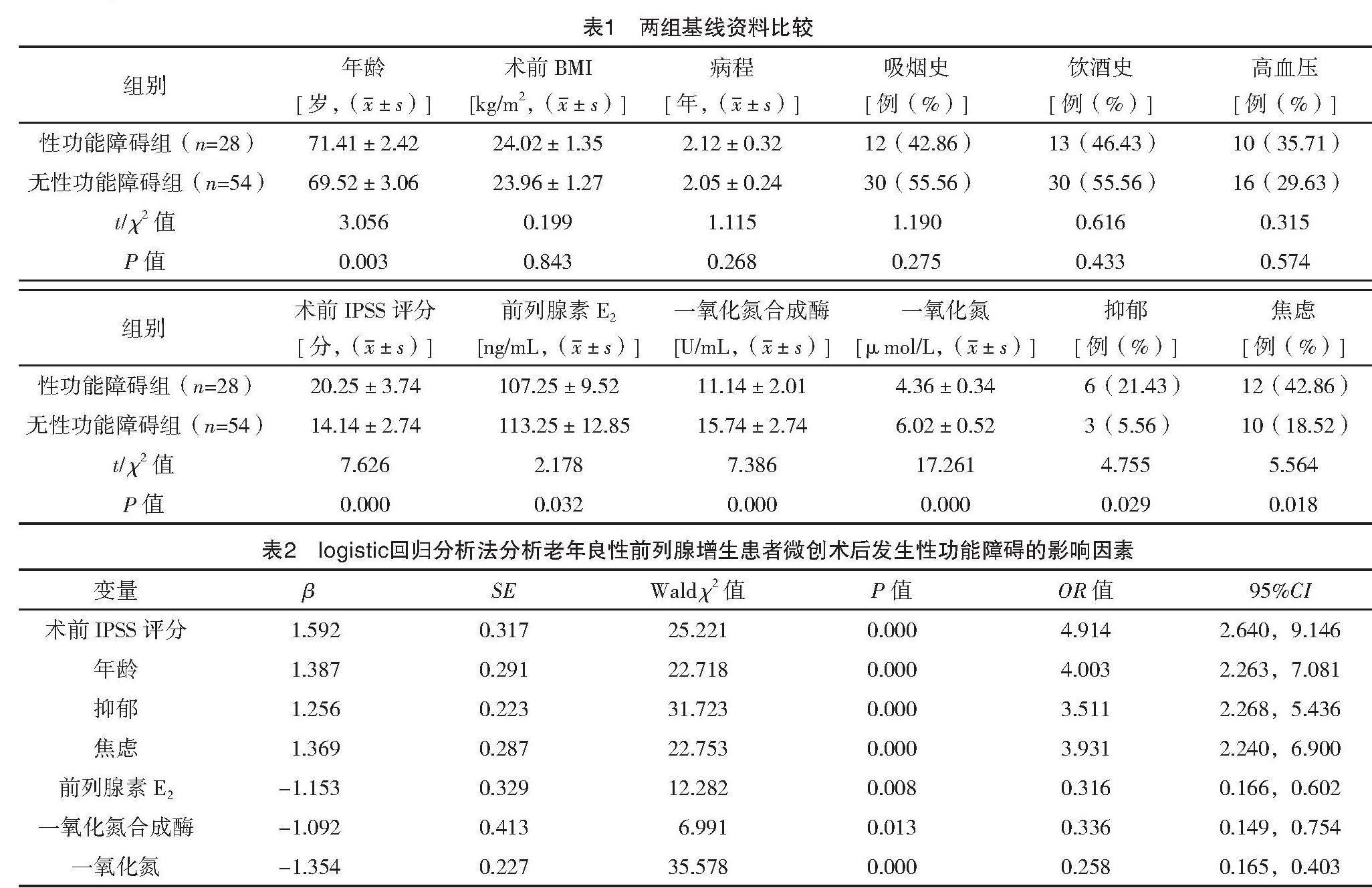
【摘要】 目的:探讨老年良性前列腺增生患者微创术后发生性功能障碍的影响因素。方法:回顾性选取赣南医学院附属兴国医院2018年12月—2021年12月赣南医学院附属兴国医院82例行微创术的老年良性前列腺增生患者的临床资料,术后随访12个月,统计分析性功能障碍发生情况。将发生性功能障碍的患者设置为性功能障碍组,未发生性功能障碍的患者设置为无性功能障碍组。采用logistic回归分析法分析老年良性前列腺增生患者微创术后发生性功能障碍的影响因素。结果:随访12个月后,在82例接受微创术的老年良性前列腺增生患者中,发生性功能障碍的患者28例,发生率为34.15%。两组术前体重指数(BMI)、病程、吸烟史、饮酒史、高血压对比,差异均无统计学意义(P>0.05);性功能障碍组术前国际前列腺症状评分(IPSS)评分、年龄均高于无性功能障碍组,抑郁、焦虑占比均高于无性功能障碍组(P<0.05),前列腺素E2、一氧化氮合成酶、一氧化氮水平均低于无性功能障碍组(P<0.05)。logistic回归分析结果显示,术前IPSS评分、年龄、抑郁、焦虑、前列腺素E2、一氧化氮合成酶、一氧化氮水平均为老年良性前列腺增生患者微创术后发生性功能障碍的影响因素(P<0.05)。结论:术前IPSS评分、年龄、抑郁、焦虑、前列腺素E2、一氧化氮合成酶、一氧化氮水平均为老年良性前列腺增生患者微创术后发生性功能障碍的影响因素,可为评估老年良性前列腺增生微创术后性功能障碍的发生风险提供可靠的预测方式。
【关键词】 前列腺素E2 一氧化氮合成酶 一氧化氮 性功能障碍 良性前列腺增生
Influencing Factors of Sexual Dysfunction in Elderly Patients with Benign Prostatic Hyperplasia after Minimally Invasive Surgery/XIE Ting, LIU Lijuan, XIE Xinjin, JIANG Peiyuan. //Medical Innovation of China, 2024, 21(13): -152
[Abstract] Objective: To investigate the influencing factors sexual dysfunction in elderly patients with benign prostatic hyperplasia after minimally invasive surgery. Method: A total of 82 elderly patients with benign prostatic hyperplasia who underwent microsurgery in Xingguo Hospital Affiliated to Gannan Medical College from December 2018 to December 2021 were retrospectively selected, followed up for 12 months after surgery, and the incidence of sexual dysfunction was statistically analyzed. The patients with sexual dysfunction were set into the sexual dysfunction group, and the patients without sexual dysfunction were set into the without sexual dysfunction group. logistic regression analysis was used to analyze the influencing factors of sexual dysfunction in elderly patients with benign prostatic hyperplasia after minimally invasive surgery. Result: After 12 months of follow-up, 28 cases of sexual dysfunction occurred in 82 patients with benign prostatic hyperplasia, with an incidence of 34.15%. There were no significant differences in preoperative body mass index (BMI), course of disease, smoking history, drinking history and hypertension between the two groups (P>0.05); the international prostate symptom score (IPSS), age in the sexual dysfunction group were higher than those in the without sexual dysfunction group, the proportion of depression and anxiety were higher than those in the without sexual dysfunction group (P<0.05); the levels of prostaglandin E2, nitric oxide synthase and nitric oxide were lower than those of without sexual dysfunction group (P<0.05). logistic regression analysis showed that preoperative IPSS score, age, depression, anxiety, prostaglandin E2, nitric oxide synthase and nitric oxide level were influential factors for sexual dysfunction in elderly patients with benign prostatic hyperplasia after minimally invasive surgery (P<0.05). Conclusion: Preoperative IPSS score, age, depression, anxiety, prostaglandin E2, nitric oxide synthase, and nitric oxide levels are influencing factors for the occurrence of sexual dysfunction in elderly patients with benign prostatic hyperplasia after minimally invasive surgery, which can provide a reliable prediction method for assessing the risk of sexual dysfunction in elderly patients with benign prostatic hyperplasia after minimally invasive surgery.
[Key words] Prostaglandin E2 Nitric oxide synthase Nitric oxide Sexual dysfunction Benign prostatic hyperplasia
First-author's address: Department of Urology, Xingguo Hospital Affiliated to Gannan Medical College, Ganzhou 342400, China
doi:10.3969/j.issn.1674-4985.2024.13.034
老年良性前列腺增生是一种常见的泌尿系统疾病[1]。微创手术已成为治疗老年良性前列腺增生的主要方法之一,然而,一些患者在手术后可能会面临性功能障碍的困扰[2-3]。性功能障碍对患者的生活质量和心理健康产生负面影响,因此,了解影响因素并制订有效的护理策略对于提高患者的康复效果至关重要[4-5]。随着行微创手术的老年良性前列腺增生患者数量逐渐增加,临床急需改善对术后性功能障碍的治疗手段[6]。目前……