三级康复网络模式对脑卒中患者预后的影响
2021-07-01王芳林万隆叶斌徐卿
王芳 林万隆 叶斌 徐卿

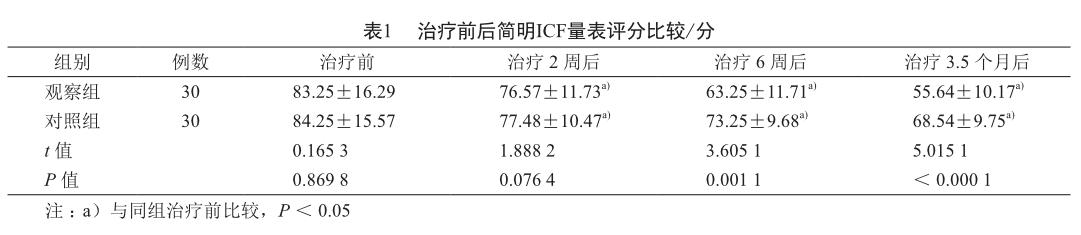

摘 要 目的:探讨三级康复网络模式对脑卒中患者预后的影响。方法:选取30例有康复治疗需求及其指征的脑卒中患者为观察组,在三级康复网络模式下进行治疗;另选取30例脑卒中患者作为对照组,在传统医疗服务模式下进行治疗。比较两组患者在治疗前后的中国版脑卒中简明《国际功能、残疾和健康分类》(International Classification of Functioning, Disability and Health, ICF)核心要素量表(以下简称为“简明ICF量表”)评分、改良的Barthel指数(modified Barthel index, MBI)和中国脑卒中临床神经功能缺损程度量表(Chinese stroke clinical neurological deficit scale, CSCNDS)评分的变化情况。结果:两组患者治疗前的一般资料和简明ICF量表评分、MBI、CSCNDS评分差异均无统计学意义。与对照组患者相比,观察组患者在治疗6周和3.5个月后的简明ICF量表评分、CSCNDS评分均显著更低,MBI显著更高(P均<0.05)。结论:三级康复网络模式可改善脑卒中患者的预后,包括促进患者康复、减轻病残程度、提高生活质量。
关键词 脑卒中 康复治疗 服务模式 神经功能 生活质量
中图分类号:R493; R743.3 文献标志码:B 文章编号:1006-1533(2021)07-0017-04
*基金项目:①上海市重要薄弱学科建设项目(2015ZB0401);②上海市闸北区医学科研项目(2015MS06)
Effect of three-level rehabilitation network mode on prognosis of stroke patients*
WANG Fang**, LIN Wanlong, YE Bin, XU Qing***(Rehabilitation Department of Traditional Chinese Medicine, Shanghai Third Rehabilitation Hospital, Shanghai 200436, China)
ABSTRACT Objective: To investigate the effect of three-level rehabilitation network mode on the prognosis of stroke patients. Methods: Thirty stroke patients with rehabilitation needs and rehabilitation indications were selected as an observation group and treated under three-level rehabilitation network mode and another 30 stroke patients were selected as a control group and treated under the traditional medical service mode. Scores of Chinese stroke concise International Classification of Functioning, Disability and Health (ICF) core elements scale (concise ICF scale), modified Barthel index (MBI), and Chinese stroke clinical neurological deficit scale (CSCNDS) were compared between the two groups before and after treatment. Results: There were no statistically significant differences between the two groups in general data, concise ICF scale scores, MBI and CSCNDS scores before treatment. The scores of concise ICF scale and CSCNDS were significantly lower while MBI were significantly higher in the observation group at 6 weeks and 3.5 months after treatment compared with the control group (P<0.05). Conclusion: The prognosis of stroke patients including the promotion of rehabilitation, the reduction of the degree of disability and the improvement of the quality of life can be improved under three-level rehabilitation network mode.
KEy WORDS stroke; rehabilitation; service mode; neurological function; quality of life
腦卒中具有高致残率、高死亡率的特点,其患者不仅需在住院期间接受神经内、外科的治疗,出院后仍需接受长时间的延续性治疗并进行康复锻炼。不过,患者出院后自行锻炼的效果差,生活自理恢复率较低[1]。随着我国人口老龄化,脑卒中在我国的发病率持续增高,对我国脑卒中后康复医疗服务能力的提高和服务方式的转变均提出了更高的要求。近年来,三级康复网络模式开始得到逐步推广,它是指通过整合三级医院、专业康复机构和社区医院的资源,为脑卒中患者自急性期住院至出院后康复期提供系统、科学和持续的医疗服务[2-3],以最大程度地改善患者预后。……