妊娠晚期血浆PDW、D-D及FIB在高危产妇产后出血中的研究
2024-06-21李英郭玲利钟卿琳
李英 郭玲利 钟卿琳
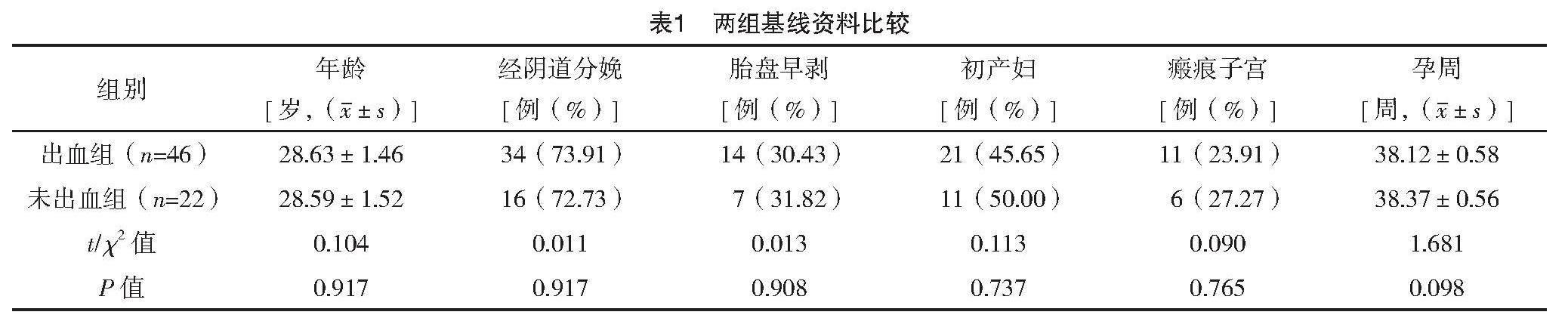
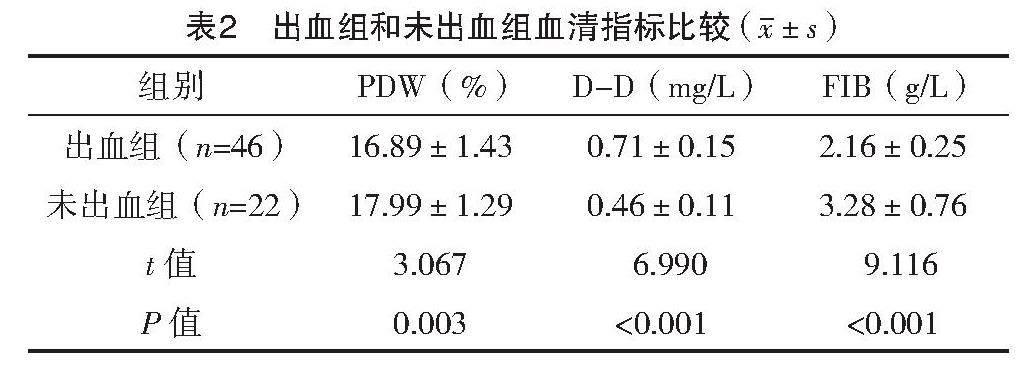

【摘要】 目的:探索妊娠晚期血浆血小板分布宽度(PDW)、D-二聚体(D-D)及纤维蛋白原(FIB)在高危产妇产后出血中的评估价值。方法:回顾性分析2021年1月—2023年2月瑞金市妇幼保健院产科收治的68例妊娠晚期高危产妇临床资料,均行PDW、D-D、FIB检测,根据观察组产妇产后是否出现产后出血,分为出血组、未出血组。比较两组血清指标,经受试者操作特征(ROC)曲线分析PDW、D-D、FIB预测效能。结果:共46例患者发生产后出血。出血组PDW(16.89±1.43)%、FIB(2.16±0.25)g/L
均低于未出血组,D-D(0.71±0.15)mg/L高于未出血组,差异均有统计学意义(P<0.05)。经ROC曲线分析,PDW、D-D、FIB分别预测高危产妇产后出血的曲线下面积为0.750、0.917、0.925。经二分类logistic回归分析,PDW、D-D、FIB是高危产妇产后出血的影响因素(P<0.05)。结论:检测妊娠晚期高危产妇PDW、D-D、FIB能够较好预测产后出血情况,可作为临床预后评估的重要指标。
【关键词】 纤维蛋白原 D-二聚体 血小板分布宽度 高危产妇 产后出血
The Study of Late Pregnancy Plasma PDW, D-D and FIB in Postpartum Hemorrhage in High-risk Puerpera/LI Ying, GUO Lingli, ZHONG Qinglin. //Medical Innovation of China, 2024, 21(14): -146
[Abstract] Objective: To explore the evaluation value of late pregnancy plasma platelet distribution width (PDW), D-dimer (D-D) and fibrinogen (FIB) in the postpartum hemorrhage in high-risk puerpera. Method: Clinical data of 68 high-risk puerpera in the late pregnancy admitted to the Obstetrics Department of Ruijin Maternal and Child Health Care Hospital from January 2021 to February 2023 were retrospectively analyzed, and PDW, D-D and FIB were detected. According to whether postpartum hemorrhage occurred, they were divided into a hemorrhage group and a no-hemorrhage group, and the serum indexes of the two groups were compared. The predictive efficiency of PDW, D-D and FIB was analyzed by receiver operating characteristic (ROC) curve. Result: A total of 46 patients had postpartum hemorrhage. PDW [(16.89±1.43) %] and FIB [(2.16±0.25) g/L] in hemorrhage group were lower than those in no-hemorrhage group, and D-D [(0.71±0.15) mg/L] was higher than that in no-hemorrhage group, the differences were statistically significant (P<0.05). According to ROC curve analyzed, the area under the carve values predicted by PDW, D-D and FIB were 0.750, 0.917 and 0.925, respectively. The binary logistic regression analysis showed that PDW, D-D and FIB were the influencing factors on postpartum hemorrhage in high-risk puerpera (P<0.05). Conclusion: Testing PDW, D-D and FIB in high-risk puerpera in late pregnancy can better predict postpartum bleeding and can be used as an important index for clinical prognosis evaluation.
[Key words] Fibrinogen D-dimer Platelet distribution width High-risk puerpera Postpartum hemorrhage
First-author's address: Department of Maternity, Ruijin Maternal and Child Health Care Hospital, Ruijin 342500, China
doi:10.3969/j.issn.1674-4985.2024.14.034
产后出血仍是导致产妇死亡的主要因素,为了降低产妇死亡率,提前准备救治措施,准确预测产后出血风险系数尤为重要[1]。有研究指出,凝血系统与抗凝系统为一个动态平衡,是预防产妇分娩期间大出血关键[2],过度的激活抗凝或凝血,容易破坏妊娠期间合理的高凝状态,出现出血性疾病,甚至引起致命性产后出血,危及生命安全,对此有学者推测凝血-纤溶系统检测在预测产后出血中具有一定意义[3]。D-二聚体(D-D)、纤维蛋白原(FIB)是临床常用的凝血评估指标,其中FIB是由肝细胞合成转换而成,当机体出血时,可减少消耗体内FIB,从而导致体内该成分蓄积,呈明显上升趋势[4];D-D是纤维蛋白单体水解后产生的降解产物,当机体出现纤溶、凝血增强时,可出现明显D-D升高,而妊娠女性D-D水平升高明显,尤其是妊娠后期,可表现为纤溶、凝血增强,但当分娩后可逐渐下降;……