运动干预睡眠障碍成年人的睡眠结构的Meta分析
2021-08-06龚明俊谭思洁孙亚麒吴旸胡晓飞
龚明俊 谭思洁 孙亚麒 吴旸 胡晓飞
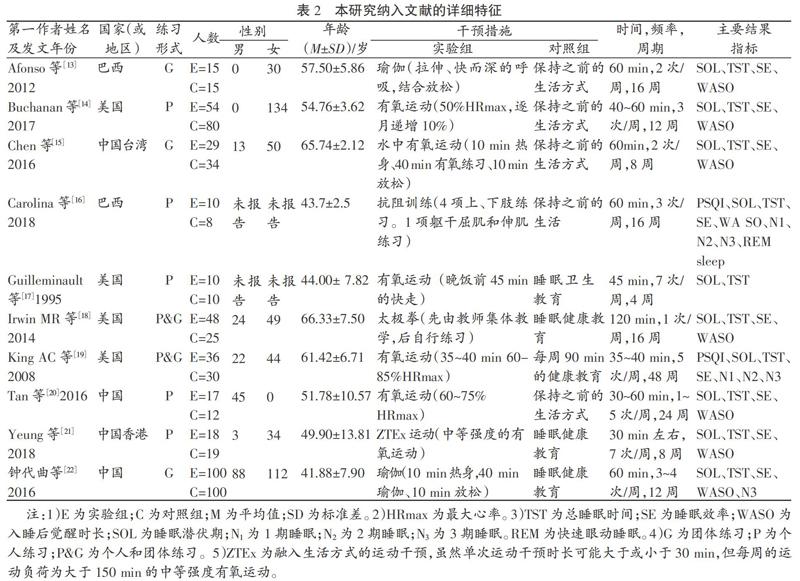

摘 要:目的:評价运动干预睡眠障碍成年人的睡眠结构的效果,为制定改善睡眠障碍的运动干预方案提供依据。方法:确定文献纳入与排除标准,检索中英文数据库。运用Revman 5.3和stata14.0对所纳入10篇文献的670名受试者的结局指标进行分析。结果:1)运动干预能缩短睡眠潜伏期(d=-0.44)、总睡眠时间(d=-0.29)、入睡后觉醒时长(d=-0.29),p值均<0.05。2)运动干预对睡眠效率、N1期、N2期、N3期睡眠比例的效应量分别是0.1、-0.3、-0.04、0.3,p值均>0.05。3)缩短睡眠潜伏期效应量最显著的要素是有氧运动(d=-0.61)、45~60 min(d=-0.66)、24~48周(d=-0.35),p值均>0.05;缩短入睡后觉醒时长最显著的要素是身心运动(d=-0.19,p>0.05),45~60 min(d=-0.34,p<0.05),12~16周(d=-0.21,p<0.05)。结论:运动干预能缩短睡眠潜伏期、总睡眠时间、入睡后觉醒时长,具有提高睡眠效率、缩短N1期、N2期睡眠,延长N3期睡眠的趋势。有氧运动在缩短睡眠潜伏期的趋势比身心运动显著,身心运动在减少入睡后觉醒时长的趋势比有氧运动显著。单次运动45~60 min、持续12周以上的运动干预方案改善效果更好。
关键词:运动干预;睡眠质量;睡眠结构;效果评价
中图分类号:G 804.55 学科代码:040302 文献标识码:A
Abstract:Objective: To evaluate the effect of exercise intervention on the sleep structure of adults with sleep disorders, and to provide the basis for the formulation of exercise intervention program for the improvement of sleep disorders. Methods: The inclusion and exclusion criteria were established, and Chinese and English databases were searched. Results of 670 participants in 10 included literatures were analyzed using RevMan 5.3 and Stata 14.0. Results: 1) Exercise intervention can shorten sleep onset latency (d=-0.44), total sleep time (d=-0.29), and wake after sleep onset(d=-0.29), p<0.05. 2) The effect sizes of exercise intervention on sleep efficiency, N1, N2 and N3 sleep ratio were 0.1, -0.3, -0.04, 0.3, p>0.05, respectively. 3) The most obvious moderators for shortening the effect of sleep onset latency are aerobic exercise (d=-0.61), 45-60 min (d=-0.66), 24-48 weeks(d=-0.35), p>0.05, respectively. The most significantly moderators for shortening the wake after sleep onset are mind-body exercise (d=-0.19, p>0.05), 45-60 min (d=-0.34, p<0.05), and 12-16 weeks (d=-0.21, p<0.05). Conclusions: Exercise intervention can significantly shorten the sleep onset latency, total sleep time, and wake after sleep onset. It has a tendency to improve sleep efficiency, shorten the proportion of N1 and N2 sleep, and extend the proportion of N3 sleep. The tendency of aerobic exercise to shorten the SOL is more obvious than mind-body exercise, and the tendency of mind-body exercise to reduce the WASO is more obvious than aerobic exercise. A single exercise for 45-60 minutes, lasting for more than 12 weeks, the improvement effect is more obvious.
Keywords: exercise intervention; sleep quality; sleep structure; effect evaluation
近年来,随着经济社会的发展,睡眠障碍已成为现代人常见疾病之一。2020年3月发布的《中国睡眠指数报告》中显示,有高达40.5%的人存在不同程度的睡眠障碍。目前对睡眠障碍的治疗包括药物治疗和非药物治疗两种手段,长期药物治疗会减少患者的非快动眼睡眠(NREM)和慢波睡眠(SWS)时长,改变睡眠结构,增加抑郁、焦虑、认知障碍等风险,故不推荐长期使用[1]。运动干预是非药物疗法的一种[2],具有很好的推广性、普适性和可接受性,在正向影响睡眠质量的同时,能有效提升人的整体健康水平。
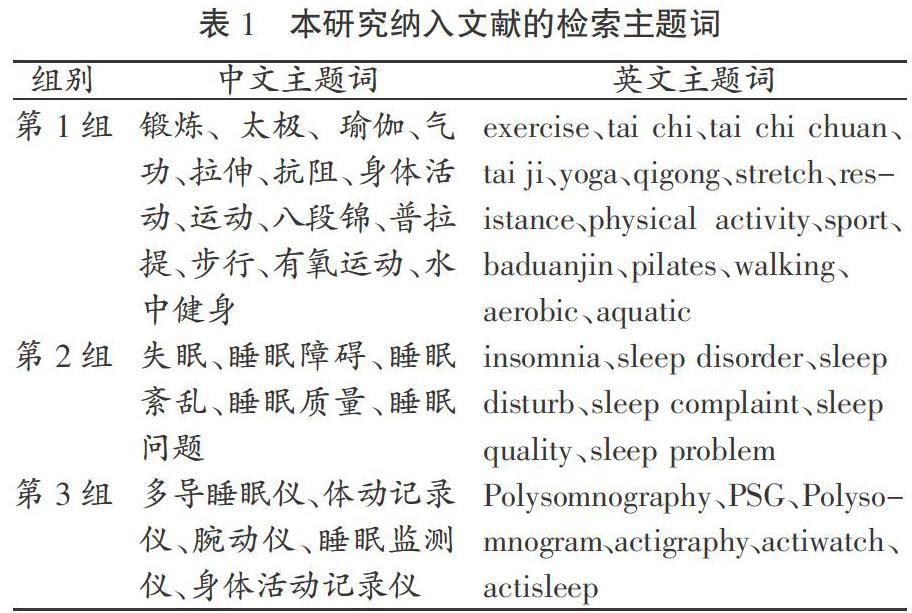
睡眠结构包括的非快动眼睡眠(NREM)和快动眼睡眠(REM)两个时相中各期睡眠的时长和比例、整夜非快动眼睡眠-快动眼睡眠(NREM-REM)循环的周期次数,反映睡眠的整体特征,其合理与否是决定睡眠质量高低的重要因素[3]。睡眠结构一般通过多导睡眠监测仪(PSG)记录的总睡眠时间(TST)、睡眠潜伏期(SOL)、睡眠效率(SE)、入睡后觉醒时长(WASO)、各期睡眠时长和比例等参数体现。