青年脑卒中患者再就业影响因素分析
2021-06-20李志凤袁柳青华艳陆蓉蓉姜从玉白玉龙
李志凤 袁柳青 华艳 陆蓉蓉 姜从玉 白玉龙

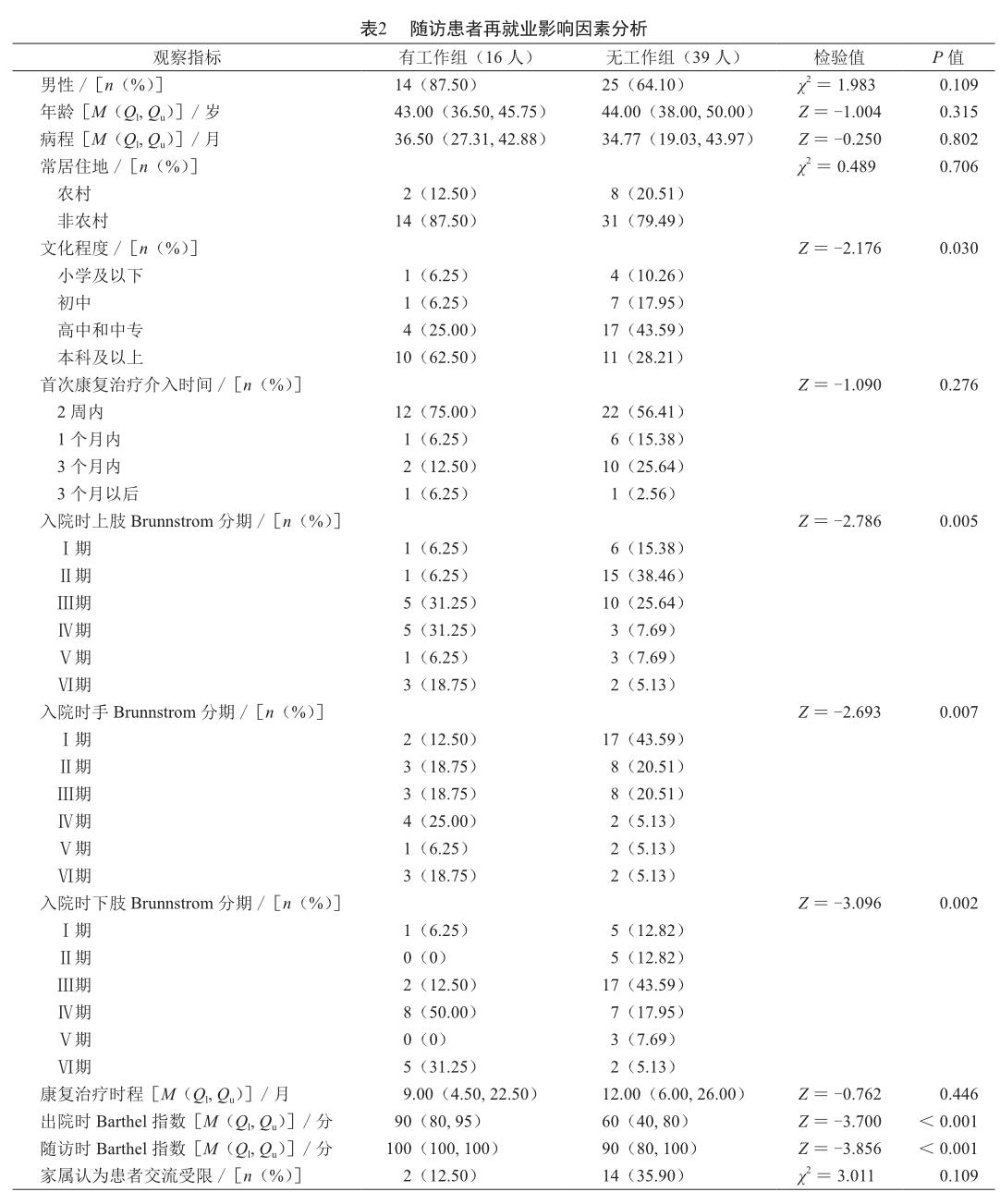
摘 要 目的:探尋青年脑卒中患者再就业的影响因素,为青年脑卒中患者的康复治疗提供参考。方法:纳入年龄18 ~ 49岁、病程<1年的首次脑卒中患者,进行电话随访。收集他们入、出院和随访时的病史资料,包括性别、年龄、文化程度、病程、常居住地、入院时上肢-手-下肢Brunnstrom分期、出院和随访时Barthel指数、首次康复治疗介入时间、康复治疗时程、是否交流受限、是否工作等。按是否工作将青年脑卒中患者分为2组,分析他们再就业的影响因素。结果:纳入青年脑卒中患者70人,电话随访到58人,失访12人。2组患者在入院时上肢-手-下肢Brunnstrom分期、出院和随访时Barthel指数、文化程度上的差异均具有统计学意义(P均<0.05),在其他方面则无显著差异。结论:日常生活能力强、文化程度高是青年脑卒中患者再就业的有利因素。加强对青年脑卒中患者的职业再培训,而不是执着于其某项机体功能的改善,可能对患者再就业更有益。
关键词 青年 脑卒中 再就业
中图分类号:C915; R743.3 文献标志码:C 文章编号:1006-1533(2021)09-0006-05
*基金项目:①中国残疾人联合会残疾人辅助器具专项研究课题(CJFJRRB33-2020);②复旦大学附属闵行医院院级课题(2021MLHC05)
Analysis of influencing factors on re-employment of young stroke patients*
LI Zhifeng1, 2**, YUAN Liuqing3, HUA Yan4, LU Rongrong4, JIANG Congyu1, BAI Yulong1, 4***(1. Department of Rehabilitation, Huashan Hospital, Fudan University, Shanghai 200040, China; 2. Department of Rehabilitation Medicine, Minhang Hospital, Fudan University, Shanghai 201100, China; 3. Department of Rehabilitation Medicine, the People Hospital of Lanshan District, Shandong Linyi 276002, China; 4. Department of Rehabilitation, Northern Division of Huashan Hospital, Fudan University, Shanghai 201907, China)
ABSTRACT Objective: To investigate the social adaptation of youth stroke and explore factors affecting their return to work by telephone interviews. Methods: The stroke inpatients with ages 18-49 and disease course less than one year were included and followed up by telephone. The data were collected including their gender, age, course of disease, usual residence, upper extremity-hand-lower extremity Brunnstrom stage at first admission, Barthel index at discharge and follow-up, educational level, time of first rehabilitation intervention, rehabilitation schedule, whether the patient has limited communication and re-employment and so on. The patients were divided into two groups according to whether they were employed or not, and the factors influencing their re-employment were analyzed. Results: A total of 70 youth stroke patients met the inclusion criteria, among them, 58 cases were followed up by telephone and another 12 patients lost follow-up, in which 2 rejected and 10 lost contact. The significant differences existed between the two groups in Brunnstrom stage of upper limbs-hands-lower limbs at admission, Barthel index at discharge and follow-up, and cultural degree (P<0.05), while the other information was not. Conclusion: Patients with higher ability of daily life and cultural degree would have a better chance to return to work. It may be more beneficial to strengthen vocational retraining for young stroke patients rather than obsessing about improvement of a certain function.
KEy WORDS youth; stroke; re-employment
脑卒中患者有年轻化趋势,青年患者对脑卒中后的功能恢复程度要求更高[1-2]。《国际功能、残疾和健康分类》从身体结构及功能(器官水平)、活动能力(个体水平)和参与能力(社会水平)3个层面评价一个人的健康状况。即除身体健康外,还应考虑社会和心理因素,如与年龄、客观因素相符的生活需求、文化需求和个人责任等[3-5]。迄今为止,关于青年脑卒中患者康复治疗的研究大多为院内研究,然而院内康复治疗不能解决患者的所有问题,大多数患者还须回归家庭和社会。本研究通过电话访谈方式,了解青年脑卒中患者的社会适应情况,探寻青年脑卒中患者再就业的影响因素,为青年脑卒中患者的长期康复治疗提供参考。
1 对象与方法
1.1 对象
本研究为观察性研究,纳入2016年5月—2019年10月在复旦大学附属华山医院北院康复医学科首次住院且符合纳入标准的患者。研究方案已获医院伦理审查委员会的批准(编号:2019-580)。
纳入标准:①青年脑卒中患者,年龄18 ~ 49岁;②首次发生脑卒中,缺血性脑卒中诊断符合《中国急性缺血性脑卒中诊治指南2018》中的诊断标准,出血性脑卒中诊断符合《中国脑出血诊治指南(2019)》中的诊断标准,同时头颅CT或磁共振成像检查见有明确的责任病灶;……
