急性脑卒中不同院外急救模式的应用效果比较
2021-02-03张巍
张巍

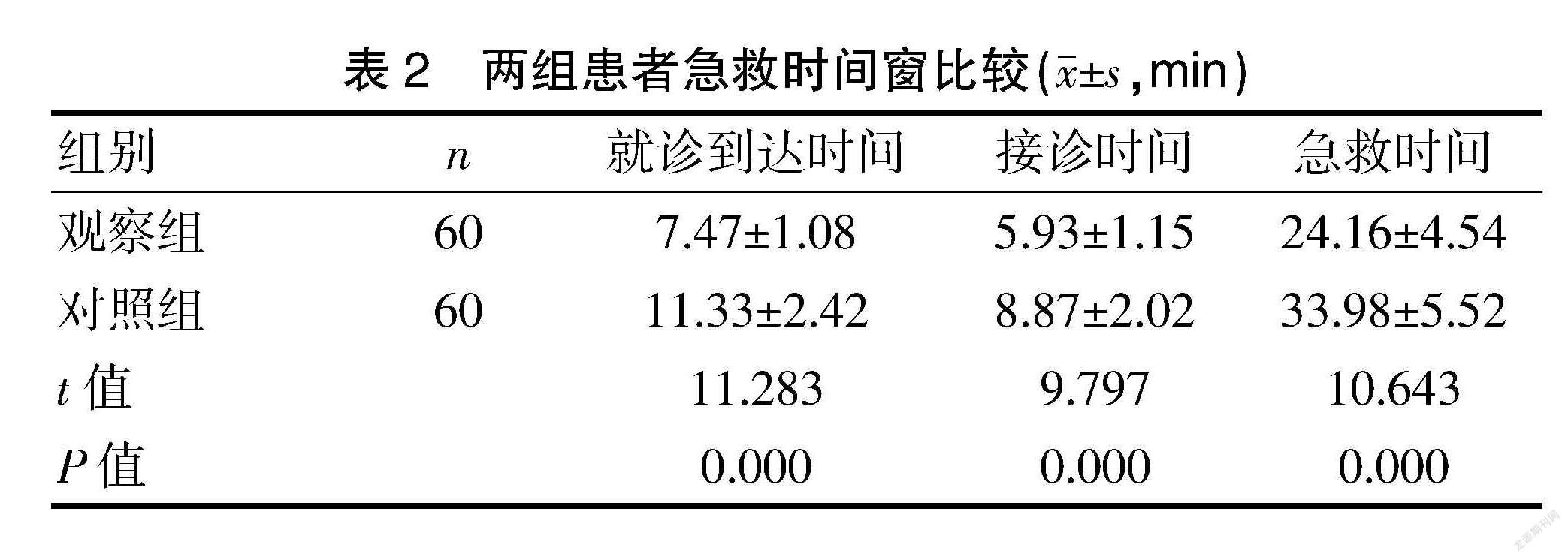


[摘要] 目的 考察急性腦卒中不同院外急救模式的应用效果。 方法 选取2018年1月至2020年12月收治的急性脑卒中患者120例作为研究对象。其中2018年1月至2019年6月收治的60例急性脑卒中患者采用常规急救模式作为对照组,2019年7月至2020年12月收治的60例急性脑卒中患者采用院外院内一体化急救模式作为观察组。比较两组就诊到达时间、接诊时间、急救时间、临床治疗总有效率和并发症发生率。 结果 观察组就诊到达时间(7.47±1.08)min、接诊时间(5.93±1.15)min、急救时间(24.16±4.54)min,均短于对照组的(11.33±2.42)min、(8.87±2.02)min、(33.98±5.52)min,差异有统计学意义(P<0.05);观察组临床治疗总有效率为88.33%,显著高于对照组的71.67%,差异有统计学意义(P<0.05);观察组并发症总发生率为10.00%,对照组并发症总发生率为28.33%,差异有统计学意义(P<0.05)。 结论 院外院内一体化急救模式能够有效缩短急性脑卒中患者治疗时间窗,降低患者并发症发生率。
[关键词] 急性脑卒中;急救模式;预后质量;并发症
[中图分类号] R743.3 [文献标识码] B [文章编号] 1673-9701(2021)35-0098-04
Comparison of application effect of different out of hospital emergency modes in acute stroke
ZHANG Wei
Department of Emergency, Xuzhou Emergency Medical Center in Jiangsu Province, Xuzhou 221009, China
[Abstract] Objective To explore the application effect of different out of hospital emergency modes in acute stroke. Methods A total of 120 patients with acute stroke who were admitted from January 2018 to December 2020 were selected as the research objects. Among them, 60 acute stroke patients who were admitted from January 2018 to June 2019 were treated with the conventional emergency mode as the control group, and 60 acute stroke patients who were admitted from July 2019 to December 2020 were treated with the integration of outside hospital and inside hospital emergency mode as the observation group. The arrival time, receiving time, emergency time, total effective rate of clinical treatment and incidence of complications were compared between the two groups. Results The arrival time of the observation group was (7.47±1.08)minutes, the reception time (5.93±1.15)minutes, and the emergency time (24.16±4.54)minutes were shorter than those of the control group (11.33±2.42) minutes and (8.87±2.02) minutes, (33.98±5.52) minutes, the difference was statistically significant (P<0.05). The total effective rate of the observation group was 88.33%, which was significantly higher than 71.67% of the control group, and the difference was statistically significant (P<0.05).The incidence of complications was 10.00% in the observation group and 28.33% in the control group, and the difference was statistically significant(P<0.05). Conclusion The integration of outside hospital and inside hospital emergency mode can effectively shorten the treatment time window for patients with acute stroke and reduce the incidence of complications.
[Key words] Acute stroke; Emergency mode; Prognosis quality; Complication
急性脑卒中发病急骤,病情变化迅速,致残率和致死率均较高,预后较差,患者临床表现为意识障碍、偏瘫、呕吐和呼吸障碍等症状[1]。急性脑卒中的治疗关键在于时间把控,及早实施有效措施对于挽救患者生命,改善预后至关重要[2-3]。传统的常规急救模式即使在医院抢救设施完善的前提下,依然存在医护人员分配不合理、院外和院内抢救衔接不良等问题,导致急救时间过长,从而延误患者最佳救治时机[4]。而院外院内一体化急救模式将院外急救、院内抢救、手术救治整个链条一体化,使医护人员救治步骤井然有序,救治分工更为明确,从而有效提高急性脑卒中患者的临床抢救效果,改善患者预后[5]。……