给予高血压脑出血患者预防性护理对患者术后下肢深静脉血栓形成的影响分析
2021-02-03陈君霞王慧梅吕雅飞刘进
陈君霞 王慧梅 吕雅飞 刘进


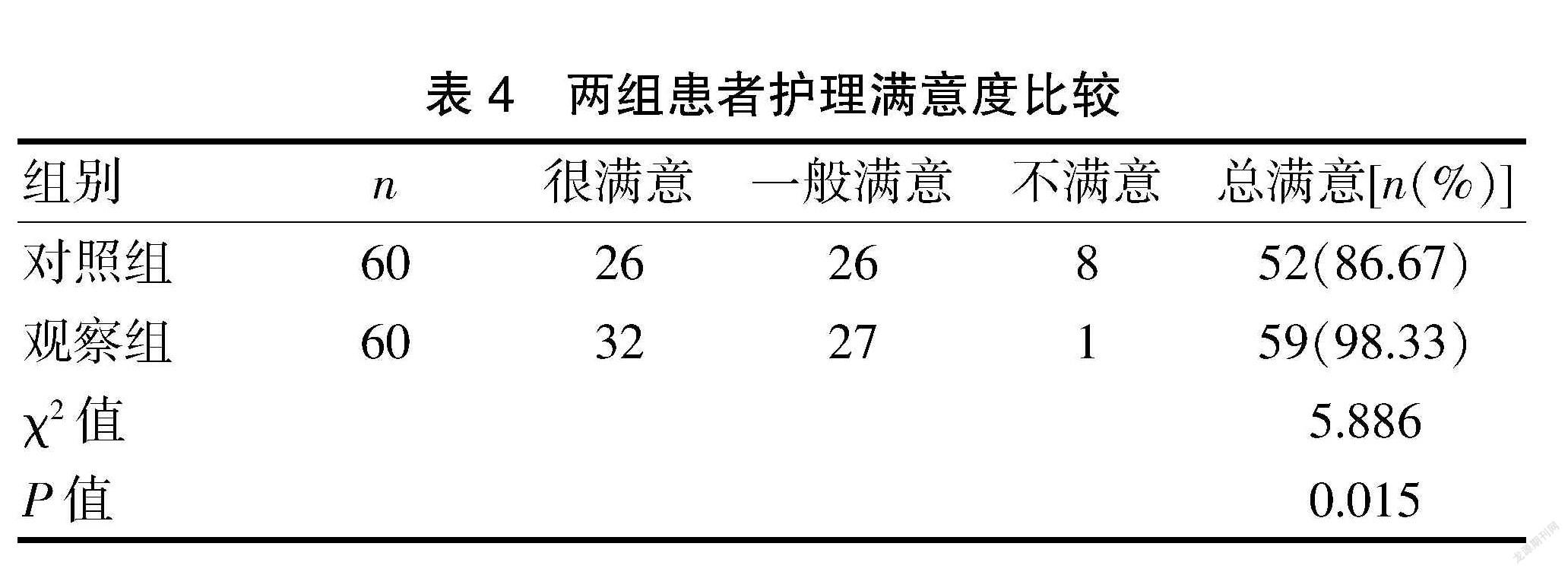
[摘要] 目的 探讨给予高血压脑出血患者预防性护理对患者术后下肢深静脉血栓形成的影响。 方法 将2017年1月至2019年12月我院神经外科行颅内血肿清除术治疗的120例高血压脑出血患者以随机数字表法分为两组,每组各60例。对照组实施常规护理,观察组实施预防性护理,比较两组术后下肢深静脉血栓形成率、双侧下肢周径差值、不良情绪评分、生活质量评分、护理满意度。 结果 观察组术后下肢深静脉血栓形成率为1.67%,对照组为11.67%,观察组低于对照组,差异有统计学意义(P<0.05)。两组双侧膝上周径差值、膝下周径差值在护理后均较护理前减小,差异有统计学意义(P<0.05),而观察组护理后的双侧膝上周径差值、膝下周径差值均小于对照组,差异有统计学意义(P<0.05)。护理后,与对照组比较,观察组SAS和SDS评分均更低,生活质量评分观察组更高,差异有统计学意义(P<0.05)。观察组护理总满意率为98.33%,对照组为86.67%,观察組高于对照组,差异有统计学意义(P<0.05)。 结论 预防性护理可对高血压脑出血患者的术后下肢深静脉血栓形成起到良好的预防作用,可切实降低下肢深静脉血栓形成风险,有利于调节患者心理状态,提升其生活质量和护理满意度。
[关键词] 高血压脑出血;下肢深静脉血栓;术后并发症;预防性护理
[中图分类号] R473 [文献标识码] B [文章编号] 1673-9701(2021)35-0171-04
Analysis on the impacts of preventive nursing for patients with hypertensive cerebral hemorrhage on deep vein thrombosis of lower extremities after operation
CHEN Junxia WANG Huimei LYU Yafei LIU Jin
Department of Neurosurgery, Lishui City People’s Hospital in Zhejiang Provnce, Lishui 323000, China
[Abstract] Objective To investigate the impacts of preventive nursing for patients with hypertensive cerebral hemorrhage on deep vein thrombosis of lower extremities after operation. Methods A total of 120 patients with hypertensive intracerebral hemorrhage undergoing intracranial hematoma removal admitted to the department of neurosurgery in our hospital from January 2017 to December 2019 were divided into the control group (n=60) and the observation group (n=60) according to the random number table method. The control group was treated with conventional nursing, while the observation group was treated with preventive nursing. The postoperative deep vein thrombosis rate, the difference of bilateral lower extremity circumferences, the score of negative emotion, the score of quality of life (QoL) and the nursing satisfaction were compared between the two groups. Results The postoperative deep vein thrombosis rate in the observation group was 1.67%, which was lower than 11.67% in the control group,the difference was statistically significant (P<0.05). After nursing, the differences of bilateral above knee circumferences and below knee circumferences in both groups were smaller than those before nursing,the difference was statistically significant (P<0.05), while the differences of bilateral above knee circumferences and below knee circumferences in the observation group were all smaller than those in the control group,the difference was statistically significant (P<0.05). After nursing, compared with the control group, the SAS and SDS scores in the observation group were all lower, and the QoL scores in the observation group were higher, the difference was statistically significant (P<0.05). The total nursing satisfaction rate was 98.33% in the observation group, which was higher than 86.67% in the control group,the difference was statistically significant (P<0.05). Conclusion Preventive nursing can play a good role in preventing deep vein thrombosis of lower extremities after operation for patients with hypertensive cerebral hemorrhage and can effectively reduce the risk of deep vein thrombosis of lower extremities, which is conducive to adjusting patients’ psychological state and improving their QoL and nursing satisfaction.
[Key words] Hypertensive cerebral hemorrhage; Deep vein thrombosis of lower extremities; Postoperative complications; Preventive nursing
高血压脑出血主要是由高血压诱发,患者发病突然,预后较差,其高病死率严重威胁到患者的生命安全[1-3]。颅内血肿清除……