社区早期认知功能干预治疗脑卒中后认知障碍的疗效
2018-11-09冯建玉
冯建玉
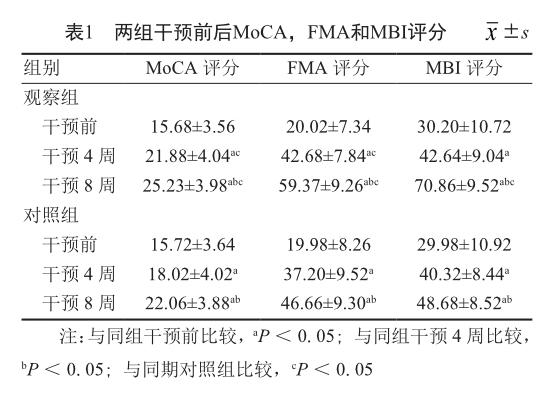
摘 要 目的:评估早期认知功能干预联合康复训练治疗脑卒中后认知功能障碍的效果。方法:选择脑卒中后认知功能障碍患者98例,随机分为观察组和对照组各49例。对照组给予常规运动功能康复训练,观察组在对照组基础上加以认知功能训练。采用蒙特利尔认知评估量表(Montreal Cognitive Assessment,MoCA)评价患者认知功能情况、采用Fugl-Meyer運动功能量表(FMA)进行偏瘫肢体运动功能评定,采用改良Barthel指数(Modified Barthel Index,MBI)评定患者生活自理能力。随访8周,分别统计所有患者治疗前、治疗后4周和8周的MoCA、FMA、MBI评分。结果:治疗4周和8周后,两组患者MoCA、FMA和MBI指数评分均较治疗前提高,治疗8周比治疗4周有进一步提高,且观察组更高于对照组,差异均有统计学意义(P均<0.05)。结论:认知功能训练联合康复训练能明显提高脑卒中后认知障碍、患肢运动功能的治疗效果和生活自理能力,可为社区康复提供思路,值得推广应用。
关键词 脑卒中;认知障碍;认知功能训练
中图分类号:R743.3 文献标志码:A 文章编号:1006-1533(2018)20-0055-04
Effect of community early cognitive function intervention in the treatment of poststroke cognitive dysfunction
FENG Jianyu(Department of Internal Medicine of Ouyang Community Health Service Center of Hongkou District, Shanghai 200081, China)
ABSTRACT Objective: To evaluate the effect of early cognitive function intervention combined with rehabilitation training in the treatment of post-stroke cognitive dysfunction. Methods: A total of 98 patients with cognitive dysfunction after stroke were selected and randomly divided into an observation group and a control group with 49 cases each. The control group was given routine exercise rehabilitation training, and the observation group received cognitive function training on the basis of the control group. The Montreal Cognitive Assessment scale(MoCA) was used to evaluate the cognitive function of patients, Fuglmeyer motor function scale(FMA) was used to evaluate the motor function of hemiplegic limbs and Modified Barthel Index(MBI) was used to evaluate patients self-care ability. During the 8 weeks of follow-up, the MoCA, FMA, and MBI scores of all patients before treatment, 4 and 8 weeks after treatment were counted. Results: After 4 and 8 weeks of treatment, the scores of MoCA, FMA and MBI index were higher in both groups than before treatment. Treatment for 8 weeks was further improved than that for 4 weeks, the observation group was higher than the control group, and the difference was statistically significant(P<0.05). Conclusion: Cognitive function training combined with rehabilitation training can significantly improve the cognitive effects of post-stroke cognition, the motor function of the affected limbs and the ability to take care of themselves, which can provide ideas for community rehabilitation and is worthy of promotion and application.
KEY WORDS stroke; cognitive dysfunction; cognitive function training
脑卒中已成为我国主要的死亡原因,同时也是中国成年人残疾的首要原因[1]。认知功能障碍(post-stroke cognitive impairment,PSCI)是脑卒中后常见后遗症, 50%~75%的患者存在不同程度的认知障碍,其中超过1/3的患者最终发展为血管性痴呆[2-4]。PSCI严重影响患者生活质量及生存时间,已成为当前国际卒中研究和干预的热点[5-6]。本研究旨在评估早期认知干预联合康复训练治疗脑卒中后认知功能障碍的效果。
1 对象与方法
1.1 对象
选择2016年11月至2018年2月由上海市欧阳路社区卫生服务中心康复病房收治的脑卒中患者98例,其中脑梗死80例(额颞叶34例,基底节区32例,脑干14例),脑出血18例(基底节区12例,脑叶4例,脑干2例);男性74例,女性24例;文盲6例,小学14例,初中28例,高中及中专40例,大专及以上10例。……