组织化管理模式对基层医院脑卒中患者随诊率的影响
2017-01-03陈淑兰张国平谌建
陈淑兰+张国平+谌建
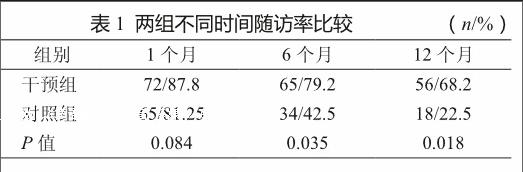
摘 要 目的:观察组织化管理模式对基层医院脑卒中患者随诊率的影响。方法:收集2014年1月—2015年5月基层医院脑卒中患者162例,分成干预组82例有针对性地按照组织化管理模式进行干预,对照组80例,按既往常规进行干预。比较两组在1、6、12个月的随诊率。结果:干预组和对照组1个月随访率分别为87.8%(72/82)和81.25%(65/80),组间差异无统计学意义(P>0.05)。干预组6和12个月的随访率分别为79.2%(65/82)和68.2%(56/82),对照组分别为42.5%(34/80)和22.5%(18/80),组间差异有统计学意义(P<0.05),尤其以12个月最为显著。结论:组织化管理能明显提高门诊脑卒中患者的随访率,尤其对远期随访率提高具有显著优势,值得推广应用。
关键词 脑卒中; 组织化; 随诊率; 基层医院
中图分类号:R743.3 文献标志码:A 文章编号:1006-1533(2016)24-0046-02
The effect of organized stroke management mode on the follow-up rate of stroke patients in the primary hospital
CHEN Shulan, ZHANG Guoping, CHEN Jian
(Second Department of Internal Medicine of Peoples Hospital, Luxi County, Pingxiang City, Jiangxi 337200, China)
ABSTRACT Objective: To observe the effect of organized stroke management mode on the follow-up rate of stroke patients in the primary hospital. Methods: One hundred and sixty-two patients with stroke in the primary hospital from January 2014 to May 2015 were randomly selected and divided into an intervention group and a control group, and the differences in follow-up rates in 1, 6 and 12 months were compared between the two groups. Results: There was no significant difference in the follow-up rate in 1 month in the intervention and the control groups. The follow-up rates in 6 and 12 months of the intervention group were higher than those of the control group, and the follow-up rate in 1 year was particularly obvious, and the difference had the statistical significance(P<0.05). Conclusion: Organized stroke management has a significant improvement on outpatient follow-up rate of stroke, and especially a significant advantage on the long term follow-up rate. It is worthy of popularization and application in the clinic.
KEY WORDS stroke; organized; follow-up rate; primary hospital
脑卒中具有发病率高、病死率高、致残率高以及复发率高等特点,是导致全球人类致残的首要病因。脑卒中患者10年内的累计复发率在43%,其二级预防工作亟待改善。尽管临床试验证实了强化药物治疗方案的重要性,但在临床实践中,药物治疗的依从性很差,尤其是长期依从性更差。本文报道将组织化管理模式应用于脑卒中门诊患者的管理中能明显提高随访率。脑卒中患者(符合1995年全国第四届脑血管病学术会议通过的诊断标准[1-3],经头颅CT或MRI检查除外颅内肿瘤和蛛网膜下腔出血),将患者信息(姓名、性别、年龄、文化程度、地址、电话、就诊时间)进行登记、建档,并分为干预组82例和对照组80例。干预组中男40例,女42例,平均年龄61.5岁。对照组80例,男38例,女42例,平均年龄62.7岁。两组性别、年龄等基线资料比较差异均无统计学意义(P>0.05)。
1.2 方法
干预组有针对性地按照组织化管理模式进行干预,包括从以下7个方面:脑卒中门诊的建立、住院部与脑卒中门诊的有效整合、危险因素的评估及控制、监督定期用药、继续康复治疗、健康宣教、心理教育。对……