社区老年糖尿病甲真菌病感染患者遵医行为的调查分析
2017-01-03王明华白姣姣臧娴王峥沈晔储英
王明华+白姣姣+臧娴+王峥+沈晔+储英+赵樾+缪飞
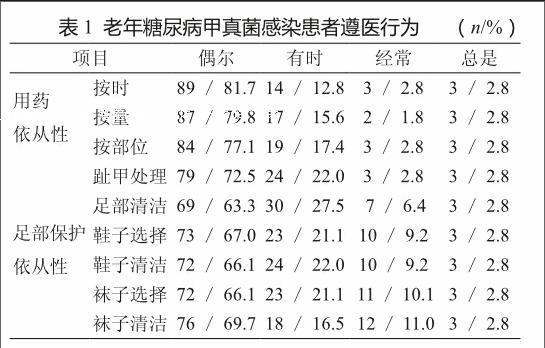
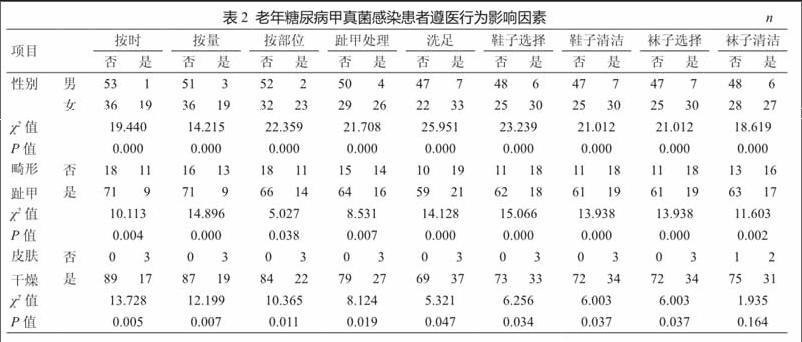
摘 要 目的:调查老年糖尿病甲真菌病感染患者的遵医行为,及其影响因素。方法:2016年4月~6月采用自行设计的问卷对上海地区某社区卫生服务中心的109例老年糖尿病甲真菌病感染患者进行遵医行为及影响因素调查。结果:社区老年糖尿病甲真菌病感染患者的遵医行为较差,其用药依从性和足部保护依从性仅为2.8%。性别、有无畸形趾甲及皮肤干燥情况影响老年糖尿病甲真菌病感染患者的遵医行为,差异有统计意义(P<0.05)。结论:应加强对老年糖尿病甲真菌感染患者的健康教育,尤其是男性患者,从而提高甲真菌病防治效果,预防糖尿病足的发生与发展。
关键词 老年糖尿病; 甲真菌病; 遵医行为
中图分类号:R587.2 文献标志码:A 文章编号:1006-1533(2016)24-0043-03
Investigation and analysis of the treatment compliance behavior of the community elderly diabetic patients with onychomycosis infection
WANG Minghua1, BAI Jiaojiao2, ZANG Xian2, WANG Zheng2, SHEN Ye1, CHU Ying1, ZHAO Yue1, MIAO Fei2(1.Xianxia Community Health Service Center of Changning District, Shanghai 200336, China; 2. Huadong Hospital affiliated to Fudan
University, Shanghai 200040, China)
ABSTRACT Objective: To investigate the treatment compliance behavior of elderly diabetic patients with onychomycosis infection and its influencing factors. Methods: From April to June 2016, a self-designed questionnaire was used to investigate the treatment compliance behavior of 109 elderly diabetic patients with onychomycosis infection and its influencing factors in a community health service center in Shanghai. Results: Elderly diabetic patients with onychomycosis infection had the poor treatment compliance behavior, and the medication compliance and foot protection compliance was only 2.8%. Gender, abnormal toenail and dry skin influenced their treatment compliance behavior, and the difference was statistically significant(P<0.05). Conclusion: The health education should be strengthened for elderly diabetic patients with onychomycosis infection, especially for the male patients so as to improve the preventive and treatment effect of onychomycosis to prevent the occurrence and development of diabetic foot.
KEY WORDS elderly diabetes; onychomycosis; treatment compliance behavior
甲真菌病俗称“灰指甲”,是临床常见的皮肤真菌病,主要表现为甲板失去光泽、变色、肥厚、轮廓异常和脆性增加[1]。老年人群是甲真菌感染的高发人群,其发生率高达51.4%[2]。糖尿病患者机体长期处于高血糖、免疫功能降低及大量广谱抗生素的应用环境下,加之常伴有血管病变、神经病变等各种并发症,使真菌感染概率大大增加。研究显示,糖尿病患者趾甲真菌病发生风险是非糖尿病患者的2.2倍[3],平均发病率为85%~93%[4]。甲真菌感染可增加糖尿病患者足部感染的发生率,诱发糖尿病足,使患者致残、致死,严重影响患者生活质量,给社会和家庭带来巨大的经济负担[5]。甲真菌病的治疗是一个漫长的过程,需要长期规范治疗和足部护理,而老年糖尿病患者大多时间生活在社区与家庭,其甲真菌感染的防治主要依靠社区和自我管理,故患者的遵医行为会极大影响治疗效果。……