人性化护理干预对手术室行腹腔镜胃癌根治术患者的负性心理及生活质量的影响
2015-09-01刘静俞耀军
刘静++俞耀军

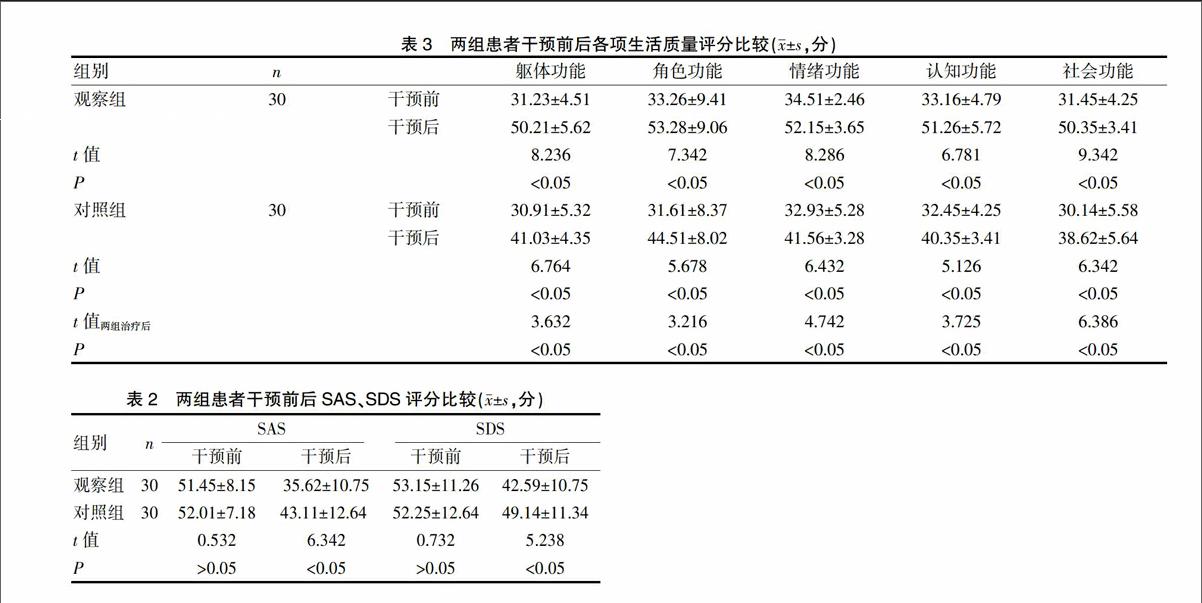
[摘要] 目的 探讨人性化护理干预对手术室行腹腔镜胃癌根治术患者的负性心理及生活质量的影响。 方法 选择我院2012年12月~2014年12月住院行腹腔镜胃癌根治术患者60例作为研究对象,根据随机数字表法随机分为对照组和观察组,每组30例。对照组采取常规护理干预。观察组在对照组基础上行人性化护理。 结果两组SAS、SDS评分干预前比较差异无统计学意义(P>0.05);干预后两组SAS、SDS评分均显著低于干预前,差异有统计学意义(t=9.234、8.638、7.742、6.752,P<0.05);且观察组干预后SAS、SDS评分明显低于对照组,差异有统计学意义(t=6.342、5.238,P<0.05)。干预前两组患者生活质量躯体功能、角色功能、情绪功能、认知功能、社会功能各项评分比较差异无统计学意义(P>0.05);干预后,两组生活质量的躯体功能、角色功能、情绪功能、认知功能、社会功能各项评分均较干预前显著提高,且观察组患者生活质量的躯体功能、角色功能、情绪功能、认知功能、社会功能各项评分达(50.21±5.62)分、(53.28±9.06)分、(52.15±3.65)分、(51.26±5.72)分、(50.35±3.41)分,显著高于对照组,差异具有统计学意义(t=3.632、3.216、4.742、3.725、6.386,P<0.05)。 结论 人性化护理能够显著改善手术室腹腔镜胃癌根治术患者的负性心理,从躯体功能、角色功能、情绪功能、认知功能、社会功能各方面提高患者的生活质量,使患者积极配合手术及护理,有利于患者术后的恢复。
[关键词] 腹腔镜胃癌根治术;手术室;人性化护理干预;负性心理;生活质量
[中图分类号] R473.73 [文献标识码] B [文章编号] 1673-9701(2015)22-0137-03
Effect of negative psychological and life quality of humanized nuring intervention in patients with laparoscopic radical gastrectomy in the operation room
LIU Jing1 YU Yaojun2
1.Operation Room, the Affiliated Hospital of Hangzhou University, Hangzhou 310012, China; 2.Department of Gastrointestinal Surgery, Second Hospital Affiliated to Wenzhou Medical College, Wenzhou 325000, China
[Abstract] Objective To discuss Effect of negative psychological and life quality of humanized nuring intervention in patients with laparoscopic radical gastrectomy in the operation room. Methods 60 patients in our hospital from December 2012 to December 2014 were Selected, who underwent laparoscopic radical gastrectomy for gastric cancer as the research objects, and they were randomly divided into control group and observation group, 30 cases in each group. Control group received routine nursing intervention. The observation group received humanistic care on the basis of the control group. Results The SAS, SDS scores of two groups before the intervention were compared, the difference was not statistically significant(P>0.05); After intervention, the SAS, SDS scores of two groups were significantly lower than those before intervention, the difference was statistically significant (t=9.234, 8.638, 7.742, 6.752, P<0.05), and after the intervention, SDS, SAS scores of observation group were significantly lower than the control group, the difference was statistically significant(t=6.342, 5.238, P<0.05). Before the intervention, the quality of life of body function, role function, emotional function, cognitive function, social function scores of two groups were compared, with no significant difference(P>0.05); after the intervention, the quality of life of body function, role function, the emotional function, cognitive function, social function the scores of two groups were significantly higher, and quality of life of body function, role function, the emotional function, cognitive function, social function scores of the observation group were(50.21±5.62), (53.28±9.06), (52.15±3.65), (51.26±5.72), (50.35±3.41) respectively, was significantly higher than that of the control group, the difference was statistically significant(t=3.632, 3.216, 4.742, 3.725, 6.386, P<0.05). Conclusion The nursing intervention can improve negative psychological of patients with gastric cancer, can improve the quality of life of body function, role function, emotional function, cognitive function, social function, so that patients can revieve operation actively and is good for recover.
[Key words] Laparoscopic radical resection of gastric cancer; Operation room; Humanized nursing intervention; Negative psychology; Quality of life\
腹腔镜胃癌根治术具有创伤小、术后恢复快、并发症少等优点,但在手术室进行穿刺及建立CO2气腹等操作对呼吸、循环、内分泌等系统的影响不容忽视[1],所以加强腹腔镜手术围术期的护理对于减少和避免腹腔镜手术后并发症的发生具有重要作用。另外,腹腔镜胃癌根治术患者术前存在焦虑、紧张、悲观、绝望等负性心理,人性化护理对于腹腔镜胃癌根治术患者围术期心理状态的调整及手术成功具有重要意义,能够有效地帮助患者适应疾病、改善情绪、提高生活质量[2]。