贸易自由化、生产率“饱和”与就业
2015-01-30张红宋文飞韩先锋魏轩
张红+宋文飞+韩先锋+魏轩
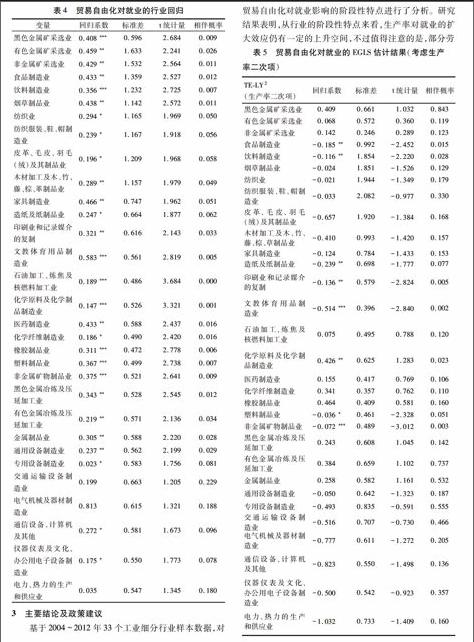
摘要:基于2004~2012年工业中33个细分行业样本数据,对贸易自由化对就业影响的阶段性特点进行了分析。实证结果表明,部分劳动密集型行业对就业的影响呈“倒U型”特征,生产率已经达到“饱和”。但从总体上来看,生产率对就业的扩大效应仍有一定的上升空间。在这一行业发展的阶段特点下,贸易自由化对就业总体上具有正向溢出效应。同时,工资上升促进了就业;释放“结构红利”促进生产率提升是解决就业矛盾的根本策略。
关键词:贸易自由化;就业;生产率“饱和”
DOI:10.13956/j.ss.1001-8409.2015.01.27
中图分类号:F426 文献标识码:A 文章编号:1001-8409(2015)01-0124-05
Trade Liberalization, Productivity “Saturation”and Employment
ZHANG Hong1,2 ,SONG Wen-fei 3,HAN Xian-feng4,WEI Xuan1
(1.School of Economics, University of Jinan, Jinan 250002;2.School of Economics, Shandong University, Jinan 250100;
3.School of Economics and Finance, Xian Jiaotong University, Xian 710061;
4.School of Economics and Management,
Northwest University, Xian 710127)
Abstract:Based on the 33 industry segments sample data from 2004 to 2012, the impact of trade liberalization on employment on the stage characteristics were analyzed.The empirical results show that some labor-intensive industries impact on employment was “inverted U” features;productivity has reached “saturation.” On the whole, however, the expansion of the productivity effect on employment is still some room for growth.At this stage of development of the industry characteristics, the trade liberalization has a positive spillover effect on employment.In addition, it has also been promoting employment wage increase is an important conclusion.Therefore, the release of "structural bonus" to promote productivity improvement is to solve the fundamental contradiction of employment policy.
Key words:trade liberalization;employment;productivity “saturation”
文献的研究结果表明贸易自由化对就业的影响与国家发展的阶段有关,突出表现在发展中国家和发达国家之间的差异。按照比较优势理论、要素禀赋论,发展中国家就业主要集中于劳动密集型产业,通过出口劳动密集型产品带动整个社会就业水平增加。以我国为例,胡昭玲等、盛斌等的研究表明出口对就业有一定的促进作用,在不同的行业或产业具有差异性[1,2]。然而,多数学者认为,贸易自由化不利于或不影响发达国家就业。Greeway和Hine的研究表明,英国贸易自由化不利于就业的增加,会减少劳动力需求<sup>[3]</sup>;Kojiro Sakurai的研究表明日本贸易自由化对就业的影响不大<sup>[4]</sup>。发达国家由于就业主要集中于资本密集型或技术密集型产业,就业与劳动密集型产业关联不大,而与国内需求结构紧密相关。贸易自由化对就业影响程度较少的关键因素是产业发展到一定阶段下的结构特征。……
