交通运输能耗与碳排放测算评价方法及应用
2015-01-30欧阳斌凤振华李忠奎毕清华周艾燕
欧阳斌+凤振华+李忠奎+毕清华+周艾燕
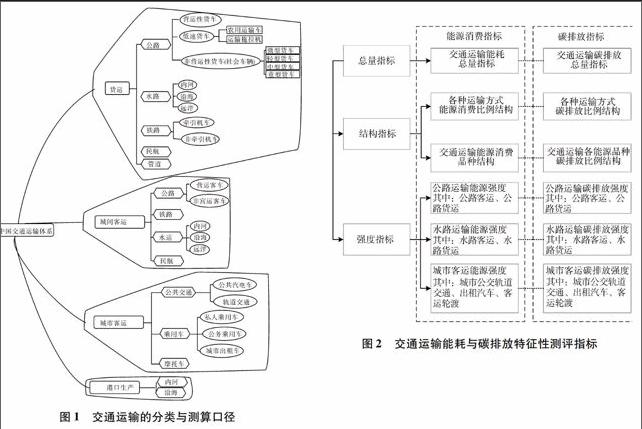
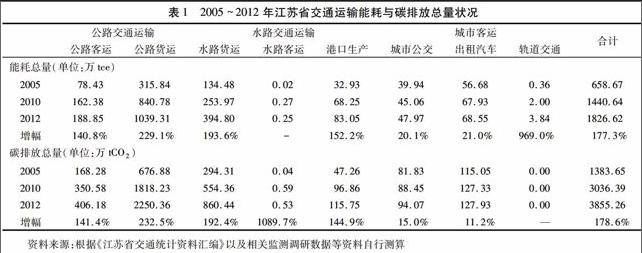
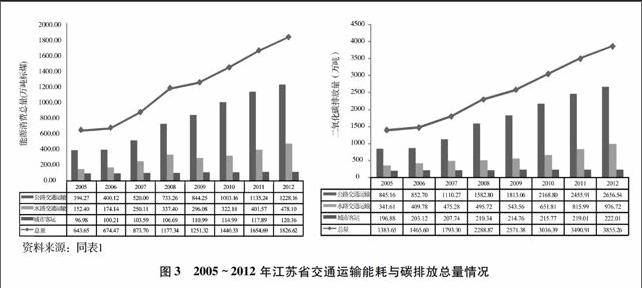
摘要:基于IPCC推荐方法,结合我国交通能耗统计基础,提出省级交通运输能耗与碳排放测算方法和特征性评价指标,对2005~2012年江苏省公路运输、水路运输(含港口)和城市客运领域的能耗与碳排放现状进行研究测算,分析能耗与碳排放总量、分能源品种与分运输方式的比例结构、能耗与碳排放强度等方面的特点,最后提出低碳交通运输发展需以降低能耗与碳排放强度为核心、以公路货运为突破重点、以优化综合运输结构和优先发展公共交通为战略导向、以发展清洁低碳能源为重要途径等政策启示。
关键词:交通运输;能耗强度;碳排放;测算方法;江苏
DOI:10.13956/j.ss.1001-8409.2015.01.30
中图分类号:F206;F224 文献标识码:A 文章编号:1001-8409(2015)01-0139-06
Calculation and Evaluation Methodology of Transport Energy
Consumption and Carbon Emission
——The Case of Jiangsu Province
OUYANG Bin1,2,FENG Zhen-hua2,LI Zhong-kui2,BI Qing-hua2,ZHOU Ai-yan2
(1.School of Management and Economics, Beijing Institute of Technology, Beijing 100181;
2.China Academy of Transportation Sciences, Beijing 100029)
Abstract:Using the methodology recommended by Intergovernmental Panel on Climate Change (IPCC), based on transport energy consumption statistics in China, a practical calculation methodology and evaluation indicators of provincial transport energy consumption and carbon dioxide emission is proposed.The energy consumption and carbon dioxide emission of transport industry from 2005 to 2012 in Jiangsu Province were empirically calculated, and the main features were systematically analyzed, from the perspectives of the total amount of energy consumption and carbon emission, the proportional structure of various transport modes and energy types, and energy and carbon emission intensity.And finally, some policy implications of low-carbon transport development were conclusively put forward, including reducing the energy and carbon intensity as the focus, breaking through the highway freight transport as the key, optimizing transport structure and giving priority to urban public transport development as a strategic choice, developing clean and low-carbon energy as an important way.
Key words:transport;energy intensity;carbon emission;calculation methodology;Jiangsu province
1 问题的提出
交通运输是国民经济和社会发展的重要基础产业和服务性行业,2010年全球交通运输能耗总量为24.10亿吨标准油,占比27.5%,仅次于工业能耗量<sup>[1]</sup>;交通运输二氧化碳(CO2)排放总量为67.5亿吨,占比22.3%<sup>[2]</sup>。交通运输碳排放已成为国家温室气体排放清单中的重要部分,同时由于其增速较快,交通运输部门已成为节能减排的重点领域<sup>[3]</sup>,在生态文明建设中肩负着重要责任。
目前,国内外学者十分重视交通运输节能减排领域的研究<sup>[4]</sup>。研究内容主要集中在以下几个方面:一是交通运输能耗和碳排放测算,包括全生命周期法、碳足迹消费模式法等[5,6]。龙江英运用全生命周期法测算了贵阳城市交通体系碳排放状况<sup>[7]</sup>。吴开亚等根据IPCC清单指南报告,测算了2000~2010年上海市交通运输业能源消费碳排放量、人均碳排放量以及碳排放强度的变化趋势<sup>[8]</sup>。……
