探讨在膝关节骨性关节炎患者中应用疼痛护理干预的价值
2021-12-13努尔阿米那·艾尔肯古丽斯旦·阿不都热西提
努尔阿米那·艾尔肯 古丽斯旦·阿不都热西提
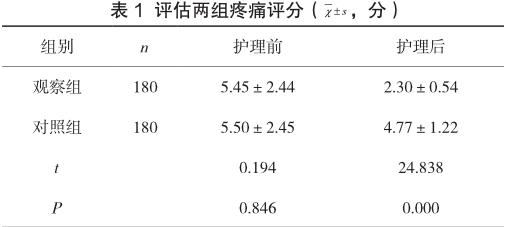
【摘 要】目的:分析针对膝关节骨性关节炎(以下简称为KOA)患者给予疼痛护理干预的作用。方法:360例KOA患者样本纳入时间由2020年4月开始,到2021年6月结束,随机均分为180例常规护理患者作为对照组,180例疼痛护理患者作为观察组,对两组护理前后VAS评分进行评估。结果:两组护理前VAS评分比较,差异小(P>0.05);与对照组护理后比较,观察组VAS评分比对照组低(P<0.05)。结论:临床在对于KOA患者进行治疗期间,主张予以疼痛护理干预,不但能够对患者的疼痛感起到缓解作用,还能减轻患者的负性情绪,对于改善患者的关节功能,提升生活质量水平具有积极意义,值得临床推广。
【关键词】膝关节骨性关节炎;疼痛护理;疼痛感;负性情绪
To explore the value of pain nursing intervention in patients with knee osteoarthritis
Nuramina Ai Erken Gulistan Abdul Rexiti
Department of Joint Orthopaedics, First Peoples Hospital of Kashgar, Xinjiang Kashgar 844000, China
【Abstract】Objective: To analyze the effect of pain nursing intervention for patients with knee osteoarthritis (KOA).Methods: 360 KOA patients were enrolled from April 2020 to June 2021. They were randomly divided into 180 routine nursing patients as the control group and 180 pain nursing patients as the observation group. The VAS scores of the two groups were evaluated before and after nursing. Results: There was little difference in VAS scores between the two groups before nursing(P>0.05). Compared with the control group after nursing, the VAS score of the observation group was lower than that of the control group(P<0.05). Conclusion: During the treatment of KOA patients, it is advocated to give pain nursing intervention, which can not only relieve the pain of patients, but also reduce the negative emotions of patients. It has positive significance for improving the joint function of patients and improving the quality of life, and is worthy of clinical promotion.
【Key?Words】Knee osteoarthritis; Pain care; Painperception; Negative emotion
KOA主要特征为膝关节软骨退行性病变、继发性骨质增生。此疾病发展速度缓慢,但是伴随着病程不断的延长,则可能会引发膝关节疼痛、肿胀、畸形等症状,造成患者躯体无法保持灵活,更加严重的患者行动受限,生活质量受到极大的影响。目前,此疾病发病率约为8.1%,并且存在明显的地域差异,并且农村人群发病率较高,若未及时地采取有效措施进行干预,则可能导致患者膝关节恢复受限[1-2]。本文就疼痛护理干预疗效进行分析,内容如下。
1 资料与方法
1.1 一般资料
择取本院2020年4月至2021年6月我院接诊的膝关节骨性关节炎患者360例予以研究,随机分为对照组(常规护理,n=180)、观察组(疼痛护理,n=180);观察组,男100例,女80例,年龄45岁~80岁,平均年龄(62.59±1.45)岁;对照组,男101例,女79例,年龄45岁~80岁,平均年龄(62.62±1.48)岁。两组一般资料比较(P>0.05),具有可比性。纳入标准:所有患者均符合《骨关节炎诊治指南》中有关膝关节骨性关节炎诊断标准。排除标准:①存在心肝肺肾脏器官疾病患者;②认知异常、精神疾病患者;③类风……