不同花期金花茶花的品质和产量比较
2021-11-15黄颖桢陈菁瑛张武君刘保财赵云青邹福贤张文晴
黄颖桢 陈菁瑛 张武君 刘保财 赵云青 邹福贤 张文晴
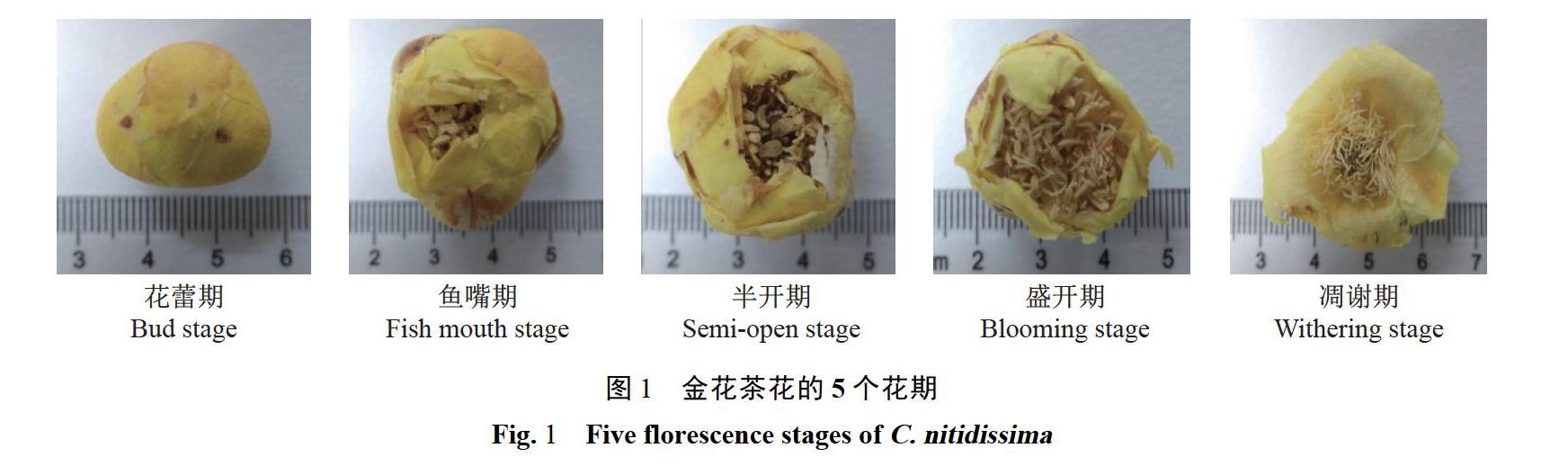

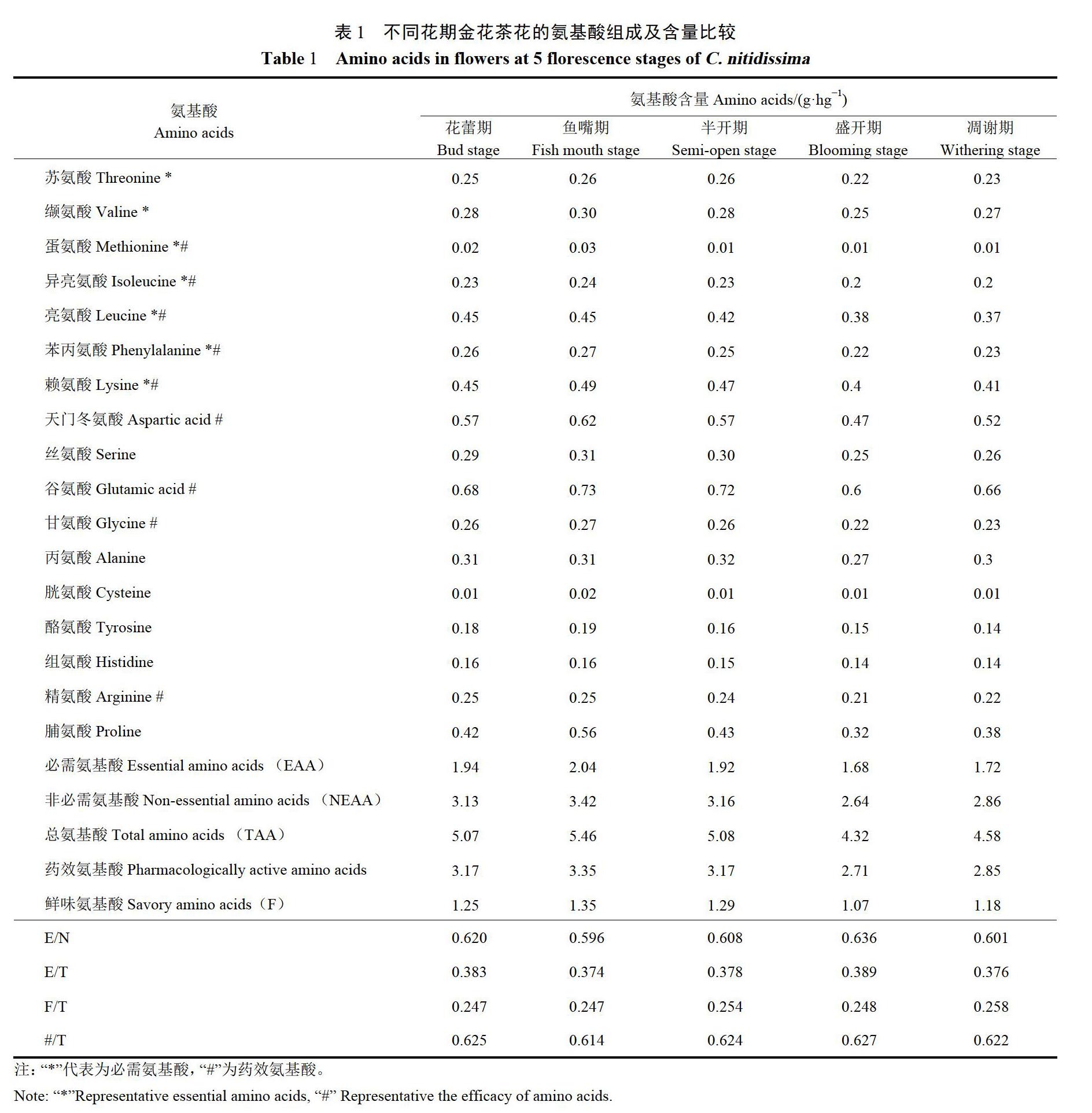
摘要:【目的】明確金花茶花的最佳采收期,为会花茶花的采收和综合丌发利用提供科学依据。【方法】对金花茶花的花蕾期、鱼嘴期、半丌期、盛丌期和凋谢期等5个小同花期的主要活性成分(总黄酮、茶多酚、总皂苷和粗多糖)和主要营养成分(氨基酸、蛋白质、粗脂肪、粗纤维和灰分)进行含量测定、比较。【结果】半丌期会花茶花的总黄酮、茶多酚和总皂苷含量最高,其次为鱼嘴期和盛丌期。会花茶花不同花期均含有7种必需氨基酸。鱼嘴期总氨基酸含量、药效氨基酸含量和鲜味氨基酸含量均较其他4个时期高,分别为5.46. 3.35和1.35 g·hg-1。5个小同花期金花茶花的氨基酸比值系数分( Score of amino acid ratio coefficient,SRC)分别为59.31、62.08、56.67、57.84和57.75,蛋氨酸+胱氨酸为第一限制氨基酸;鱼嘴期的蛋白质含量最高,为5.85 g·hg-1。各花期中均含有较多的纤维,含量为16.8- 17.5 g·hg-1。凋谢期脂肪的含量最高,其次是鱼嘴期。各花期的灰分含量为3.64- 3.88 g·hg-1。营养成分含量的因子分析综合得分排序为:花蕾期>鱼嘴期>半丌期>凋谢期>盛丌期。考察不同花期金花茶花的单花重和形态表明鱼嘴期和半丌期的商品性状接近,同时产量较传统采收期增加ll.9%。【结论】鱼嘴期和半丌期的金花茶花分别具有较高的活性成分含量、营养成分含量和产量。
关键词:金花茶花;花期;活性成分;营养成分;产量;因子分析
中图分类号:R282
文献标志码:A
文章编号:1008-03 84( 2021) 080899-10
Quality and Yield of Camellia nitidissima Flowers at Florescence Stages
HUANG Yingzhen 1.2*, CHEN Jingying 1.2, ZHANG Wujun 1.2. LIU Baocai 1.2.
ZHAO Yunqing 1.2, ZOU Fuxian 2. ZHANG Wenqing 2
(1. Institute ofAgricultural Bioresource, Fujian Academy ofAgricultural Sciences. Fuzhou, Fujian 350003. China;
2. Medicinal Plant Research Center, Fujian Academy of Agricultural Sciences. Fuzhou, Fujian 350003. China )
Abstract:【Objective】Optimal time for harvesting Camellia nitidissima flowers was investigated.【Method】The primaryfunctional ingredients (such as, total flavonoids, tea polyphenols. total saponins, and crude polysaccharide) and the majornutrients (such as. amino acids, protein. crude fat. crude fiber, and ash) of the camellia flowers at budding, fish-mouth, semi-open, blooming, and withering stages were determined for the evaluation.【Resultl】The flowers at the semi-open stage hadthe highest contents of total flavonoids, tea polyphenols, and total saponin. They were followed by those at the fish-mouth andblooming stages. The flowers at all stages contained 7 essential amino acids but varied in different aspects. The total aminoacids, pharmacologically functional amino acids. and savory ammo acids were 5.46 g·hg-1, 3.36 g·hg-l , and l.35 g·hg-1.respectively, in the fish-mouth flowers which were higher than those at other 4 stages. The score of ratio coefficient (SRC) onamino acids in the flowers at budding, fish-mouth. semi-open. blooming, and withering stages were 59.3 1. 62.08. 56.67. 57.84.and 57.75. respectively. Methionine and cysteine were the most limiting amino acids in the flowers. The protein content of 5.85g·hg-l was highest at fish-mouth stage; the relatively rich fiber content ranging between 16.8 g·hg-l and 17.5 g·hg-1 existed atall stages; the fat peaked at withering and followed by fish-mouth stage; and the ash content of 3.64-3.88 g·hg-l did not varymuch by florescence stages. An overall ranking on the nutrition scores of the flowers at different stages was budding> fish-mouth > semi-opening > withering > blooming. The weight and morphology of individual camellia flowers at fish-mouth andsemi-open stages showed a similar commercial value but a significant increase of Il .9% on yield over the traditional harvestingperiod. 【Conclusion】C. nitidissima flowers in the fish-mouth and semi-open stages had relatively high contents offunctional ingredients and nutrients. in addition to a significantly higher yield over those picked at other stages as traditionallypracticed.
Key words: Camellia nitidissima flowers: florescence stages; functional ingredients; nutrients; yield; factor analysis
0 引言
【研究意义】金花茶(Camellia nitidissima Chi)为山茶科( Theaceae)山茶属(Camellia)常绿灌木或小乔木,分布于我国广西防城金花茶国家级自然保护区内的阔叶林中,自然居群数量少,野生分布生境狭窄,是我国一级保护植物和《国际生物多样性公约》附属Ⅱ物种[1],其花色金黄,形态美观,素有“茶族皇后”“植物界大熊猫”的美称[2]。金花茶的叶和花是……