基于网络药理学与分子对接探讨黄芪治疗溃疡性结肠炎的作用机制
2021-07-11郝民琦王佳慧李晓玲李海龙吴玉泓
郝民琦 王佳慧 李晓玲 李海龙 吴玉泓
中图分类号 R285;R574.1 文献标志码 A 文章编号 1001-0408(2021)10-1215-09
DOI 10.6039/j.issn.1001-0408.2021.10.10
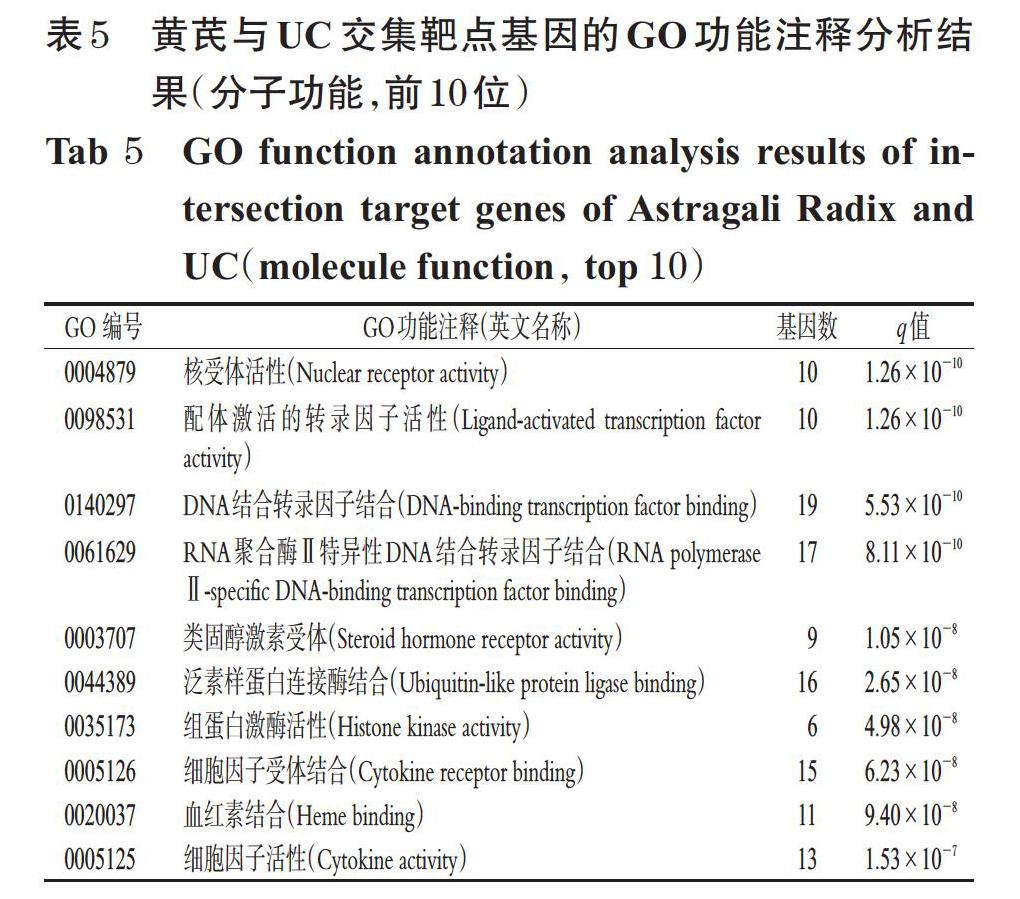
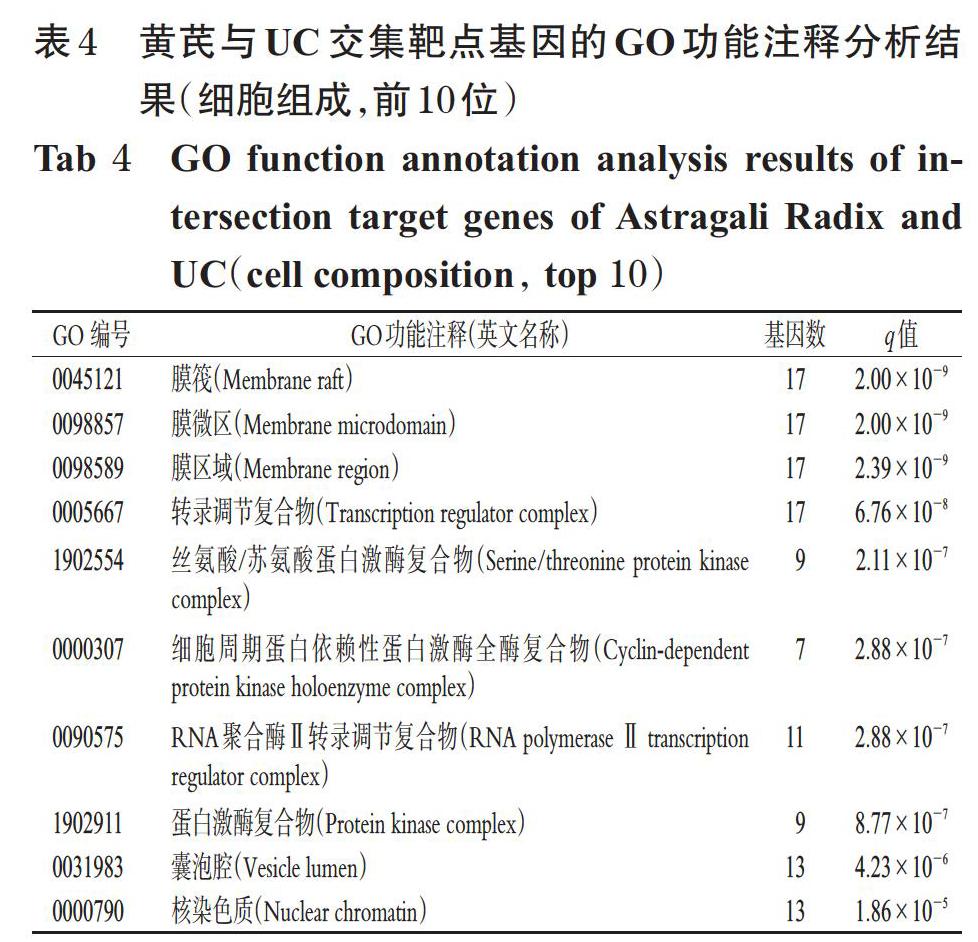
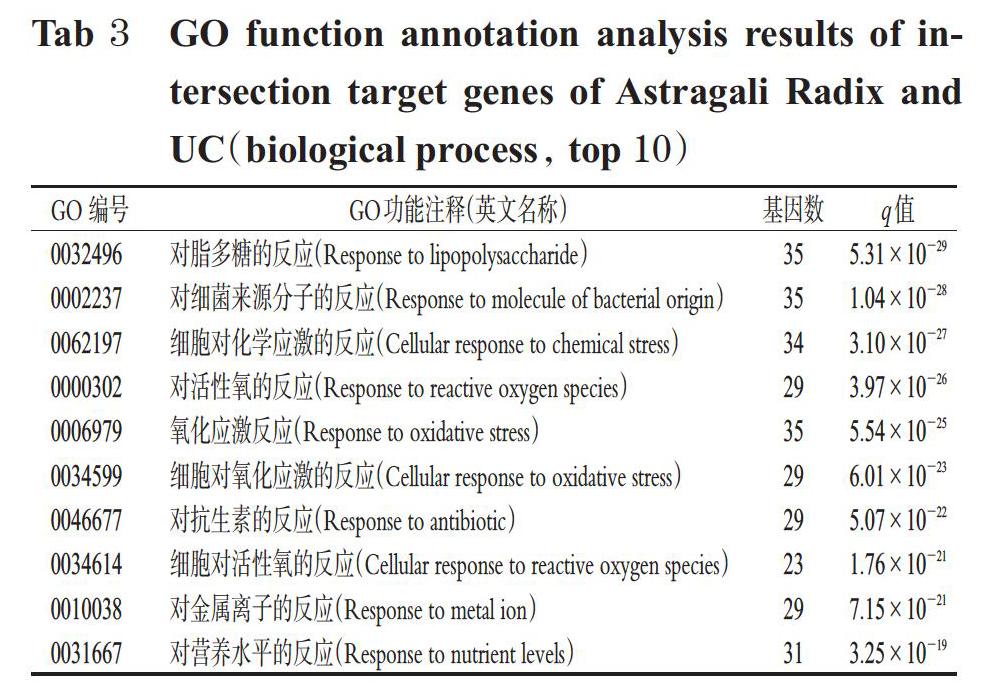
摘 要 目的:预测黄芪对溃疡性结肠炎(UC)的可能作用靶点与机制,为临床应用黄芪治疗UC的后续研究提供参考。方法:经中药系统药理学分析平台数据库(TCMSP)和UniProt KB数据库检索黄芪的活性成分及其对应靶点基因,经Gene Cards数据库检索UC疾病相关靶点基因,借助Venny 2.1.0在线作图工具获取黄芪与UC的交集靶点基因,并应用Cytoscape 3.7.0软件构建“药物-化合物-交集靶点”相互作用网络。利用STRING数据库获取交集靶点的蛋白质-蛋白质相互作用关系(PPI)网络,并应用Cytoscape 3.7.0软件进行可视化分析和拓扑学分析以获取核心靶点基因。借助DAVID数据库对交集靶点基因进行基因本体(GO)功能注释及KEGG通路富集,并应用Cytoscape 3.7.0软件构建“靶点-通路”富集网络。通过AutoDock vina 1.1.2软件将度值排名前5位的活性成分与核心靶点基因编码蛋白进行分子对接,应用Discovery Studio 3.5软件绘制结合模式图。结果:黄芪中共有化合物143个,共筛选出了活性成分20个,对应的靶点基因189个;UC疾病相关靶点基因共4 356个。黄芪(涉及14种活性成分)与UC的交集靶点基因有126个。PPI网络中的核心靶点基因为AKT1、MAPK1、RB1、JUN等。GO功能注释共得到GO条目2 294个(q值<0.05),包括生物过程条目2 093个(如对脂多糖的反应、对细菌来源分子的反应等)、细胞组成条目49個(如膜筏、膜微区等)、分子功能条目152个(如核受体活性、配体激活的转录等)。KEGG通路富集分析共得到条目160个(q值<0.05),如流体剪切应力和动脉粥样硬化信号通路、磷脂酰肌醇3激酶/蛋白激酶B(PI3K/Akt)、白细胞介素17(IL-17)信号通路等。分子对接结果显示,度值排名前5位的活性成分(槲皮素、山柰酚、芒柄花黄素、异鼠李素、7-O-methylisomucronulatol)与核心靶点编码蛋白的结合能均小于-5.0 kcal/mol。结论:黄芪中的槲皮素、山柰酚、芒柄花黄素异等活性成分可能通过作用于MAPK14、JUN、AKT1等靶点基因,进而对PI3K/Akt、IL-17等信号通路产生调控作用,最终发挥对UC的治疗作用。
关键词 黄芪;活性成分;溃疡性结肠炎;网络药理学;分子对接;作用机制
Study on the Mechanism of Astragali Radix in the Treatment of Ulcerative Colitis Based on Network Pharmacology and Molecular Docking
HAO Minqi1,2,3,WANG Jiahui1,2,LI Xiaoling1,2,LI Hailong2,4,WU Yuhong1(1. School of Basic Medicine, Gansu University of TCM, Lanzhou 730000, China; 2. Key Laboratory of Dunhuang Medicine and Its Transformation of Ministry of Education, Gansu University of TCM, Lanzhou 730000, China; 3. Key Laboratory of TCM Mining and Innovation Transformation, Gansu University of TCM, Lanzhou 730000, China; 4. First Clinical Medicial School, Gansu University of Chinese Medicine, Lanzhou, 730000, China)
ABSTRACT OBJECTIVE:To predict the potential target and mechanism of Astragali Radix in the treatment of ulcerative colitis (UC), and to provide reference for the clinical application of Astragali Radix in the treatment of UC. METHODS:The active components and their corresponding target genes of Astragali Radix were retrieved by TCMSP and UniProt KB database. The related target genes of UC were searched by Gene Cards database. The intersection target genes of Astragali Radix and UC were obtained by Venny 2.1.0 online mapping tool, and interaction network of “drug-compound-intersection target” was constructed by using Cytoscape 3.7.0 software. PPI network of intersecting targets was obtained by using STRING database, and the visualization analysis and topological analysis were carried out by using Cytoscape 3.7.0 software to obtain the core target genes. By using DAVID database, the gene ontology (GO) function annotation and KEGG pathway enrichment of intersecting target genes were carried out, and the “target-pathway” enrichment network was constructed by using Cytoscape 3.7.0 software. Through AutoDock vina 1.1.2 software, the top five active components in the list of degree value were linked with the protein encoded by the core target genes; Discovery Studio 3.5 software was applied to draw out binding pattern map. RESULTS:There were 143 compounds in Astragali Radix, 20 active components were screened out, and 189 corresponding target genes were selected; there were 4 356 UC disease related target genes. There were 126 intersection target genes of Astragali Radix (involving 14 active components) and UC. The core target genes in PPI network were AKT1, MAPK1, RB1, JUN, etc. A total of 2 294 GO items (q value<0.05) were obtained from GO functional annotation, including 2 093 biological process items (e.g. response to lipopolysaccharide, response to molecule of bacterial origin), 49 cell composition items (e.g. membrane raft, membrane microdomain), and 152 molecular function items (e.g. nuclear receptor activity, ligand-activated transcription factor activity). KEGG pathway enrichment analysis yielded 160 items (q value<0.05), such as fluid shear stress and atherosclerosis signaling pathway, phosphatidylinositol 3 kinase/protein kinase B (PI3K/Akt) signaling pathway,interleukin-17 (IL-17) signaling pathway. Molecular docking results showed that top 5 active ingredients (quercetin, kaempferol, formenonetin, isorhamnetin, 7-O-methylisomucronulatol) in the list of degree value had binding energies<5.0 kcal/mol with the protein encoded core targets. CONCLUSIONS: Quercetin, kaempferol, formononetin and other active components in Astragali Radix may play a role in the treatment of UC through the action of MAPK14,JUN,AKT1 and other target genes,and then on the signal pathways such as PI3K/Akt and IL-17.
KEYWORDS Astragali Radix; Active ingredients; Ulcerative colitis; Network pharmacology; Molecular docking; Mechanism of action
潰疡性结肠炎(UC)是一种慢性、非特异性肠道炎症性疾病,其临床多表现为反复发作或持续性的腹痛、腹泻、黏液脓血便或不同程度的全身症状[1]。历代中医学家认为,该病的主要病因为内外之邪影响脾胃,使脾胃运化失司,而脾胃气虚是发病的根本[2]。……
