护理风险管理在内科护理中的应用效果观察
2021-02-03李宝恩
李宝恩
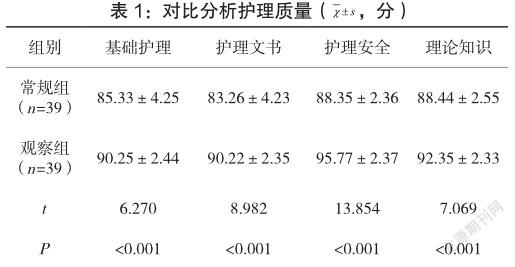
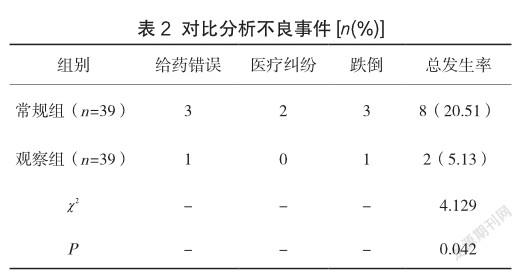
【摘 要】目的:探讨分析内科患者采用护理风险管理的临床运用效果。方法:选择本院2020年6月至2021年7月收治的内科患者作为研究主体,纳选对象共计78例,以随机数字表法将其均匀划分为两组,每组各39例,常规组采取常规护理管理,观察组则采取护理风险管理,组间对比两组护理质量及不良事件。结果:与常规组进行比较,观察组各项护理质量评分均明显比常规组高,组间对比(P<0.05);同时观察组不良事件发生概率5.13%远远比常规组低,组间对比(P<0.05)。结论:采取护理风险管理能显著提升护理质量,还能减少不良事件发生机率,临床应用价值显著。
【关键词】内科护理;护理方法;护理风险管理;护理效果;服务质量
Observation on the application effect of nursing risk management in internal nursing
Li Baoen
Xian County Peoples Hospital, Cangzhou City, Hebei Province, Cangzhou Hebei 062250, China
【Abstract】Objective:To explore and analyze the clinical application effect of nursing risk management in internal medicine patients. Methods:The internal medicine patients admitted in our hospital from June 2020 to July 2021 were selected as the main body of the study. A total of 78 patients were recruited. They were evenly divided into two groups by random number table method, each with 39 cases, the conventional group Routine nursing management was adopted, while the observation group adopted nursing risk management. The quality of care and adverse events between the two groups were compared. Results: Compared with the routine group, the observation groups various nursing quality scores were significantly higher than those of the routine group, and the comparison between groups was(P<0.05); at the same time, the 5.13% probability of adverse events in the observation group was far lower than that of the routine group, and the comparison between the groups was(P<0.05). Conclusion: Adopting nursing risk management can significantly improve the quality of nursing and reduce the probability of adverse events. The clinical application value is significant.
【Key?Words】Internal Medicine Nursing; Nursing Methods; Nursing Risk Management; Nursing Effects; Service Quality
内科护理所涉及的内容非常广,而且内科疾病通常都是慢性病,受长期疾病折磨,患者的身心不仅会受到严重的摧残,而且还会大大增加护理难度。再加上患者常常伴有很多不良的情绪,使得易引起护患纠纷。而护理风险管理能够根据患者实际情况,予以有效的解决措施,还能降低护理风险[1]。基于此,文章以内科患者为例(研究时间:2020年6月至2021年7月),应用护理风险管理的方式,相关内容如下。
1 资料与方法
1.1 一般资料
选择本院2020年6月至2021年7月收治的内科患者作为研究主体,纳选对象共计78例,以随机数字表法将其均匀划分为两组,每组各39例。常规组,男性18例,女性21例,年龄25岁~74岁,平均年龄(53.39±1.69)岁,糖尿病患者有13例,心血管病患者有11例,脑血管病患者有15例。观察组,男性17例,女性22例,年龄25岁~75岁,平均年龄(53.78±1.79)岁,糖尿病患者有15例,心血管病患者有11例,脑血管病患者有13例。对于上述數据资料,两组差异不显著(P>0.05)。
1.2 方法
1.2.1 39例常规组患者采取常规护理:包含平常的生活护理、用药指导、饮食护理以及生命体征监测等多个方面的护理措施。