恶性肿瘤患者失眠发生的特征及对生命质量影响的临床调查
2020-10-21邓湘琴梁慧林宏远崔超宇
邓湘琴 梁慧 林宏远 崔超宇
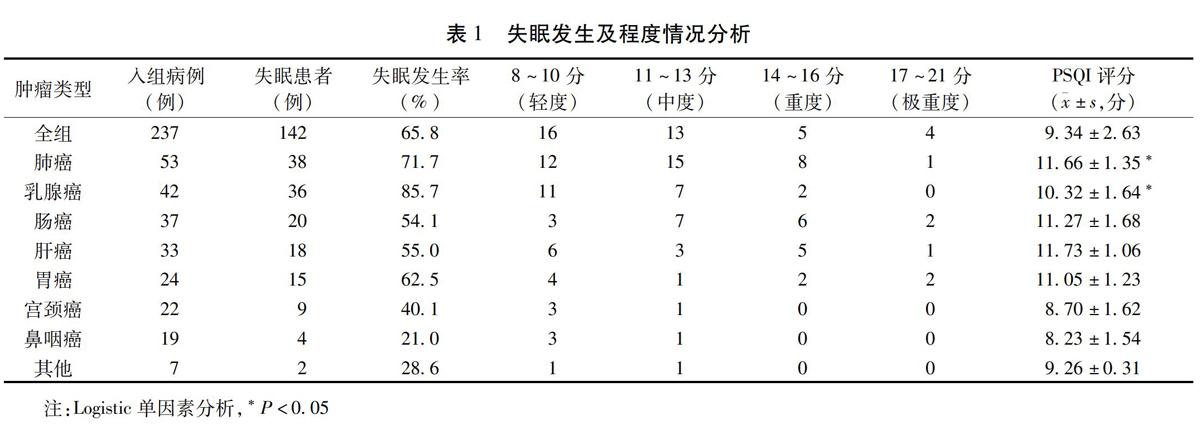
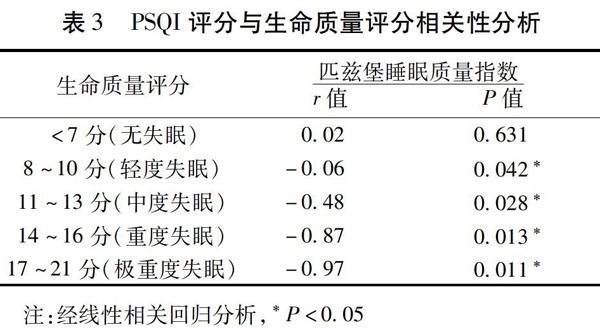
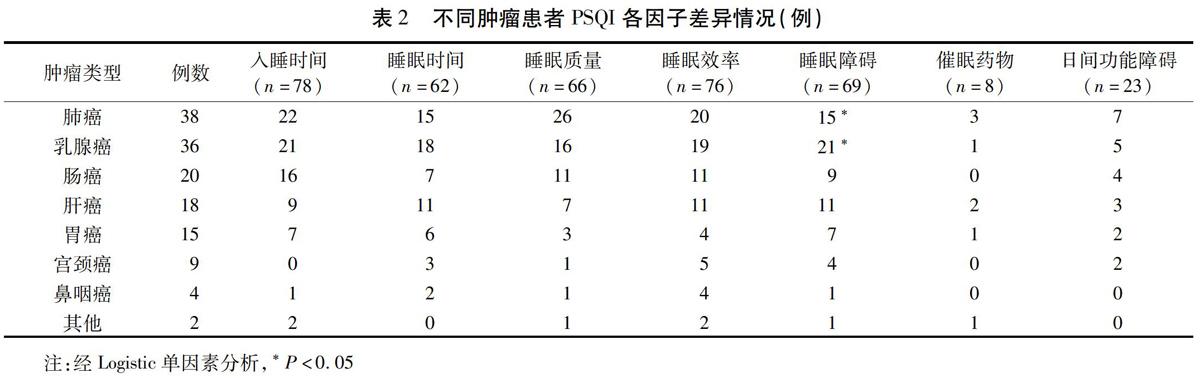
摘要 目的:調查常见恶性肿瘤失眠患者的发病和特征分布状况对生命质量影响。方法:通过匹兹堡睡眠质量指数(PSQI)和生命质量评价量表,对2018年1月至2019年1月湖南省肿瘤医院中西结合科及湖南省中医药研究院附属医院肿瘤科的237例门诊及住院恶性肿瘤患者进行问卷调查。结果:调查发现65.8%的肿瘤患者患有失眠,常见肿瘤失眠发生率依次为乳腺癌85.7%>肺癌71.7%>胃癌62.5%>肝癌55%>肠癌54.1%>宫颈癌40.1%>其他28.6%>鼻咽癌21%,Logistic单因素分析发现乳腺癌(P=0.037)和肺癌(P=0.047)较其他肿瘤更易出现失眠。不同肿瘤PSQI评分由高到低依次为肝癌>肺癌>肠癌>胃癌>乳腺癌>其他>宫颈癌>鼻咽癌;Logistic单因素分析不同肿瘤与PSQI7个因子成分相关性,表明乳腺癌(P=0.021)较其他肿瘤更易出现睡眠障碍,肺癌(P=0.033)较其他肿瘤更易出现睡眠质量问题。PSQI评分与生命质量评分线性回归分析,PSQI<7分,r=0.04,P>0.05,表明两者无明显线性关系。PSQI>8,r<0,P<0.05,表明两者呈负相关性。PSQI>14分,r<0,P<0.01,生命质量评分下降明显,表明重度及极重度失眠对生命质量影响更为明显。结论:肿瘤患者失眠发生及特征与肿瘤类型相关,本研究可为有针对性的预防及治疗肿瘤相关性失眠提供依据。
关键词 肿瘤相关性失眠;恶性肿瘤;生命质量
Clinical Investigation on the Occurrence and Characteristics of Insomnia and Its Effect on Quality of Life in Patients with Malignant Tumor
DENG Xiangqin1,LIANG Hui2,LIN Hongyuan1,CUI Chaoyu1
(1 Hunan University of Traditional Chinese Medicine, Changsha 410208, China;2 Hunan Cancer Hospital, Changsha 410013, China)
Abstract Objective:To investigate the occurrence,characteristics and life quality in patients with cancer related insomnia.Methods:The Pittsburgh Sleeping Quality Index scale(PSQI)and the Quality of Life scale were used.A questionnaire survey was conducted among 237 outpatients and inpatients with cancers in Hunan University of TCM and Hunan Cancer Hospital.Results:It was found that 65.8% cancer patients suffered from insomnia.The incidences of insomnia were 85.7% in breast cancer>71.7% in lung cancer>62.5% in gastric cance>55% in liver cancer>54.1% in colorectal cancer>40.1% in cervical cancer>28.6% in others>21% in nasopharyngeal carcinoma.The results showed that breast cancer(P=0.037)and lung cancer(P=0.047)were more likely to have insomnia than other cancers.The sequence of PSQI scores in patients with a variety of cancers from highest to lowest was liver cancer>lung cancer>colorectal cancer>gastric cancer>breast cancer>other>cervical cancer>nasopharyngeal carcinoma.The correlation between different cancers and seven components in PSQI were analyzed by single factor analytic approach.The results showed that breast cancer(P=0.021)was more likely to have sleep disorders than others,and lung cancer(P=0.033)was more likely to have sleep quality problems than others.Linear regression analysis indicated that there were no significant linear relationships between the scores of PSQI and quality of life scale when PSQI<7,r=0.04,P>0.05.There was a negative correlation between them when PSQI>8,r<0,P<0.05.When PSQI>14,r<0,P<0.01,the quality of life score decreased significantly,indicating that severe and extremely severe insomnia patients had more obvious effects on quality of life.Conclusion:The occurrence and characteristics of insomnia in cancer patients are related to the types of cancer.This study can provide evidence for targeted prevention and treatment of cancer-related insomnia.
Keywords Tumor-related insomnia; Malignant tumor; Quality of life
中图分类号:R730+R338.63文献标识码:Adoi:10.3969/j.issn.2095-7130.2020.01.004
睡眠是一个复杂、规律的生理过程,直接影响机体功能恢复及体力储备。相当高的恶性肿瘤人群伴发失眠,因肿瘤因素继发的失眠被称为肿瘤相关性失眠(Cancer Related Insomnia,CRI)是指肿瘤患者发病后出现睡眠时间、睡眠质量的缺乏,以入睡困难、睡后易醒、醒后难以入睡以及伴或不伴多梦、醒后疲乏等为主要临床表现[1]。在肿瘤相关性失眠患者中,不同肿瘤的占比存在差异,但不同肿瘤相关性失眠的发生率及特征差异报道较少,本文通过了解不同肿瘤类型的失眠发生和特征分布情况及对生命质量的影响,为针对性的干预治疗从而提高生命质量提供重要的临床依据。