早期运动联合体位护理干预预防脑卒中后SHS的效果
2020-08-31池金美林胡英黄惠兰
池金美 林胡英 黄惠兰

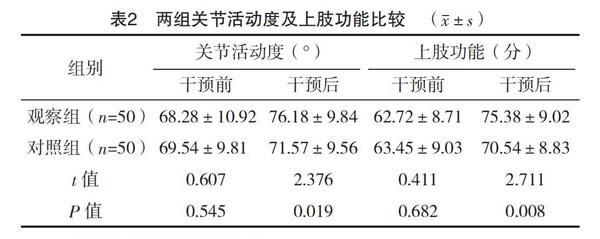
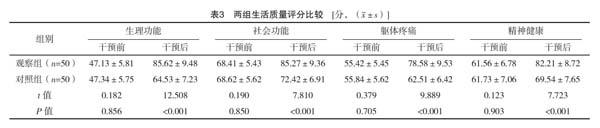
【摘要】 目的:研究早期运動联合体位护理干预对预防脑卒中后肩手综合征(SHS)的效果。方法:选取2017年1月-2019年1月于笔者所在医院治疗的卒中后偏瘫患者100例,按简单随机化法分为观察组(50例)和对照组(50例)。对照组采用常规护理,观察组在对照组的基础上采用早期运动和体位护理干预。比较两组关节疼痛、肿胀、活动度、上肢功能及生活质量的情况。结果:干预后,观察组疼痛评分及肿胀程度均小于对照组,差异有统计学意义(P<0.05);观察组关节活动度及上肢功能评分均大于对照组,差异有统计学意义(P<0.05);观察组生活质量(生理功能、社会功能、躯体疼痛、精神健康)评分高于对照组,差异有统计学意义(P<0.05)。结论:早期运动和体位护理干预能有效改善卒中后偏瘫患者的关节疼痛及肿胀程度,能有效提高患者的关节活动度和上肢功能,预防SHS的发生,提高患者的生活质量。
【关键词】 肩手综合征 脑卒中 疼痛 关节活动度 护理干预
doi:10.14033/j.cnki.cfmr.2020.20.032 文献标识码 B 文章编号 1674-6805(2020)20-00-03
Effect of Early Exercise and Posture Nursing Intervention on Prevention of SHS after Stroke/CHI Jinmei, LIN Huying, HUANG Huilan. //Chinese and Foreign Medical Research, 2020, 18(20): -83
[Abstract] Objective: To study the effect of early exercise and posture nursing intervention on prevention of shoulder hand syndrome (SHS) after stroke. Method: From January 2017 to January 2019, 100 patients with after-stroke hemiplegia were selected and divided into the observation group (50 cases) and the control group (50 cases) according to simple randomized method. Routine nursing was used in the control group, and early exercise and posture nursing intervention were used in the observation group on the basis of the control group. The joint pain, swelling, mobility, upper limb function and quality of life of the two groups were compared. Result: After intervention, the pain score and swelling degree of the observation group were lower than those of the control group, the differences were statistically significant (P<0.05), the joint mobility and upper limb function score of the observation group were higher than those of the control group, the differences were statistically significant (P<0.05), the quality of life score of the observation group was higher than that of the control group, the difference was statistically significant (P<0.05). Conclusion: Early exercise and posture nursing intervention can effectively improve the degree of joint pain and joint swelling of hemiplegic patients after stroke, improve the degree of joint mobility and upper limb function of patients, prevent the occurrence of SHS, and improve the quality of life of patients.
[Key words] Shoulder hand syndrome Stroke Pain Joint mobility Nursing intervention
First-authors address: Gaozhou Peoples Hospital, Gaozhou 525200, China
肩手综合征(SHS)为临床上卒中后偏瘫常见的并发症,患者主要有肩关节活动受限和疼痛等表现,对肢体功能恢复造成一定影响,严重可引起肩部及手畸形,严重影响患者的生活质量[1],故早期预防SHS对促进患者康复十分重要。但临床常规护理重视度不够,且患者缺乏患肢的主动运动,故对患肢疼痛、活动度等改善效果欠佳,对患者生活质量改善效果不大[1]。而早期运动和体位干预可通过体位摆放和促进患者主被动运动等提高肩关节活动度。同时通过制作预防肩手综合征的宣教视频,使患者及其家属能更加直观地认识到肩手综合征的危害,并了解相关预防措施。其在常规护理的基础上可以进一步改善患者的关节疼痛、提高患者关节活动度等[2]。故本文研究了早期运动联合体位护理干预对预防脑卒中后SHS的效果,具体如下。……