家庭护理干预对宫颈癌患者负性情绪和生活质量的影响
2019-04-21宋志群
宋志群
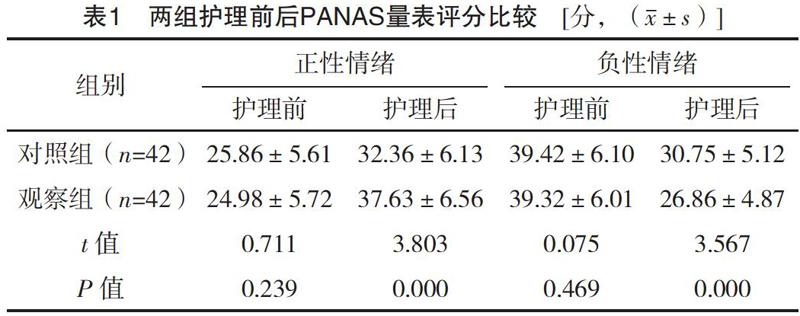
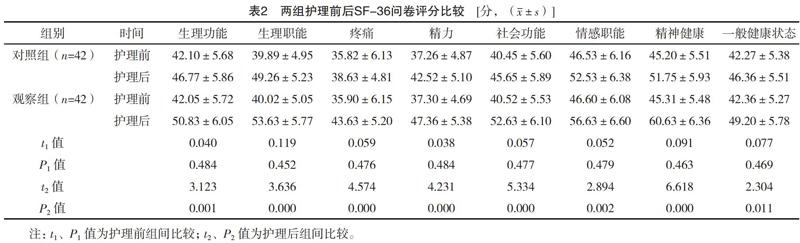
【摘要】 目的:探究与观察家庭护理干预对宫颈癌患者负性情绪和生活质量的影响程度。方法:选取2016年7月-2018年6月笔者所在医院收治的84例宫颈癌患者为研究对象,根据随机数字表法分为对照组(常规宫颈癌护理)42例和观察组(家庭护理干预)42例。比较两组护理前后PANAS量表及SF-36问卷评分。结果:护理前两组PANAS量表及SF-36问卷评分比较差异无统计学意义(P>0.05),护理后观察组上述量表评分均优于对照组,差异均有统计学意义(P<0.05)。结论:家庭护理干预对宫颈癌患者负性情绪和生活质量的影响相对较好,在宫颈癌患者中的应用价值较高。
【关键词】 家庭护理干预 宫颈癌 负性情绪 生活质量
doi:10.14033/j.cnki.cfmr.2019.30.048 文献标识码 B 文章编号 1674-6805(2019)30-0-03
[Abstract] Objective: To investigate and observe the influence degree of family nursing intervention for the negative emotions and life quality of patients with cervical cancer. Method: A total of 84 patients with cervical cancer from July 2016 to June 2018 were selected for the study, and they were divided into the control group (routine nursing of cervical cancer) and the observation group (family nursing intervention) by the method of random number table, with 42 cases each group. Then the PANAS scale and SF-36 questionnaire of two groups before and after the nursing were compared. Result: There was no significant difference in the scores of PANAS scale and SF-36 questionnaire between the two groups before nursing (P>0.05). After nursing, the scores of the above scale in the observation group were better than those in the control group, and the differences were statistically significant (P<0.05). Conclusion: The influence of family nursing intervention for the negative emotions and life quality of patients with cervical cancer are relatively better, so its application value in the patients with cervical cancer is higher.
[Key words] Family nursing intervention Cervical cancer Negative emotions Life quality
First-authors address: First Peoples Hospital of Yancheng, Yancheng 224000, China
宮颈癌是女性发病率较高的一类恶性肿瘤,而本病患者采用放疗及化疗治疗较多,由此导致的机体不适感突出,加之疾病本身的不适感及恶性疾病的性质等因素,患者的负性情绪表达突出,生活质量也相对较差,因此对宫颈癌患者进行上述方面的改善需求较高[1-2]。本研究就家庭护理干预对宫颈癌患者负性情绪和生活质量的影响程度进行探究与观察,结果总结如下。
1 资料与方法
1.1 一般资料
选取2016年7月-2018年6月笔者所在医院收治的84例宫颈癌患者为研究对象。纳入标准:年龄20~65岁;符合宫颈癌诊断标准;初次入院接受治疗。排除标准:文盲;合并慢性基础疾病;精神异常。根据随机数字表法分为对照组(常规宫颈癌护理)42例和观察组(家庭护理干预)42例。对照组年龄30~63岁,平均(46.6±8.0)岁;分期:Ⅰ期4例,Ⅱ期12例,Ⅲ期18例,Ⅳ期8例;文化程度:小学2例,初中15例,中专15例,高中及以上者10例。观察组年龄31~64岁,平均(46.8±8.1)岁;分期:Ⅰ期4例,Ⅱ期11例,Ⅲ期18例,Ⅳ期9例;文化程度:小学3例,初中15例,中专14例,高中及以上者10例。两组……
