蒙特利尔认知评估在轻度认知障碍转化随访研究中的应用
2019-04-21赵梅珍徐晓云张蔚金磊冯春花
赵梅珍 徐晓云 张蔚 金磊 冯春花

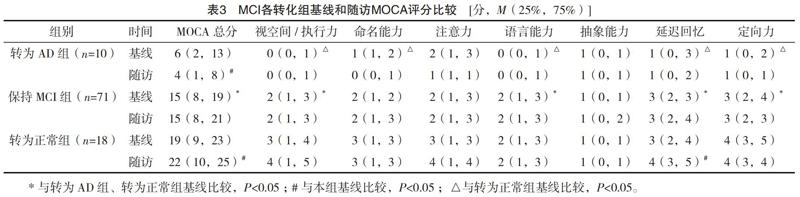
【摘要】 目的:蒙特利爾认知评估在轻度认知障碍(MCI)转化随访研究中的应用。方法:选择2012年10月-2015年10月到笔者所在医院记忆门诊就诊的184例患者为研究对象,进行认知功能评估(MOCA)和临床资料收集,平均随访(2.70±0.80)年。根据纳入标准分为MCI组(99例)、正常组(30例)和AD组(55例),采用MOCA评估比较MCI转化的神经心理学变化特征。结果:MCI组随访MOCA总分较基线增加,AD组随访延迟回忆评分较基线增加,差异均有统计学意义(P<0.05)。MCI组有10例转化为AD,18例逆转为正常,71例保持MCI状态。转为AD组基线MOCA总分低于保持MCI组,保持MCI组基线MOCA总分低于转为正常组,差异均有统计学意义(P<0.05)。转为AD组基线视空间/执行力、延迟回忆、语言能力、定向力评分均低于保持MCI组,差异均有统计学意义(P<0.05);转为AD组基线视空间/执行力、命名能力、延迟回忆、语言能力、定向力评分均低于转为正常组,差异均有统计学意义(P<0.05)。转为AD组随访MOCA总分较基线下降,转为正常组随访MOCA总分较基线增加,差异均有统计学意义(P<0.05)。转为正常组随访延迟回忆评分较基线增加,差异有统计学意义(P<0.05)。保持MCI组和转为正常组随访MOCA各分项评分、基线MOCA各分项评分比较,差异均无统计学意义(P>0.05)。结论:MCI早期阶段的总体认知功能可发生好转甚至逆转为正常。视空间/执行力、延迟回忆、语言能力、定向力基线MOCA评分较低可以预测MCI转化为AD。MCOA作为MCI随访研究工具有一定预测作用。
【关键词】 轻度认知功能障碍 蒙特利尔认知评估 阿尔茨海默病 神经心理学
doi:10.14033/j.cnki.cfmr.2019.30.079 文献标识码 B 文章编号 1674-6805(2019)30-0-03
[Abstract] Objective: To study the application of Montreal cognitive assessment in follow-up study of mild cognitive impairment conversion. Method: A total of 184 patients who visited the memory clinic of the authors hospital from October 2012 to October 2015 were selected as subjects for the study. All patients underwent cognitive function assessment (MOCA) and clinical data collection. The average follow-up time was (2.70±0.80) years. According to the inclusion criteria, patients were divied into the MCI group (99 cases), the normal group (30 cases) and the AD group (55 cases). The neuropsychological characteristics of MCI conversion were evaluate by MOCA. Result: The total score of MOCA at follow-up in the MCI group was higher than that of baseline, and the delayed recall score at follow-up in the AD group was higher than that of baseline, and the differences were statistically significant (P<0.05). In the MCI group, 10 cases converted to AD, 18 cases reversed to normal, and 71 cases maintained MCI status. The total score of MOCA at baseline in the conversion AD group was lower than that of the maintenance MCI group, and the total score of MOCA at baseline in the maintenance MCI group was lower than that of the conversion normal group, and the differences were statistically significant (P<0.05). Visuospatial/executive, delayed recall, language ability, and orientation scores at baseline in the conversion AD group were all lower than those of the maintenance MCI group, and the differences were statistically significant (P<0.05). Visuospatial/executive ability, naming ability, delayed recall, language ability and orientation scores at baseline in the conversion AD group were all lower than those of the conversion normal group, and the differences were statistically significant (P<0.05). The total score of MOCA at follow-up in the conversion AD group was lower than that of baseline, and the total score of MOCA at follow-up in the conversion normal group was higher than that of baseline, and the differences were statistically significant (P<0.05). Delayed recall score at follow-up in the conversion normal group was higher than that of baseline, and the difference was statistically significant (P<0.05). Subscore of MOCA at follow-up and subscore of MOCA at baseline were compared between the maintenance MCI group and the conversion normal group, and the differences were not statistically significant (P>0.05). Conclusion: In the early stage of MCI, the general cognitive function can improve or even reverse to normal. Low scores of visuospatial/executive ability, delayed recall, language ability, and orientation at baseline can predict MCI converte to AD. MCOA as a follow-up study tool of MCI has a certain predictive effect.
[Key words] Mild cognitive impairment Montreal cognitive assessment Alzheimer disease Neuropsychology
First-authors address: Zhoupu Hospital in Pudong New Area of Shanghai, Shanghai 201318, China
轻度认知功能障碍(mild cognitive impairment,MCI)是一种介于正常衰老与痴呆间的过渡状态,此阶段的老年人存在主观或客观上的认知功能障碍[1]。因此,作为痴呆的前驱症状,此阶段是痴呆早期预防的可行阶段。目前,蒙特利尔认知评估(MoCA)弥补了简易智能精神状态检查量表(MMSE)的缺陷,可用于筛查MCI和轻度AD,应用范围较广,适合于多种认知障碍的评价[2-3]。
1 资料与方法
1.1 一般资料
(1)AD纳入标准:按照美国精神病学会的精神障碍诊断、统计手册第四修订版(DSM-IV)标准、美国国立神经及交流疾病研究所及AD相关疾病协会(NINCDS-ADRDA)制定的“很可能的AD”诊断标准,患者出现记忆力下降、失语、失用、失认症及执行力障碍等认知能力退化表现中至少1项;社会角色功能或职业能力减退;认知能力呈现进行性减退。……
