培门冬酶与左旋门冬酰胺酶对急性淋巴细胞白血病患者凝血功能的影响
2019-04-21朱平欣泉廖欣熊慕珺梁禹环
朱平 欣泉 廖欣 熊慕珺 梁禹环

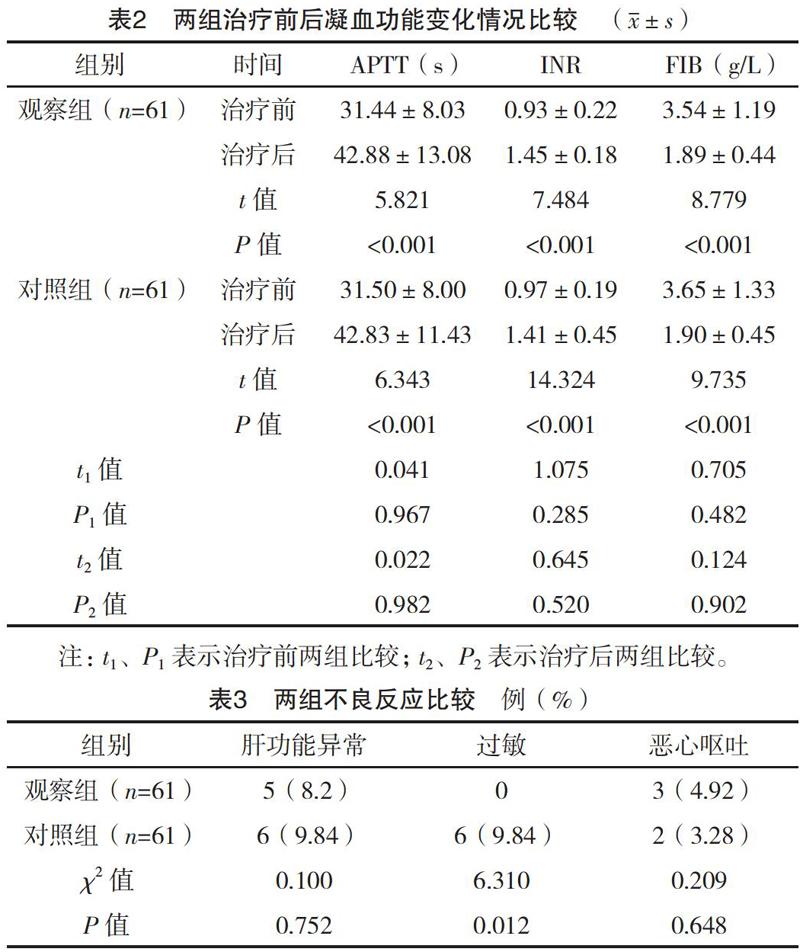
【摘要】 目的:探究培门冬酶与左旋门冬酰胺酶治疗急性淋巴细胞白血病患者的临床效果,并观察对患者凝血功能的影响。方法:选取笔者所在医院2014年7月-2018年7月收治的122例急性淋巴细胞白血病患者为研究对象,按照不同的治疗方法分为观察组及对照组,每组61例。对照组行左旋门冬酰胺酶治疗,观察组行培门冬酶治疗。观察两组临床疗效、不良反应发生率及凝血功能的变化情况。结果:观察组总有效率为98.36%,高于对照组的96.72%,差异无统计学意义(字2=0.342,P>0.05)。观察组治疗后APTT为(42.88±13.08)s,高于对照组的(42.83±11.43)s,差异无统计学意义(P>0.05);观察组治疗后INR为(1.45±0.18),高于对照组的(1.41±0.45),差异无统计学意义(P>0.05);观察组治疗后FIB为(1.89±0.44)g/L,低于对照组的(1.90±0.45)g/L,差異无统计学意义(P>0.05)。观察组肝功能异常发生率低于对照组,恶心呕吐发生率高于对照组,差异均无统计学意义(P>0.05);观察组无过敏,显著低于对照组的9.84%,差异有统计学意义(字2=6.310,P<0.05)。结论:培门冬酶与左旋门冬酰胺酶治疗急性淋巴细胞白血病均可取得较好的效果,两种药物均能延长APTT,升高INR,降低FIB,但左旋门冬酰胺酶易引发过敏症状,患者对培门冬酶的耐受性较高,安全可靠。
【关键词】 培门冬酶 左旋门冬酰胺酶 急性淋巴细胞白血病 凝血功能
doi:10.14033/j.cnki.cfmr.2019.30.013 文献标识码 B 文章编号 1674-6805(2019)30-00-03
[Abstract] Objective: To investigate the clinical effect of Pegaspargase and L-asparaginase in the treatment of patients with acute lymphoblastic leukemia and to observe the effect on the coagulation function of patients. Method: From July 2014 to July 2018, 122 patients with acute lymphoblastic leukemia admitted to the authors hospital were selected as the study subjects. Patients were divided into the observation group and the control group according to different treatment methods, with 61 cases in each group. The control group was treated with L-asparaginase and the observation group was treated with Pegaspargase. The clinical efficacy, incidence of adverse reactions and changes of coagulation function were observed between the two groups. Result: The total effective rate of the observation group was 98.36%, which was higher than 96.72% of the control group, and the difference was not statistically significant (字2=0.342, P>0.05). After treatment, APTT in the observation group was (42.88±13.08) s, which was higher than (42.83±11.43) s of the control group, and the difference was not statistically significant (P>0.05). After treatment, INR in the observation group was (1.45±0.18), which was higher than (1.41±0.45) of the control group, and the difference was not statistically significant (P>0.05). After treatment, FIB in the observation group was (1.89±0.44) g/L, which was lower than (1.90±0.45) g/L of the control group, and the difference was not statistically significant (P>0.05). The incidence of abnormal liver function in the observation group was lower than that of the control group, and the incidence of nausea and vomiting in the observation group was higher than that of the control group, and the differences were not statistically significant (P>0.05). There was no allergy in the observation group, which was significantly lower than 9.84% of the control group, and the difference was statistically significant (字2=6.310, P<0.05). Conclusion: Both Pegaspargase and L-asparaginase can achieve good effect in the treatment of acute lymphoblastic leukemia. Both drugs can prolong APTT, increase INR, and reduce FIB, but L-asparaginase is easy to cause allergic symptoms. Patients have a high tolerance to Pegaspargase, which is safe and reliable.
[Key words] Pegaspargase L-asparaginase Acute lymphoblastic leukemia Coagulation function
First-authors address: Chenzhou First Peoples Hospital, Chenzhou 423000, China
急性淋巴细胞白血病(acute lymphoblastic leukemia,ALL)为一种异质性疾病,临床表现为贫血、发热与感染、出血及器官组织浸润等[1]。ALL发病率较高,随着现代医疗水平的进步,ALL的缓解率可达74%~93%,但治愈率不到50%,整体疗效欠佳[2]。左旋门冬酰胺酶可在ALL诱导缓解及巩固治疗阶段起到重要的作用,但在治疗过程中,患者易出现过敏等不良反应[3]。有学者指出,培门冬酶治疗ALL具有较好的临床效果,可有效降低异种蛋白的免疫原性[4]。基于此,本文选取笔者……
