芪味理肺汤方剂与糖皮质激素协同治疗哮喘小鼠气道炎症的研究
2016-07-11朱唯芳顾道兰顾娟杨宇
朱唯芳 顾道兰 顾娟 杨宇
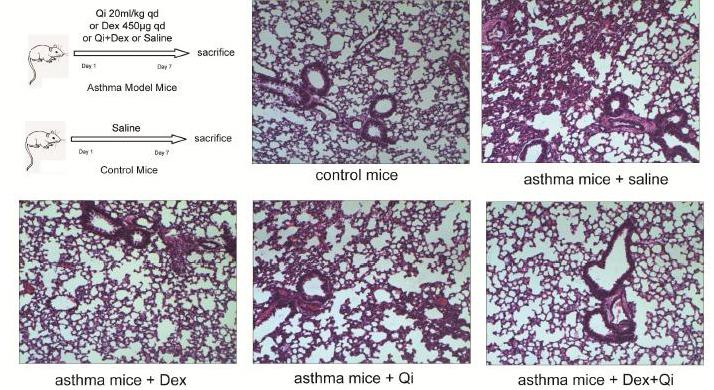
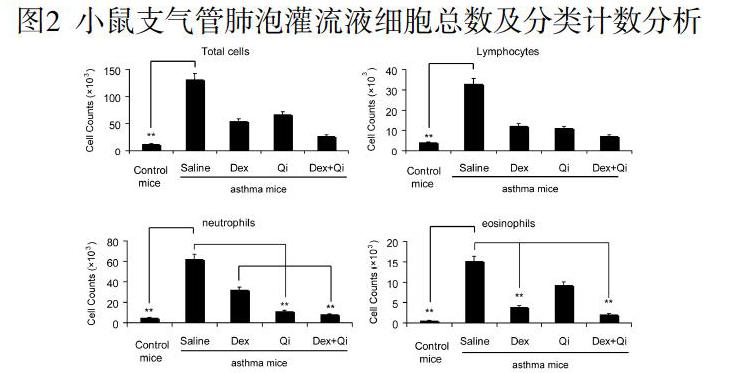
【摘要】目的:利用小鼠支气管哮喘模型探讨中药芪味理肺汤方剂(简称芪肺汤)的疗效及其与糖皮质激素联用的协同作用机制。方法:雄性BALB/c小鼠随机分组后建立支气管哮喘模型,分别采用地塞米松、芪肺汤、地塞米松+芪肺汤联用进行胃饲给药治疗,并设立相关对照组。处理1周后,通过肺组织病理染色、支气管肺泡灌洗液(BALF)细胞分类计数评价炎症治疗效果,通过ELISA检测BALF细胞因子的表达。结果:对比哮喘对照组,三个治疗组均出现肺部炎症部分减轻及BALF细胞计数的减少,其中联用组表现为中性粒细胞及嗜酸性细胞计数的共同下降。结论:芪味理肺汤方剂与糖皮质激素联合运用能协同抑制嗜酸性细胞及中性粒细胞激活,对激素非敏感哮喘治疗可能具有较大意义。
【关键词】芪味理肺汤;哮喘;气道炎症;中性粒细胞;糖皮质激素
Abstract:Objective: To investigate the synergistic therapeutic effect of Qiweileifeitang (Qi) with glucocorticoid for allergic inflammation in bronchial asthma mouse models. Methods: 50 mice were randomly divided into for 5 groups for dexamethasone or Qi or combined treatment,the pathological changes of lung tissue and cell counts in bronchoalveolar lavage fluid (BALF) were used to evaluate the therapeutic efficacy. Results: The lung pathological changes and cell counts in BALF most significantly decreased in the combined group comparing to other control groups. Conclusion: Combination of Qi and glucocorticoid may be a better strategy for glucocorticoid insensitive asthma therapy as it can both inhibit neutrophils and eosinophils activation.
Keywords:Qiweilifeitang;asthma;airway inflammation;neutrophils;glucocorticoid
【中图分类号】R4 【文献标识码】A 【文章编号】1671-8801(2016)03-0005-02
支气管哮喘(asthma,简称哮喘)形成的经典病理机制是由气道的炎性因子和炎性细胞的活化 [1]。目前研究证实,糖皮质激素可以有效地影响Th2相关的嗜酸性细胞的分化及功能,但是仍然存在部分患者对糖皮质激素治疗不敏感,影响临床疗效[2]。近期研究证实了Th17细胞及中性粒细胞相关的炎症反应在哮喘气道炎症中具有重要作用,并可能是部分哮喘患者糖皮质激素不敏感的重要机制[3]。围绕Th17细胞调控进行的哮喘治疗可能是当前糖皮质激素疗法的有益补充。芪味……