慢性乙型肝炎低病毒血症患者转阴的影响因素与治疗策略探讨
2024-06-21陶学萍李丽娇漆阳红邓勇欧书强
陶学萍 李丽娇 漆阳红 邓勇 欧书强
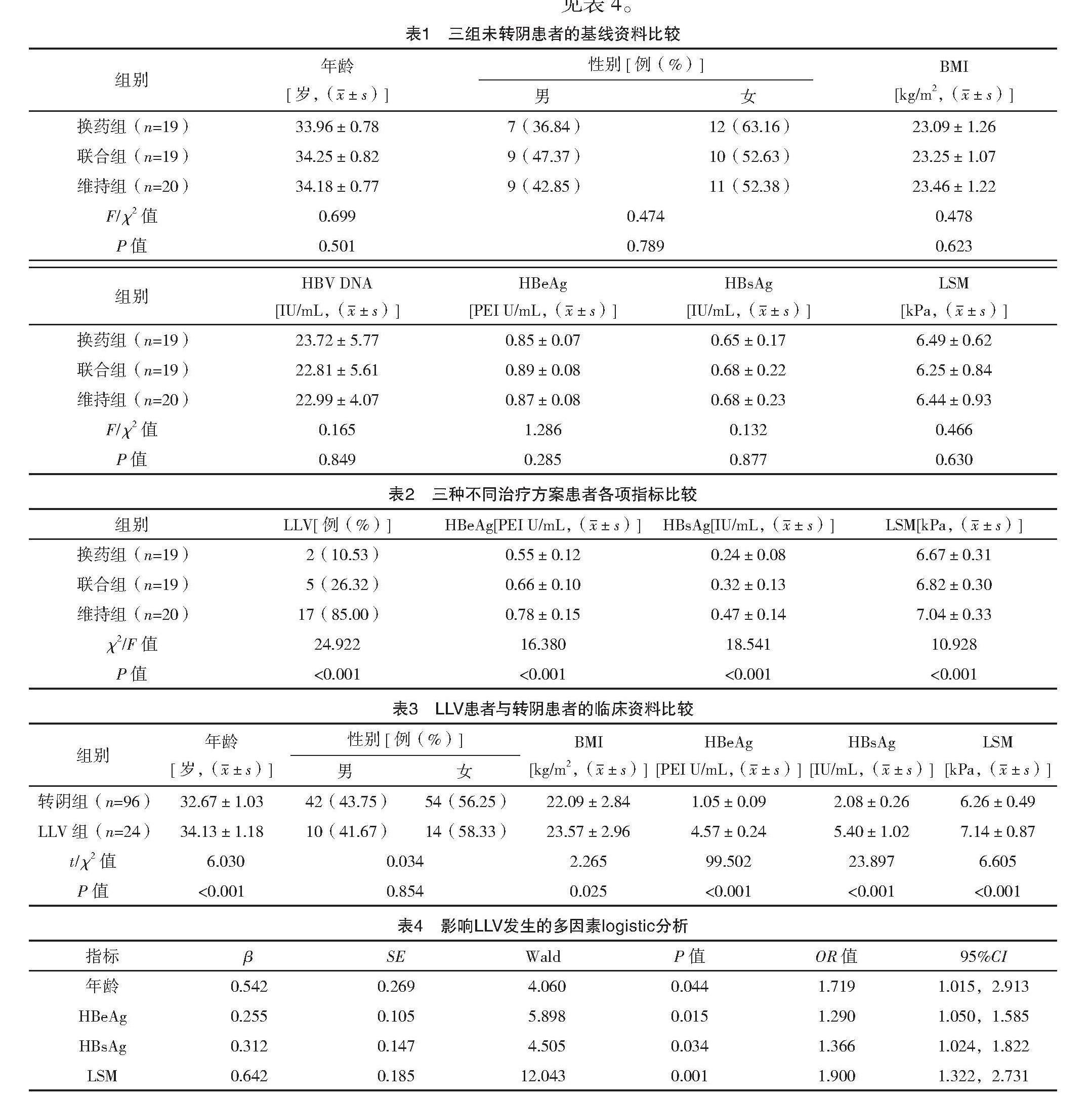
【摘要】 目的:对慢性乙型肝炎(CHB)低病毒血症患者转阴的影响因素进行分析,并对相关治疗策略进行探讨。方法:选取2019年1月—2022年1月于萍乡市第二人民医院感染科就诊的接受一线核苷(酸)类似物(NAs)药物进行抗病毒治疗的CHB患者120例为研究对象。恩替卡韦或富马酸替诺福韦二吡呋酯治疗36周后,采用随机数字表法将未转阴患者(HBV DNA≥10 IU/mL)分为联合组(n=19)、换药组(n=19)、维持组(n=20),并采用不同治疗方案治疗12周,收集三组的一般资料,比较三组LLV的发生情况、HBV DNA、乙型肝炎e抗原(HBeAg)、乙型肝炎表面抗原(HBsAg)及肝硬度值(LSM)。同时,比较转阴患者与LLV患者的临床基线资料,并采用多因素logistic回归分析影响LLV发生的因素。结果:治疗36周后,CHB患者转阴62例,转阴率为51.67%,未转阴患者58例,占比48.33%。三种不同治疗方案中,维持组的LLV发生率最高,为85.00%,其次为联合组和换药组,分别为26.32%、10.53%。三组LLV发生率、HBeAg、HBsAg、LSM比较,差异均有统计学意义(P<0.05)。多因素logistic回归分析结果显示,年龄、HBsAg、HBeAg、LSM均是影响LLV转阴的因素(P<0.05)。结论:目前临床上的一线NAs药物治疗对LLV患者的转阴率还需要进一步的提高,可通过改变治疗的药物或联合其他NAs药物来提高患者的转阴率,对于LLV患者的治疗方案还仍需要进一步的讨论和改进。
【关键词】 慢性乙型肝炎 低病毒血症 一线核苷(酸)类似物
Discussion on Influencing Factors and Treatment Strategy of Negative Conversion in Chronic Hepatitis B Patients with Low-level Viremia/TAO Xueping, LI Lijiao, QI Yanghong, DENG Yong, OU Shuqiang. //Medical Innovation of China, 2024, 21(15): -166
[Abstract] Objective: To analyze the influencing factors of negative conversion in chronic hepatitis B (CHB) patients with low-level viremia, and to discuss the related treatment strategies. Method: A total of 120 CHB patients who received antiviral therapy with first-line nucleos (t) ide analogues (NAs) drugs in Department of Infectious Disease, Pingxiang NO.2 People's Hospital from January 2019 to January 2022 were selected as the study objects. After 36 weeks of treatment with Entecavir or Tenofovir Disoproxil Fumarate, patients who did not turn negative (HBV DNA≥10 IU/mL) were divided into combination group (n=19), change drug group (n=19) and maintenance group (n=20) by random number table method, and they were treated with different treatment plans for 12 weeks. General data of the three groups were collected. The incidence of LLV, HBV DNA, hepatitis B e antigen (HBeAg), hepatitis B surface antigen (HBsAg) and liver stiffness measurement (LSM) of the three groups were compared. At the same time, the clinical baseline data of patients with negative conversion and LLV were compared. Multivariate logistic regression analysis was used to discuss the factors affecting the negative conversion of LLV. Result: After 36 weeks of treatment, 62 patients with CHB turned negative, the negative rate was 51.67%, and 58 patients did not turn negative, accounting for 48.33%. Among the three different treatment regimens, the incidence of LLV in maintenance group (85.00%) was the highest, followed by combination group (26.32%) and change drug group (10.53%). There were significant differences in the incidence of LLV, HBeAg, HBsAg and LSM among the three groups (P<0.05). Multivariate logistic regression analysis showed that age, HBsAg, HBeAg and LSM were all factors that affected the negative conversion of LLV (P<0.05). Conclusion: The current clinical first-line NAs drug therapy still needs to further improve the negative conversion rate of LLV patients, and it can be improved by changing the therapeutic drugs or combining with other NAs drugs. The treatment plan for LLV patients still needs further discussion and improvement.
[Key words] Chronic hepatitis B Low-level viremia First-line nucleos (t) ide analogues
First-author's address: Department of Infectious Disease, Pingxiang NO.2 People's Hospital, Pingxiang 337000, China
doi:10.3969/j.issn.1674-4985.2024.15.038
慢性乙型肝炎(chronic hepatitis B,CHB)是患者感染乙型肝炎病毒(hepatitis B virus,HBV)而引起的肝脏疾病,是我国常见的慢性传染病之一,其主要通过性、母婴、血液和体液等途径传播[1]。CHB是肝纤维化、肝癌、肝硬化等肝脏疾病的重要诱导因素,目前临床上使用核苷(酸)类似物[nucleos(t)ide analogues,NAs]来控制患者病情的发展,缓解肝脏的进一步损伤[2]。但已有许多研究证实CHB患者NAs抗病毒治疗过程中,存在着低病毒血症(low-level viremia,LLV),且LLV与多种临床不良结局有关[3]。目前国内外关于LLV的相关定义暂无统一标准,国内专……