肌内效贴技术结合电针治疗脑卒中后肩手综合征Ⅰ、Ⅱ期的临床疗效观察
2021-07-27游莹乔潘江张泓李里
游莹乔 潘江 张泓 李里
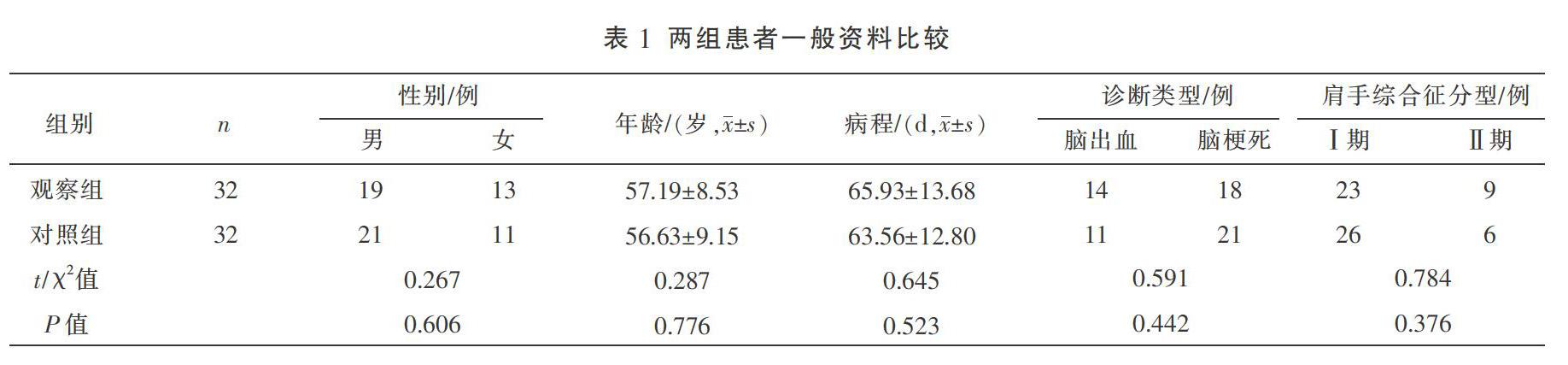
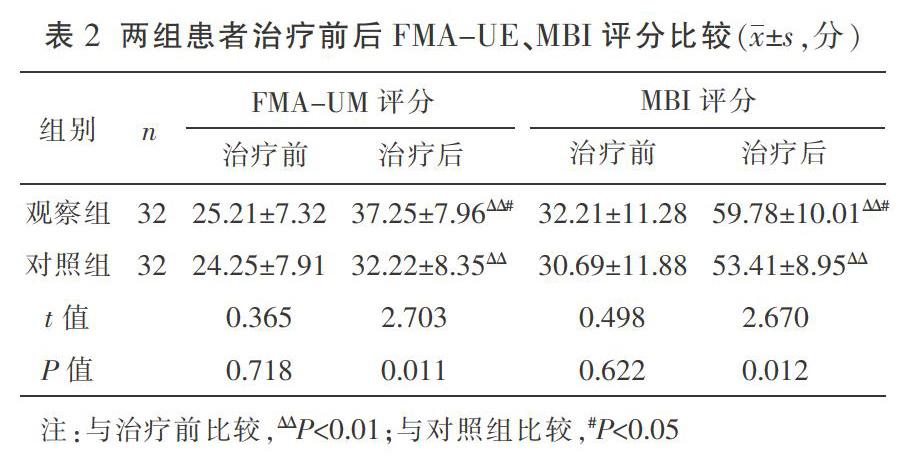
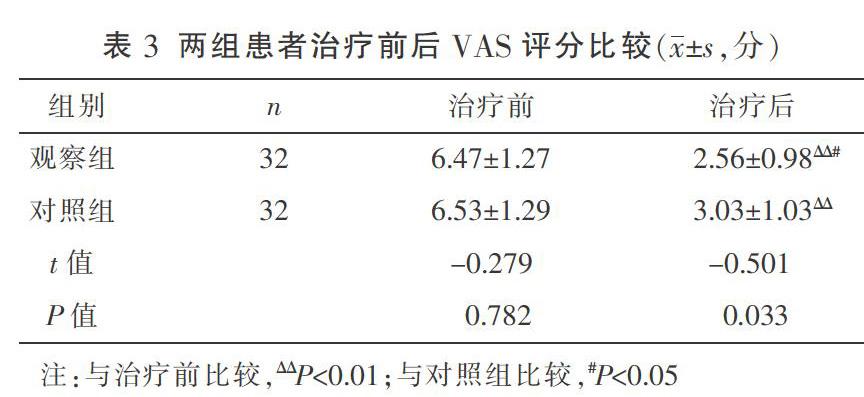
〔摘要〕 目的 觀察肌内效贴技术结合电针治疗脑卒中后肩手综合征Ⅰ、Ⅱ期的临床疗效。方法 选择64例脑卒中后肩手综合征Ⅰ、Ⅱ期的患者,随机分为观察组和对照组,每组32例,两组患者均给予常规药物及康复治疗,对照组采用电针治疗,观察组在对照组的基础上结合肌内效贴技术治疗。治疗前后比较两组患者的上肢运动功能(fugl-meyer assessment upper extremity, FMA-UE)、关节被动活动范围(passive range of motion, PROM)、疼痛视觉模拟评分(visual analogue scale, VAS)、水肿程度、改良Barthel指数(modified barthel index, MBI)。结果 治疗后,两组患者的FMA-UE、PROM、MBI评分较治疗前均明显提高(P<0.01),VAS和水肿程度评分较治疗前明显降低(P<0.01);且观察组FMA-UE、PROM、MBI评分高于对照组(P<0.05),VAS和水肿程度评分低于对照组(P<0.05)。两组患者的总有效率比较差异无统计学意义(P>0.05),但观察组愈显率明显优于对照组(P<0.01)。结论 肌内效贴技术结合电针治疗能有效改善脑卒中后肩手综合征Ⅰ、Ⅱ期患者的上肢功能,减轻疼痛与水肿,提高日常生活能力。
〔关键词〕 脑卒中;肩手综合征;肌内效贴;电针
〔中图分类号〕R245.9 〔文献标志码〕B 〔文章编号〕doi:10.3969/j.issn.1674-070X.2021.03.011
〔Abstract〕 Objective To observe the effect of kinesio technique combined with electroacupuncture in the treatment of stage I and II of shoulder-hand syndrome after stroke. Methods 64 patients with stage I and II of shoulder-hand syndrome after stroke were randomly divided into the observation group and the control group, 32 cases in each group, both groups were given routine drugs and rehabilitation treatment, the control group was treated with electroacupuncture, the observation group was treated with kinesio technique on the basis of the control group. The upper limb fug1-meyer motor function (FMA-UE), passive range of motion (PROM), pain visual analogue score (VAS), degree of edema and modified barthel index (MBI) were compared between the two groups before and after treatment. Results After treatment, the scores of FMA-UE, PROM and MBI of the two groups were significantly improved before treatment (P<0.01), and the scores of VAS and edema degree were significantly decreased before treatment (P<0.01); the scores of FMA-UE, PROM and MBI of the observation group were higher than those of the control group (P<0.05), and the scores of VAS and edema degree were lower than those of the control group (P<0.05). There was no significant difference in the total effective rate between the two groups (P>0.05), but the effective rate of the observation group was significantly better than that of the control group (P<0.01). Conclusion Kinesio technique combined with electroacupuncture can effectively improve the upper limb function of patients with stage I and II of shoulder-hand syndrome after stroke, relieve pain and edema, and improve daily life ability.
〔Keywords〕 stroke; shoulder-hand syndrome; kinesio; electroacupuncture
肩手综合征(shoulder hand syndrome, SHS)又称反射性交感神经营养不良(reflex sympathetic dystrophy, RSD),是脑卒中后常见的并发症之一,多在脑卒中后1~3个月内发生[1]。其临床症状主要表现为肩痛、手腕部肿痛、皮温增高、上肢各关节活动受限并且活动时疼痛加剧,严重者后期关节变形、肌肉萎缩,严重影响患者的上肢功能、日常生活能力和生活质量。由于脑卒中后SHS病因、发病机制尚未明确,目前临床上主要以对症治疗为主,提倡早期发现、早期诊断,并进行积极治疗[2]。目前,常用的治疗方法有西药治疗、物理治疗、康复治疗、中药治疗、针灸治疗、封闭疗法、神经阻滞及神经切除术等,其中,采用电针联合康复疗法具有独特的优势[3]。本研究采用肌内效贴技术结合电针治疗脑卒中后肩手综合征Ⅰ、Ⅱ期的方法,临床效果显著,现报道如下。
1 资料与方法