全髋关节置换术后不同时间开始康复训练对Harris评分的影响
2021-07-05刘瑾荣悦彤赵云
刘瑾 荣悦彤 赵云
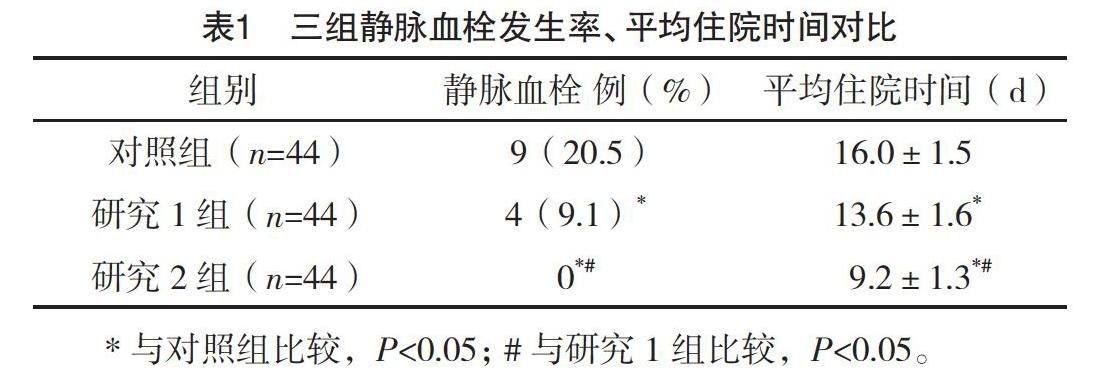


【摘要】 目的:探討全髋关节置换术后不同时间开始康复训练对Harris评分的影响。方法:选取2018年3月-2020年3月收治的行全髋关节置换术的132例患者,按术后不同时间开始康复训练分为对照组、研究1组和研究2组,各44例。三组均按统一程度开展康复训练,对照组术后第10天开始康复训练,研究1组术后第3天开始康复训练,研究2组术后第1天开始康复训练。比较三组死亡率、静脉血栓发生率、平均住院时间、康复训练完成情况、生活质量和不同时间点的Harris评分。结果:研究组1组、研究2组的静脉血栓发生率、平均住院时间均优于对照组(P<0.05),研究2组的静脉血栓发生率、平均住院时间均优于研究1组(P<0.05)。三组康复训练完成进度比较,差异无统计学意义(P>0.05)。康复训练1个月时,研究1组、研究2组Harris评分均高于对照组(P<0.05),研究组1组和研究2组的Harris评分对比,差异无统计学意义(P>0.05);康复训练3个月时,对照组与研究1组的Harris评分对比,差异无统计学意义(P>0.05),研究2组的Harris评分高于对照组、研究1组(P<0.05)。康复训练6个月时,三组的Harris评分对比,差异无统计学意义(P>0.05);康复训练6个月时,研究组1组、研究2组的社会关系、心理领域、生理领域评分均高于对照组(P<0.05),且研究组2组的社会关系、心理领域、生理领域评分均高于研究1组(P<0.05)。结论:与术后第10天开始康复训练相比,术后第1天和第3天开始康复训练的效果更好,早期进行康复训练能有效缩短全髋关节置换术患者的住院时间,降低发生静脉血栓风险,提高患者髋关节康复程度,改善生活质量,可根据患者的具体情况,在确保患者生命体征平稳的前提下,为患者选择术后第1天或第3天开始锻炼。
【关键词】 生活质量 髋关节功能 康复训练 全髋关节置换术 下肢静脉血栓
Effect of Rehabilitation Training at Different Times after Total Hip Arthroplasty on Harris Score/LIU Jin, RONG Yuetong, ZHAO Yun. //Medical Innovation of China, 2021, 18(14): 0-075
[Abstract] Objective: To investigate the effect of rehabilitation training at different time on Harris score after total hip arthroplasty. Method: A total of 132 patients who underwent total hip arthroplasty from March 2018 to March 2020 were selected, they were divided into control group, study group 1 and study group 2, with 44 patients in each group, according to the rehabilitation training at different time after surgery. The three groups were all carried out rehabilitation training according to a unified degree. The control group started rehabilitation training on the 10th day after surgery, the study group 1 started rehabilitation training on the 3rd day after surgery, and the study group 2 started rehabilitation training on the 1st day after surgery. Mortality rate, incidence rate of venous thrombosis, average length of hospital stay, completion of rehabilitation training, quality of life and Harris score at different time points were compared among the three groups. Result: The incidence of venous thrombosis and average length of hospital stay in study group 1 and study group 2 were better than those in control group (P<0.05), and the incidence of venous thrombosis and average length of hospital stay in study group 2 were better than those in study group 1 (P<0.05). There was no statistical significance in the progress of rehabilitation training among the three groups (P>0.05). After 1 month of rehabilitation training, Harris scores in study group 1 and study group 2 were higher than that in control group (P<0.05), while Harris scores in study group 1 and study group 2 showed no statistical significance (P>0.05); after 3 months of rehabilitation training, there was no statistically significant difference in Harris score between the control group and study group 1 (P>0.05), but Harris score in study group 2 was higher than those in the control group and study group 1 (P<0.05). After 6 months of rehabilitation training, there was no significant difference in Harris scores among the three groups (P>0.05). After 6 months of rehabilitation training, the scores of social relationship, psychological field and physiological field in study group 1 and study group 2 were higher than those in control group (P<0.05), and the scores of social relationship, psychological field and physiological field in study group 2 were higher than those in study group 1 (P<0.05). Conclusion: Compared with the postoperative day 10 start rehabilitation training, postoperative 1 and 3 days begin to better the effect of rehabilitation training, early rehabilitation training can effectively shorten the hospitalization time of patients with total hip replacement and reduce risk of venous thrombosis, increase the degree of hip joint in patients with rehabilitation, to improve the quality of life, according to the specific circumstances of patients, on the premise of ensuring stable vital signs of patients, exercise is selected for patients on the first or third day after surgery.
[Key words] Quality of life Hip function Rehabilitation training Total hip arthroplasty Lower extremity venous thrombosis
First-authors address: Hongqi Hospital Affiliated to Mudanjiang Medical University, Mudanjiang 157011, China
doi:10.3969/j.issn.1674-4985.2021.14.018
全髖关节置换术对于最大程度恢复和保留关节功能、纠正关节畸形、消除终末期关节疼痛,具有其他任何方法无可比拟的优越性,是目前关节成形术中最为成功的外科技术[1-2]。与手术的推广、成功相比,术后的康复无论在推广中还是效果上都略逊一筹。全髋关节置换术后,髋关节功能能否恢复的关键与积极有效的早期康复训练有着紧密相关,有效的康复训练能够减少术后并发症的发生,帮助患者早期下床活动,因此,术后康复训练在临床也越来越被重视,相关研究也越来越多,康复训练方法也逐渐趋于完善[3-4]。但术……