响应面法优化小龙虾超声波辅助腌制工艺
2021-06-15孔金花葛庆丰诸永志卞欢闫征徐为民王德宝
孔金花 葛庆丰 诸永志 卞欢 闫征 徐为民 王德宝

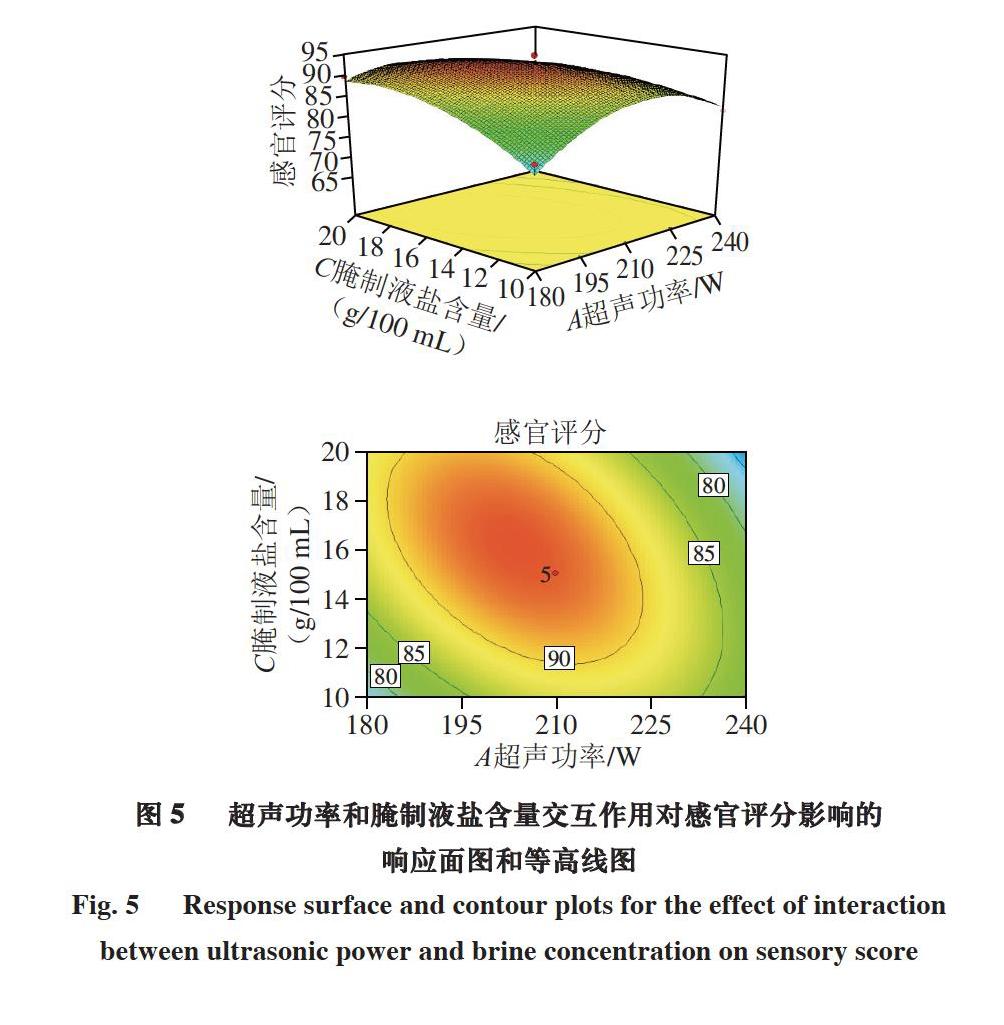
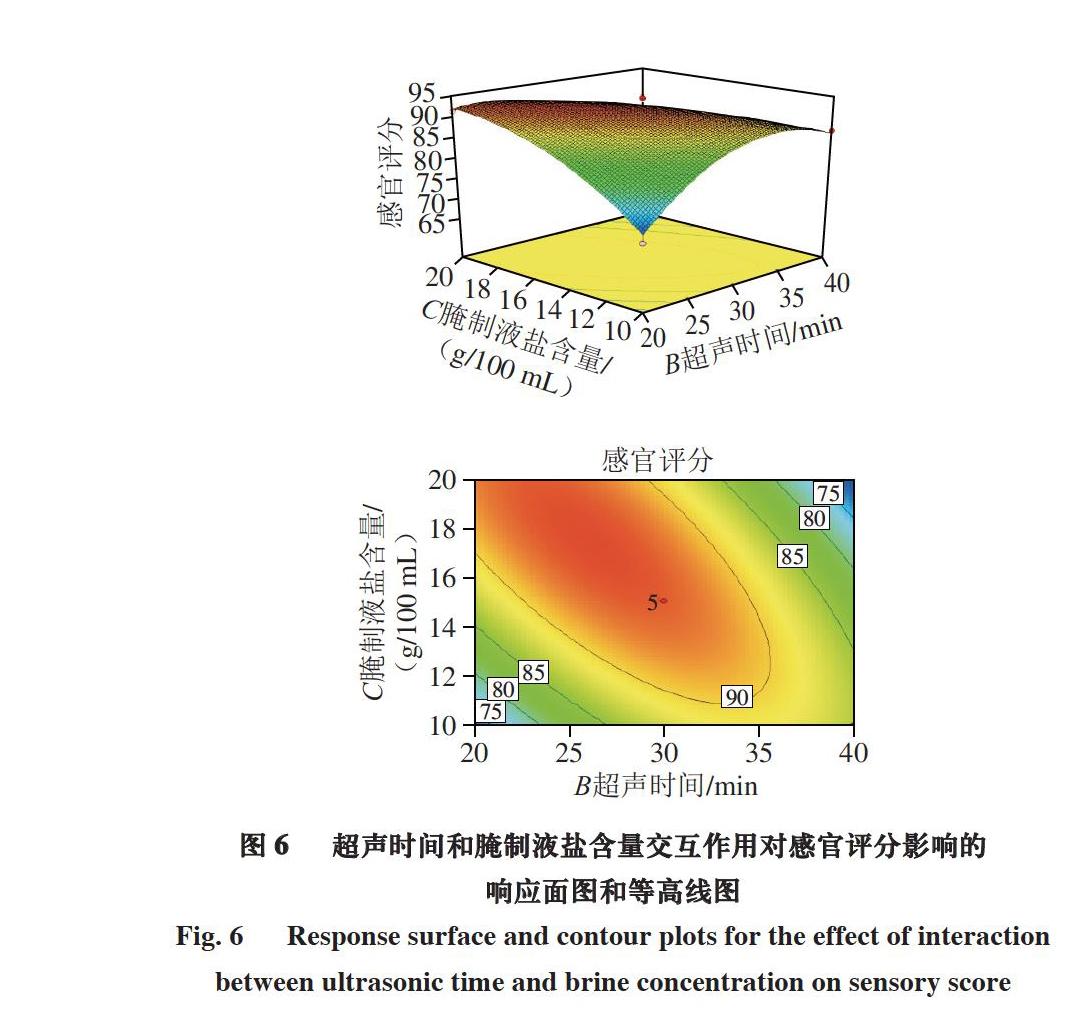
摘 要:以小龙虾为研究对象,探讨超声波辅助腌制小龙虾的加工工艺。以超声功率、超声时间、腌制液盐含量为单因素影响因子,小龙虾的感官评分和氯化钠含量为响应值,进行响应面优化分析。结果表明,经优化后的小龙虾腌制条件为超声功率210 W、超声时间30 min、腌制液含盐量17 g/100 mL,在此工艺条件下小龙虾的感官评分为91.2 分,氯化钠含量为0.82%,与预测值接近,表明该腌制工艺合理有效。
关键词:小龙虾;超声波;腌制;响应面;工艺优化
Optimization of Ultrasonic-Assisted Salting Conditions for Crayfish by Response Surface Methodology
KONG Jinhua1,2, GE Qingfeng1,*, ZHU Yongzhi2, BIAN Huan2, YAN Zheng2, XU Weimin2, WANG Debao2
(1.College of Food Science and Engineering, Yangzhou University, Yangzhou 225127, China; 2.Institute of Agricultural Products Processing, Jiangsu Academy of Agricultural Sciences, Nanjing 210014, China)
Abstract: In this study, we optimized the ultrasonic-assisted salting process of crayfish using response surface methodology (RSM). Ultrasonic power, ultrasonic time, and brine concentration were taken as independent variables, and sensory evaluation score and salt content of cured crayfish as response variables. The results showed that the optimized conditions were as follows: 210W ultrasonic power, 30 min ultrasonic time, and 17 g/100 mL brine concentration. Cured crayfish prepared under these conditions scored 91.2 in overall sensory evaluation, and its sodium chloride content was 0.82%, which were both close to the predicted values, indicating that the curing process was reasonable and valid.
Keywords: crayfish; ultrasonic; salting; response surface methodology; process optimization
DOI:10.7506/rlyj1001-8123-20210309-061
中圖分类号:TS254.1 文献标志码:A 文章编号:
引文格式:
孔金花, 葛庆丰, 诸永志, 等. 响应面法优化小龙虾超声波辅助腌制工艺[J]. 肉类研究, 2021, 35(3): . DOI:10.7506/rlyj1001-8123-20210309-061. http://www.rlyj.net.cn
KONG Jinhua, GE Qingfeng, ZHU Yongzhi, et al. Optimization of ultrasonic-assisted salting conditions for crayfish by response surface methodology[J]. Meat Research, 2021, 35(3): . DOI:10.7506/rlyj1001-8123-20210309-061. http://www.rlyj.net.cn
小龙虾学名克氏原螯虾(Procambarus clarkii),也称为红螯虾和淡水小龙虾,是我国重要的淡水经济虾类[1],因其风味独特,肉质鲜美且营养价值高,备受广大消费者青睐[2]。近年来,小龙虾产业发展迅猛,产量逐年增长,但是小龙虾加工仍然存在加工形式单一、加工方式落后等问题。因此,开发和研究新的小龙虾加工工艺对小龙虾产业的发展具有重要意义[3]。
腌制是肉制品加工的重要工艺,不仅能够提高保藏性,而且可以改善肉制品的风味、色泽、保水性等品质特性[4-6]。对小龙虾进行腌制是以食盐为腌制剂对其进行基础调味,不仅保持了小龙虾原有的风味,同时提高了虾肉的保水性,使肉质更有弹性[7]。但是传统的静水腌制方法存在腌制速率低、氯化钠分布不均匀等问题。且小龙虾甲壳坚硬,腌制较禽肉更不易入味,而超声波可以有效改善腌制速率等问题[8]。……
