产前二维超声及四维超声STIC技术筛查胎儿心脏畸形的价值分析
2021-05-06肖晓娟郭珍
肖晓娟 郭珍


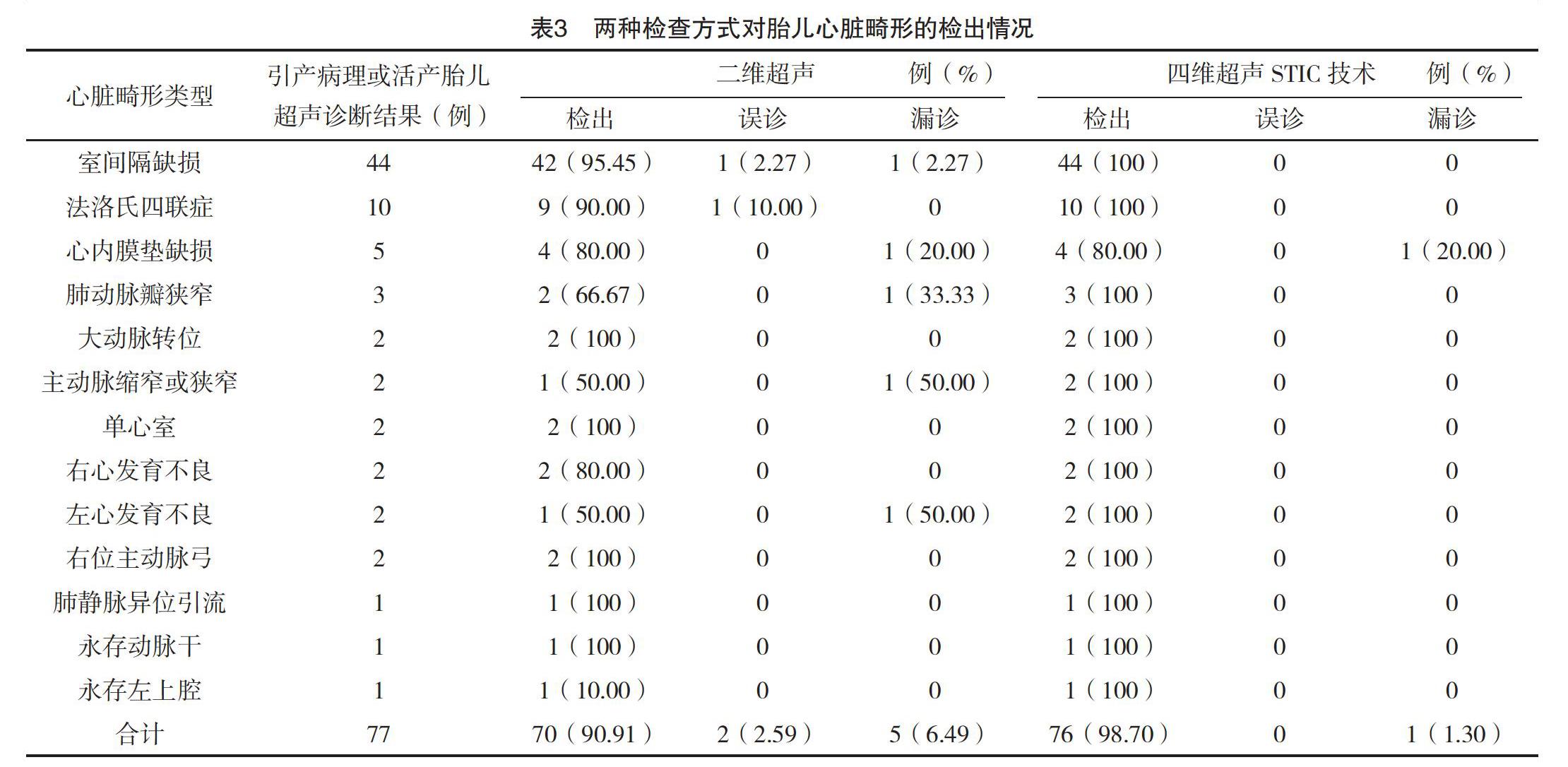
【摘要】 目的:探討产前二维超声及四维超声时间-空间关联成像(spatio-temporal image correlation,STIC)技术筛查胎儿心脏畸形的价值。方法:选择2017年2月-2019年6月就诊于本院的疑似胎儿心脏畸形孕妇84例,均行二维超声及四维超声STIC技术检查。比较两种检查方式图像采集时间、筛查时间及图像质量。以活产胎儿诊断或引产病理结果为金标准,比较两种检查方式对胎儿心脏畸形的检出情况。结果:84例疑似孕妇中为胎儿心脏畸形者77例(91.67%);四维超声STIC技术图像采集时间和筛查时间均短于二维超声(P<0.05)。四维超声STIC技术对右心室流出道、五腔心、左心室流出道、主动脉弓、三血管气管、腔静脉长轴、动脉导管弓及四腔心的显示率高于二维超声(P<0.05)。四维超声STIC技术对胎儿心脏畸形的诊断准确率为98.70%高于二维超声的90.91%(P<0.05);两种检查方式对胎儿心脏畸形的误诊率与漏诊率比较,差异均无统计学意义(P>0.05)。结论:四维超声STIC技术检查时间短,可清晰显示心脏各诊断标准切面,弥补二维超声检查不精确、不完善的缺点,利于提高胎儿心脏畸形检出率,为产前筛查提供更可靠依据。
【关键词】 胎儿心脏畸形 时间-空间关联成像技术 四维超声 二维超声
The Value of Prenatal Two-dimensional Ultrasound and Four-dimensional Ultrasound STIC in Screening Fetal Heart Malformations/XIAO Xiaojuan, GUO Zhen. //Medical Innovation of China, 2021, 18(01): -163
[Abstract] Objective: To explore the value of prenatal two-dimensional ultrasound and four-dimensional ultrasound spatio-temporal image correlation (STIC) technology for screening fetal heart malformations.
Method: A total of pregnant women with suspected fetal heart malformations visited our hospital from February 2017 to June 2019 were selected. All of them were examined by two-dimensional ultrasonic and four-dimensional ultrasonic STIC technologies. The image acquisition time, screening time and image quality of the two inspection methods were compared. The detection of fetal heart malformation was compared between the two methods based on the diagnosis of live birth or pathological results of induced labor. Result: Among 84 suspected pregnant women, 77 cases (91.67%) were fetal heart malformations. The acquisition time and screening time of four-dimensional ultrasound STIC technology were shorter than those of two-dimensional ultrasound (P<0.05). The display rate of four-dimensional ultrasound stic on right ventricular outflow tract, five chamber heart, left ventricular outflow tract, aortic arch, three vessel trachea, long axis of vena cava, ductus arteriosus and four chamber heart were higher than those of two-dimensional ultrasound (P<0.05). The diagnostic accuracy of four-dimensional ultrasound STIC technology for fetal heart malformations was 98.70%, which was higher than 90.91% of two-dimensional ultrasound (P<0.05). There were no significant differences in the misdiagnosis rate and missed diagnosis rate of fetal heart malformation between the two methods (P>0.05). Conclusion: The four-dimensional ultrasound STIC technology has a short examination time, which can clearly display the each diagnostic standard section of the heart , make up for the shortcomings of inaccuracy and imperfection of the two-dimensional ultrasound. It can improve the detection rate of fetal heart malformation and provide more reliable basis for prenatal screening.
[Key words] Fetal heart malformation Spatio-temporal image correlation Four-dimensional ultrasound
Two-dimensional ultrasound
First-authors address: Maternal and Child Health Hospital of Jiangxi Province, Nanchang 330000, China
doi:10.3969/j.issn.1674-4985.2021.01.039
胎儿心脏畸形发生与母体、外界环境因素、遗传性因素等密切相关,发生率约占新生儿出生总数的0.4%~1.3%[1-2]。临床对于胎儿心脏畸形尚无有效治疗方式,若产前能及时筛查出胎儿心脏畸形,及时选择终止妊娠,是提高出生人口质量主要措施。二维超声在产前筛查中具有不可替代作用,但检查会受到宫内条件与胎儿心脏畸形复杂性的限制,诊断准确性欠佳[3-5]。四维超声时间-空间关联成像(spatio-temporal image correlation,STIC)技术与二维超声相比,可直观、全面显示胎儿心脏结构形态、空间位置以及与周围组织的关系,为产前胎儿超声诊断提供新的方法与思路。本研究分析了产前二维超声及四维超声STIC对筛查胎儿心脏畸形的价值,旨在为临床干预提高参考依据,现报道如下。……
