H型高血压患者血清学指标与颈动脉粥样硬化程度的相关性及临床价值探讨
2021-05-06朱宏宇
朱宏宇
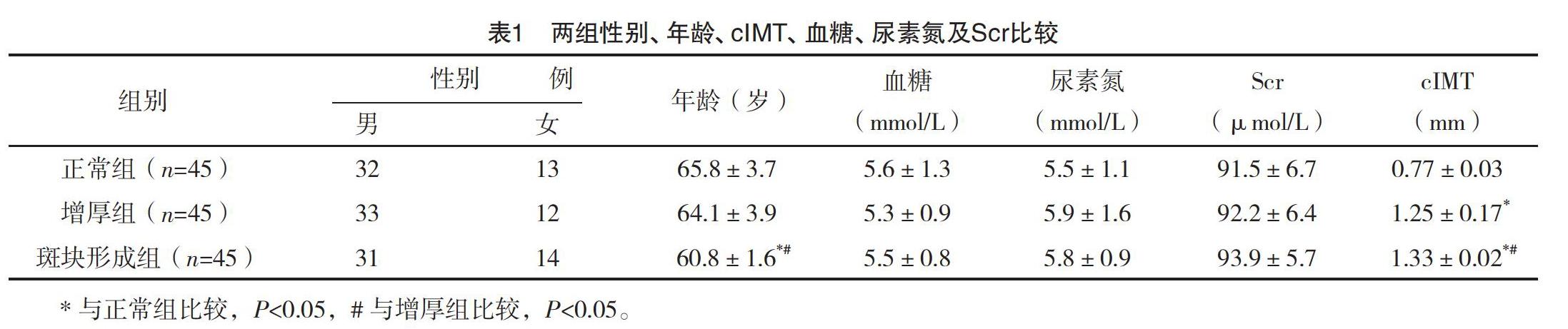
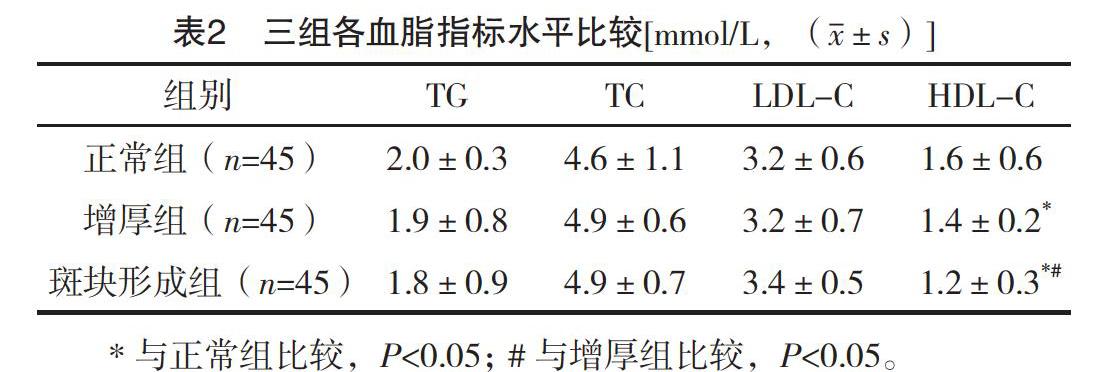
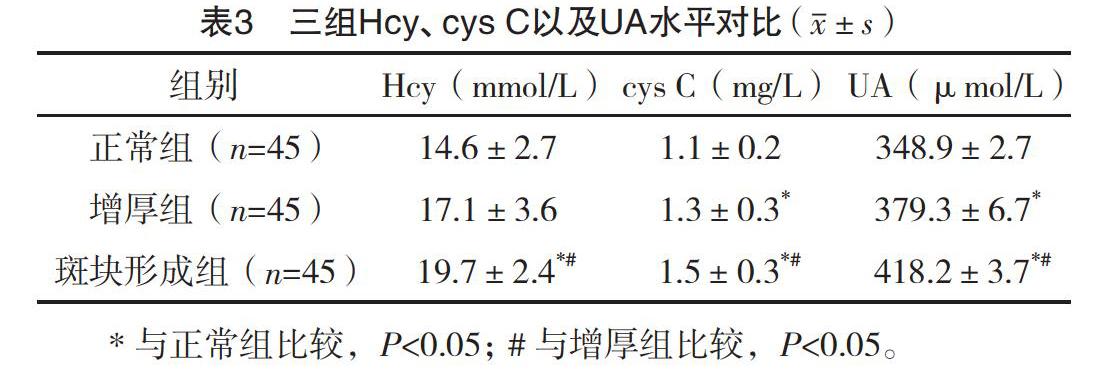
【摘要】 目的:分析H型高血壓患者血清学指标与颈动脉粥样硬化程度的相关性及探讨其临床价值。方法:选取2018年5月-2020年1月本院收治的H型高血压患者135例。所有患者进行颈动脉超声检查,并根据颈动脉内中膜厚度(carotid intima media thickness,cIMT)将其分为正常组(n=45),增厚组(n=45)及斑块形成组(n=45)。比较三组性别、年龄、cIMT、各血清学指标及血脂指标。分析血清学指标与cIMT的相关性。结果:三组性别、血糖、尿素氮、血肌酐(Scr)、低密度脂蛋白胆固醇(LDL-C)、甘油三酯(TG)及总胆固醇(TC)比较,差异均无统计学意义(P>0.05)。斑块形成组年龄低于正常组与增厚组(P<0.05)。斑块形成组高密度脂蛋白胆固醇(HDL-C)低于正常组与增厚组,且增厚组HDL-C低于正常组(P<0.05)。斑块形成组cIMT、Hcy、胱抑素C(cys C)及血尿酸(UA)均高于正常组与增厚组,且增厚组cIMT、cys C与UA均高于正常组(P<0.05)。cIMT与Hcy、cys C、UA均呈正相关性(P<0.05),其中与Hcy关系最密切;cIMT与HDL-C呈负相关性(P<0.05)。结论:颈动脉粥样硬化与机体多项血清学指标存在明显联系,其中与Hcy关系最密切。随着Hcy水平升高,H型高血压患者颈动脉粥样硬化程度逐渐加重,可通过检测Hcy等血清学指标水平的方式评估患者颈动脉病变情况,为临床医师诊断提供数据支持。
【关键词】 颈动脉粥样硬化 H型高血压 血清同型半胱氨酸
Correlation between Serological Indicators and Degree of Carotid Atherosclerosis in Patients with H-type Hypertension and Its Clinical Value/ZHU Hongyu. //Medical Innovation of China, 2021, 18(01): 0-030
[Abstract] Objective: To analyze the correlation between serological indicators and degree of carotid atherosclerosis in patients with H-type hypertension and to explore its clinical value. Method: A total of 135 patients with H-type hypertension admitted to our hospital from May 2018 to January 2020 were selected. All patients underwent carotid ultrasound examination, and according to their carotid intima media thickness (cIMT) they were divided into normal group (n=45), thickened group (n=45) and plaque formation group (n=45). Sex, age, cIMT, serological indicators and blood lipid index were compared among the three groups. The correlation between serological indicators and cIMT was analyzed. Result: There were no statistically significant differences among the three groups in gender, blood glucose, urea nitrogen, blood creatinine (Scr), low-density lipoprotein cholesterol (LDL-C), triglyceride (TG) and total cholesterol (TC) (P>0.05). The age of the plaque formation group was lower than that of the normal group and thickening group (P<0.05). High-density lipoprotein cholesterol (HDL-C) in the plaque formation group was lower than that in the normal and thickened groups, and HDL-C in the thickened group was lower than that in the normal group (P<0.05). cIMT, Hcy, cystatin C (cys C) and serum uric acid (UA) in the plaque formation group were higher than those in the normal and thickened groups, the levels of cIMT, cys C and UA in the thickened group were higher than those in the normal group (P<0.05). cIMT was positively correlated with Hcy, cys C and UA (P<0.05), among which, it was most closely correlated with Hcy. cIMT was negatively correlated with HDL-C (P<0.05). Conclusion: Carotid atherosclerosis is significantly associated with multiple serological indexes of the body, among which Hcy is the most closely related. With the increase of Hcy level, the degree of carotid atherosclerosis in patients with H-type hypertension gradually worsens. The condition of carotid artery lesions in patients can be evaluated by detecting the level of serological indicators such as Hcy, so as to provide data support for the diagnosis of clinicians.
[Key words] Carotid atherosclerosis H-type hypertension Serum homocysteine
First-authors address: Tengzhou Hospital of Traditional Chinese Medicine, Tengzhou 277599, China
doi:10.3969/j.issn.1674-4985.2021.01.007
H型高血压属于临床比较多见的高血压类型,主要由血清同型半胱氨酸(Hcy)水平升高所致,属原发性高血压范畴[1]。随着医学临床研究的深入而不断拓展,越来越多的研究指出血浆Hcy水平升高对于动脉粥样硬化的形成可以起到促进作用,进而诱导多种心脑血管疾病,增加患病风险[2]。急性脑梗死属于当前临床比较多见的神经内科疾病,具有进展快、危险性高等特点,患者多伴有高血压疾病[3]。动脉粥样硬化引起的脑部血液供应障碍是导致急性脑梗死的主要原因,特别是颈动脉粥样硬化[4]。传统的颈动脉粥样硬化危险因素包含糖尿病、高血压、吸烟以及高血脂等,但是近几年越来越多的学者在研究中指出,血尿酸、Hcy、胱抑素C(cys C)等指标在颈动脉粥样硬化发生发展过程中同样发挥着重要作用[5]。本研究通过对H型高血压不同颈动脉内壁厚度类型患者相关血清学指标进行检测的方式,分析Hcy等血清学指标水平与患者颈动脉粥样硬化程度之间的关系,探究其在颈动脉粥样硬化诊断中的应用价值,现报道如下。
