高盆樱桃种子萌发特性初探
2021-02-18叶小玲陈端妮胡晓敏
叶小玲 陈端妮 胡晓敏


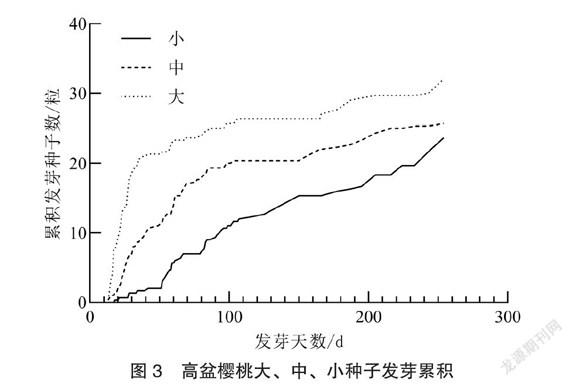

摘要:高盆樱桃Cerasus cerasoides原生于西藏和云南地带,为我国唯一冬季开花的樱属树种。其树形优美,花色艳丽,造景效果好,目前多应用于云南地区的绿化及造林。为探索高盆樱桃种子的萌发特性,测定其长、宽、厚、百粒重、吸水特性、发芽特性以及芽苗质量指标,并初步探索种子大小对种子萌发的影响。结果表明:高盆樱桃种子浅褐色,呈卵圆状;平均长10.56 mm,平均宽7.89 mm,平均长宽比为1.34,平均厚6.06 mm,平均百粒重为25.48 g;在培养皿铺纱布保湿的环境下种子发芽率为42.67%;大种子发芽势、发芽率等数值均高于中、小种子,种子大小与发芽率呈正相关。
关键词:高盆樱桃;种子形态;发芽率
中图分类号:S685.99
文献标志码:A
文章编号:1671-2641(2021)06-0074-04
收稿日期:2021-03-24
修回日期:2021-06-03
Abstract: Cerasus cerasoides is the only winter flowering species of Cerasus in China, which is native to Tibet and Yunnan. C. cerasoides is beautiful in shape and color, which has good landscaping effect. At present, it is mostly used in afforestation in Yunnan Province. In order to explore the germination characteristics of C. cerasoides seeds, the length, width, thickness, 100-grain weight, water absorption properties, germination rate and seedlings growth of the seeds were observed. Meanwhile, the effect of seed size on its germination was studied. The results showed that the seeds of C. cerasoides were light brown and oval-shaped, with an average length of 10.56 mm, an average width of 7.89 mm, an average length-to-width ratio of 1.34, an average thickness of 6.06 mm, and an average 100-seed weight was 25.48 g. The germination rate was 42.67% under the condition of moistening with gauze in the culture dish. The germination potentiality and germination rate of large seeds were higher than those of medium and small seeds, and the seed size was positively correlated with germination rate.
Key words: Cerasus cerasoides; Seed morphology; Germination rate
高盆樱桃Cerasus cerasoides又名冬樱花和云南早樱等,为蔷薇科樱属落叶乔木[1],是云南省二级保护植物[2],野生分布于我国云南和西藏,尼泊尔[3]、泰国北部[4]、印度北部[5]等也有分布。高盆樱桃花色粉红,是我国唯一在深秋及冬季开花的野生樱花,是优良的园林风景和森林修复树种[6~7],具丰富遗传资源,是良好的育种材料,在喜马拉雅地区常作药用植物,极具开发价值。目前国内高盆樱桃的应用多集中在云南,且存在野生资源破坏严重,繁育技术研究落后,基础研究不够深入等问题[8]。随着全球气候变暖,未来高盆樱桃的适生范围将缩小[9],作为资源开发基础的相关繁育技术水平亟待提高。
目前,高盆樱桃多采用种子繁殖[10~13],最佳发芽温度为25℃[13],通常情况下种子发芽率低,去除种壳[13]、冷藏[14]和播种前用30℃温水浸种12 h[10]等操作能促进种子发芽。……