高血压脑出血患者术后脑水肿程度危险因素探讨
2021-02-03赵燕平杨刚赵洁佳英
赵燕平 杨刚 赵洁 佳英
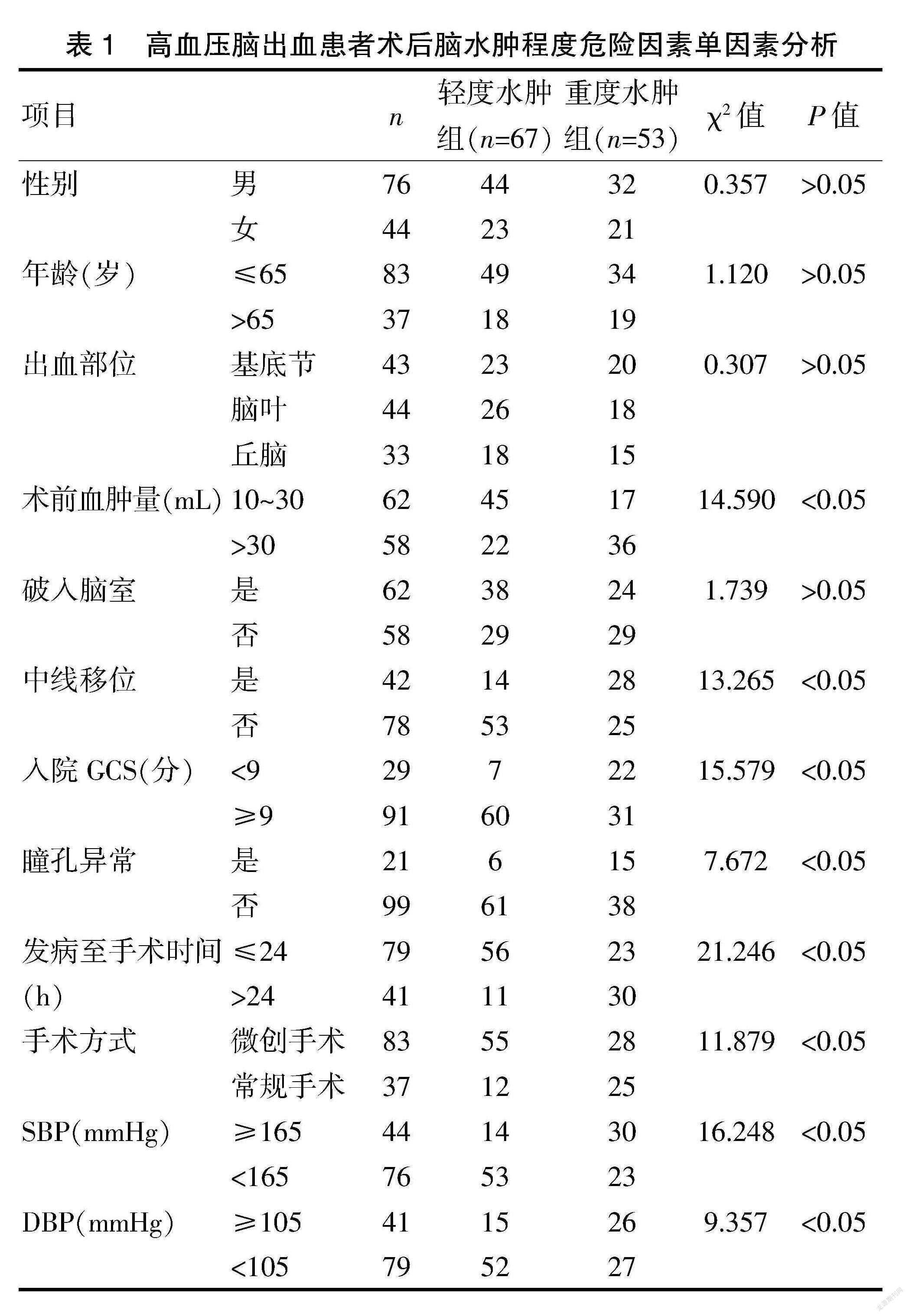


[摘要] 目的 探讨高血压脑出血患者术后脑水肿程度危险因素。 方法 选择2019年1月至2020年8月在我院手术治疗的高血压脑出血患者120例的临床资料进行回顾性分析。根据BECTS评分分为重度水肿组53例,轻度水肿组67例。收集患者一般资料及临床资料,单因素及多因素分析患者术后脑水肿程度影响因素。 结果 ①单因素分析结果显示,术前血肿量>30 mL、中线移位、入院GCS<9分、瞳孔异常、发病至手术时间>24 h、常规手术、SBP≥165 mmHg、DBP≥105 mmHg的患者术后重度脑水肿率更高(P<0.05)。②多因素分析結果显示,术前血肿量>30 mL、中线移位、瞳孔异常、发病至手术时间>24 h、入院时SBP≥165 mmHg是术后脑水肿程度的独立危险因素(P<0.05),而入院时GCS≥9分、微创手术是保护因素(P<0.05)。 结论 高血压脑出血患者术后脑水肿程度的影响因素较多,其中患者病情、血肿量、是否中线移位、发病至入院手术时间长、入院时的收缩压等均能影响术后脑水肿程度。
[关键词] 高血压脑出血;术后;脑水肿;危险因素
[中图分类号] R743.34 [文献标识码] B [文章编号] 1673-9701(2021)35-0095-03
Investigation on the risk factors of postoperative cerebral edema in patients with hypertensive intracerebral hemorrhage
ZHAO Yanping YANG Gang ZHAO Jie FENG Jiaying
Intensive Care Unit, Zhuji People′s Hospital of Zhejiang Province, Zhuji 311800, China
[Abstract] Objective To investigate the risk factors of postoperative cerebral edema in patients with hypertensive intracerebral hemorrhage. Methods The clinical data of 120 patients with hypertensive intracerebral hemorrhage undergoing surgery admitted to our hospital from January 2019 to August 2020 were selected and analyzed retrospectively. According to BECTS score, they were divided into the severe edema group (n=53) and the mild edema group (n=67). The general data and clinical data of patients were collected, and the impacting factors of postoperative cerebral edema were analyzed by univariate and multivariate analysis. Results ①The results of univariate analysis showed that the preoperative hematoma volume of patients was > 30 mL, with midline shift. And the GCS was <9 points on admission, with abnormal pupil. The time from onset to operation was > 24 h. After conventional operation, the SBP of patients was ≥165 mmHg and DBP was ≥105 mmHg, with higher rate of postoperative severe brain edema(P<0.05). ②The results of multivariate analysis showed that the preoperative hematoma volume of patients was >30 mL, with midline shift and abnormal pupil. The time from onset to operation was >24 h. And SBP≥165 mmHg on admission was the independent risk factors for postoperative brain edema (P<0.05), while if GCS was ≥9 points on admission, the minimally invasive surgery was a protective factor (P<0.05). Conclusion There are many impacting factors on postoperative brain edema in patients with hypertensive intracerebral hemorrhage, including the patient′s condition, hematoma volume, midline shift, operation time from onset to admission, systolic blood pressure on admission and other factors can all impact the postoperative brain edema.
[Key words] Hypertensive cerebral hemorrhage; Postoperative; Brain edema; Risk factor
高血压脑出血是由于脑内动脉、静脉或毛细血管破裂引起脑实质内的一种自发性脑血管病,具有高血压特性。高血压脑出血具有高发病率、高致残率和高致死率,危害患者的健康及生命安全。手术治疗是目前高血压脑出血患者的主要方法,能够及时清除血肿,减少血肿对其他脑组织的压迫作用。但术后患者脑水肿是常见并发症,严重的水肿会出现明显的头痛、头晕、恶心、呕吐,甚至在术后再次出现意识障碍程度加深,伴肢体运动功能变差等,一旦发生脑疝,甚至危及患者生命[1-3]。……