奥硝唑治疗厌氧菌性盆腔感染的临床疗效观察
2018-04-13彭云波
彭云波
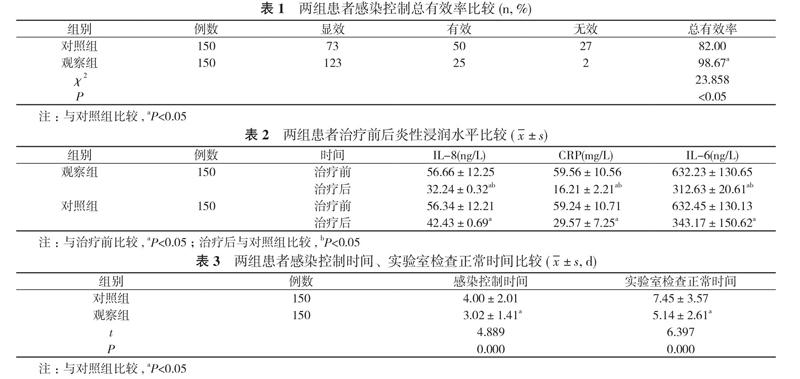
【摘要】 目的 探讨奥硝唑治疗厌氧菌性盆腔感染的临床疗效。方法 300例厌氧菌性盆腔感染患者, 随机分为对照组和观察组, 每组150例。对照组患者给予替硝唑治疗, 观察组患者给予奥硝唑治疗。比较两组患者感染控制总有效率、感染控制时间、实验室检查正常时间及治疗前后患者炎性浸润水平。结果 观察组患者感染控制总有效率为98.67%, 高于对照组的82.00%, 差异具有统计学意义(P<0.05)。治疗前, 两组患者炎性浸润水平比较差异无统计学意义(P>0.05);治疗后, 两组患者炎性浸润水平均优于本组治疗前, 且观察组优于对照组, 差异具有统计学意义(P<0.05)。观察组感染控制时间、实验室检查正常时间均短于对照组, 差异具有统计学意义(P<0.05)。结论 奥硝唑治疗厌氧菌性盆腔感染的临床疗效确切, 可有效改善炎症状态, 缩短疗程, 值得推广。
【关键词】 奥硝唑;厌氧菌性盆腔感染;临床疗效
DOI:10.14163/j.cnki.11-5547/r.2018.10.053
【Abstract】 Objective To discuss the clinical efficacy of ornidazole in the treatment of anaerobic pelvic infection. Methods A total of 300 patients with anaerobic pelvic infection were randomly divided into control group and observation group, with 150 cases in each group. The control group was treated with tinidazole, and the observation group was treated with ornidazole. Comparison were made on total infection control efficiency, infection control time, laboratory test normal time and inflammatory infiltration levels before and after treatment between the two groups. Results The observation group had higher total infection control efficiency as 98.67% than 82.00% in the control group, and the difference was statistically significant (P<0.05). Before treatment, both groups had no statistically significant difference in inflammatory infiltration levels (P>0.05). After treatment, both groups had better inflammatory infiltration levels than before treatment, and the observation group was better than the control group. Their difference was statistically significant (P<0.05). The observation group had shorter infection control time and laboratory test normal time than the control group, and their difference was statistically significant (P<0.05). Conclusion Ornidazole shows affirmative clinical efficacy in treating anaerobic pelvic infection and can effectively improve inflammatory state and shorten the course of treatment. It is worth promoting.
【Key words】 Ornidazole; Anaerobic pelvic infection; Clinical efficacy
厭氧菌性盆腔感染为女性生殖器官和周围结缔组织感染性疾病之一, 其发病率高, 主要有慢性和急性盆腔炎, 患者发病后, 盆腔、卵巢和输卵管等部位可能产生脓肿而影响生育功能, 治疗不及时可导致病情反复发作, 迁延不愈, 带给患者不良身心影响, 还可影响正常工作和生活。目前对于厌氧菌性盆腔感染多采用抗菌药物进行积极控制[1-3]。本研究选择2016年2月~2017年5月300例厌氧菌性盆腔感染患者进行分组对照, 分析了奥硝唑治疗厌氧菌性盆腔感染的临床疗效, 现报告如下。
1 资料与方法
1. 1 一般资料 选择2016年2月~2017年5月本院收治的300例厌氧菌性盆腔感染患者作为研究对象, 随机分为观察组和对照组, 每组150例。观察组年龄21~65岁, 平均年龄(41.24±7.92)岁;病程4 d~10个月, 平均病程(4.51±
1.83)个月。对照组年龄21~64岁, 平均年龄(41.21±7.61)岁;病程3 d~10个月, 平均病程(4.52±1.83)个月。两组患者年龄、病程等一般资料比较差异无统计学意义(P>0.05), 具有可