“家庭健康教育”对居家养老高血压患者的管理效果
2017-07-16李望王琛陈林波陈晖
李望+王琛+陈林波+陈晖
摘 要 目的:探讨初步实施以“家庭健康教育”为核心的管理模式对居家养老高血压患者的管理效果。方法:招募宜川辖区内居家养老的老年高血压患者142人,其中男性36人,女性106人,平均年龄(84.61±6.51)岁,开展为期6个月的家庭健康教育干预,评价干预前后高血压防治知识水平、防治态度与信念、服药依从性以及血压控制水平。结果:干预后研究对象在高血压防治知识水平、防治态度与信念、服药依从性有显著提高(P均<0.001),血压控制水平明显提高(P<0.001)。结论:家庭健康教育干预可以提高居家养老老年高血压患者的高血压防治知识水平、防治态度与信念、以及服药依从性,从而达到改善血压控制水平的效果。
关键词 高血压;居家养老;家庭健康教育;效果
中图分类号:R544.1 文献标志码:A 文章编号:1006-1533(2017)12-0056-02
Analysis of the management effect of “family health education” for the home endowment elderly hypertensive patients
LI Wang, WANG Chen, CHEN Linbo, CHEN Hui(Yichuan Community Health Service Center of Putuo District, Shanghai 200065, China)
ABSTRACT Objective: To explore the management effect of implementation of the management mode of “family health education” as the core for the home endowment hypertensive patients. Methods: Within the jurisdiction of Yichuan 142 home endowment hypertensive patients were recruited, among them 36 were male and 106 female, with an average age of (84.61±6.51) years old. A six-month family health education intervention was carried out for them. The level of hypertension prevention and control knowledge, attitude and belief, medication compliance and blood pressure control were evaluated before and after intervention. Results: After intervention, the levels of hypertension prevention and control knowledge, attitude and belief and medication compliance of the research objects were significantly improved(P<0.001). The level of blood pressure control was significantly improved (P<0.001). Conclusion: Family health education intervention can improve the levels of hypertension prevention and control knowledge, attitude and belief, and medication compliance of the home endowment elderly hypertensive patients so as to improve the effect of blood pressure control.
KEY WORDS hypertension; home endowment; family health education; effect
随着人口老龄化程度的加重,人口的平均期望寿命不断提高,养老需求日益增加[1]。社区居家养老服务中健康教育服务在老年人越来越注重养老服务质量以及生命质量的今天显得尤为重要[2]。本文旨在探讨以“家庭健康教育为核心”的管理模式对居家养老高血压患者进行管理的效果。
1 对象与方法
1.1 研究对象
在社区居家养老签约老人进行需求评估,筛查患有高血压病的老人142人,其中男性36人,女性106人,平均年龄(84.61±6.51)岁,80岁以上老年人占75.35%。所有参加对象均签署知情同意书。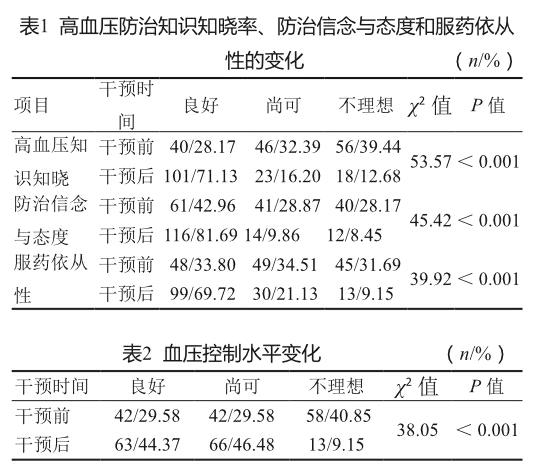
1.2 研究方法
1.2.1 家庭健康教育
传统的健康教育是对患者进行相关疾病的健康教育干预,而家庭健康教育是在對患者干预时,同步对患者同伴进行健康教育干预,使患者在家庭环境的影响下,增强高血压防治知识水平、提高态度、信念和依从性,改善不良的生活习惯和行为,控制血压。……