凶险性前置胎盘孕妇MRI征象与产后出血的关系分析
2024-06-21顾林陈俊杰
顾林 陈俊杰
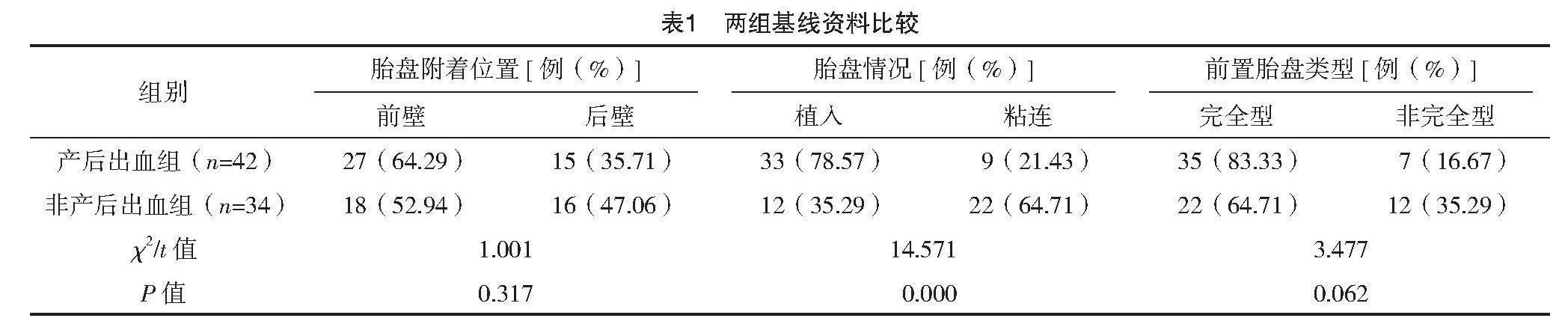
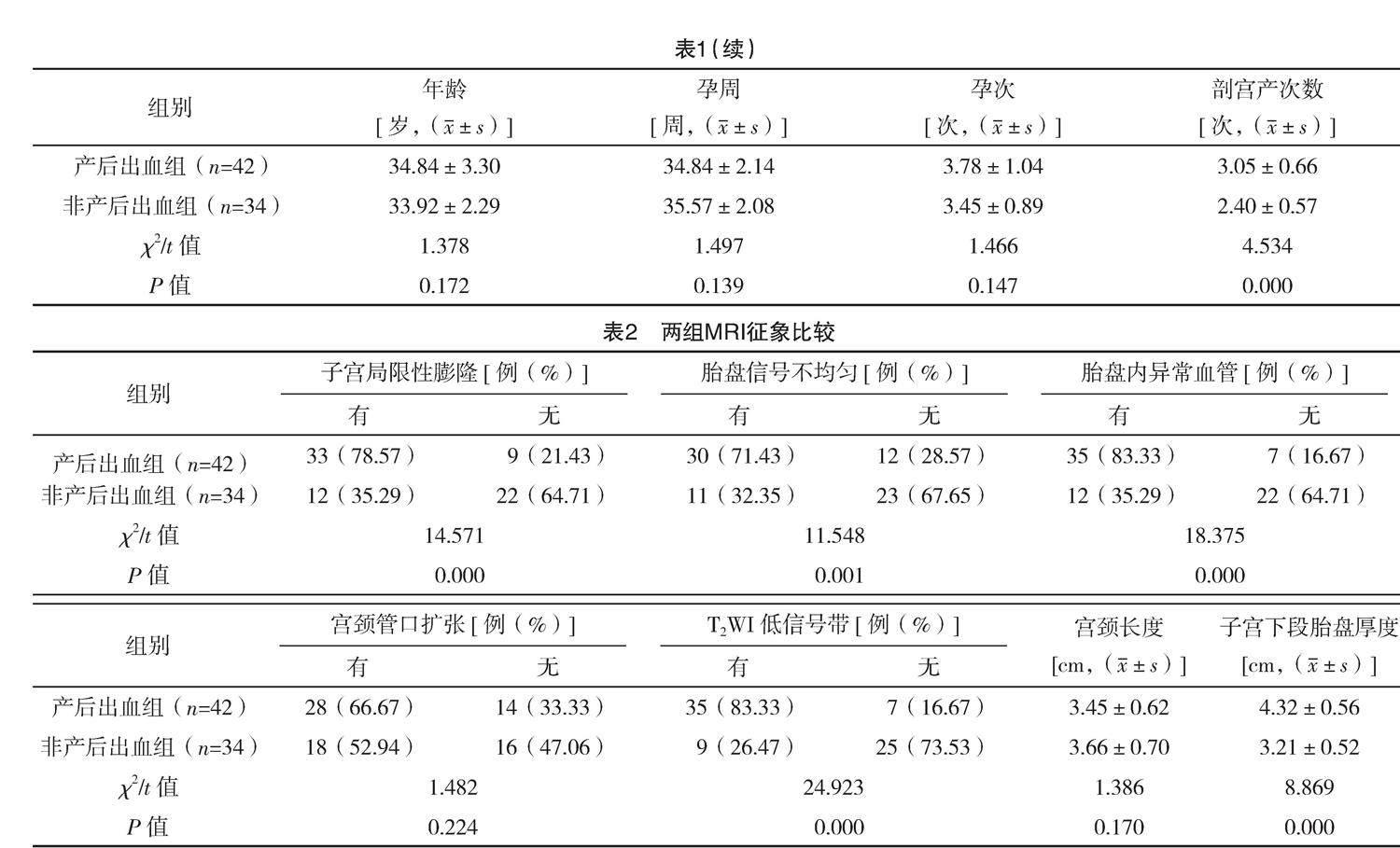
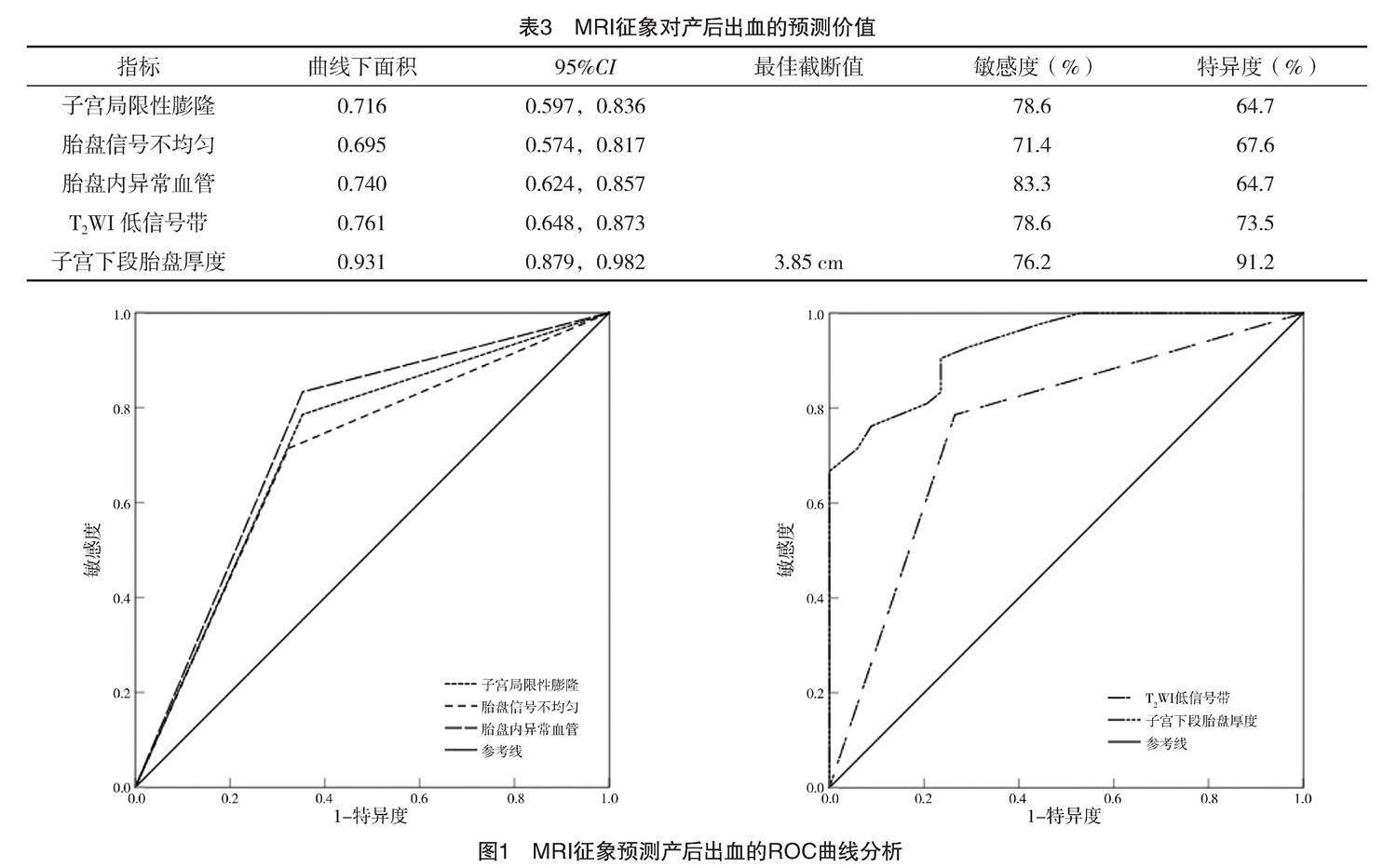
【摘要】 目的:探讨凶险性前置胎盘(PPP)孕妇磁共振成像(MRI)征象与产后出血的关系分析。方法:回顾性分析2018年1月—2023年8月新余市妇幼保健院收治的76例PPP孕妇的临床资料,根据是否发生产后出血分为产后出血组(n=42)和非产后出血组(n=34)。比较两组MRI征象及与产后出血的相关性。结果:产后出血组胎盘植入比例高于非产后出血组,剖宫产次数多于非产后出血组(P<0.05)。产后出血组MRI征象中子宫局限性膨隆、胎盘信号不均匀、胎盘内异常血管、T2WI低信号带占比均高于非产后出血组,子宫下段胎盘厚度大于非产后出血组,差异均有统计学意义(P<0.05)。两组宫颈管口扩张占比及宫颈长度比较,差异均无统计学意义(P>0.05)。受试者操作特征(ROC)曲线分析显示,PPP孕妇MRI征象子宫局限性膨隆、胎盘信号不均匀、胎盘内异常血管、T2WI低信号带、子宫下段胎盘厚度预测产后出血的曲线下面积分别为0.716、0.695、0.740、0.761、0.931;敏感度分别为78.6%、71.4%、83.3%、78.6%、76.2%;特异度分别为64.7%、67.6%、64.7%、73.5%、91.2%。结论:PPP孕妇MRI征象子宫局限性膨隆、胎盘信号不均匀、胎盘内异常血管、T2WI低信号带、子宫下段胎盘厚度与产后出血存在一定相关性,MRI征象检测有助于提高产后出血的诊断效能。
【关键词】 凶险性前置胎盘 产后出血 MRI征象 相关性
Analysis of Relationship Between MRI Signs and Postpartum Hemorrhage in Pregnant Women with Pernicious Placenta Previa/GU Lin, CHEN Junjie. //Medical Innovation of China, 2024, 21(13): -108
[Abstract] Objective: To investigate the analysis of relationship magnetic resonance imaging (MRI) signs and postpartum hemorrhage in pregnant women with pernicious placenta previa (PPP). Method: A retrospective analysis was performed on clinical data of 76 PPP pregnant women admitted to Maternity and Child Care Center of Xinyu from January 2018 to August 2023, according to whether postpartum hemorrhage occurred, they were divided into postpartum hemorrhage group (n=42) and non-postpartum hemorrhage group (n=34). The MRI signs and correlation with postpartum hemorrhage were compared between the two groups. Result: The proportion of placenta implantation in the postpartum hemorrhage group was higher than that in the non-postpartum hemorrhage group, and the number of cesarean section was more than that in the non-postpartum hemorrhage group (P<0.05).The proportion of uterine local swelling, uneven placental signal, abnormal blood vessels in the placenta, and T2WI low signal band in MRI signs on the postpartum hemorrhage group were higher than those in the non-postpartum hemorrhage group, the placental thickness in the lower uterine segment were greater than those in the non-postpartum hemorrhage group, the differences were statistically significant (P<0.05). There were no significant differences in the proportion of cervical dilation and cervical length between the two groups (P>0.05). Receiver operating characteristic (ROC) curve analysis showed that the areas under the curve of uterine local swelling, uneven placental signal, abnormal blood vessels in placenta, T2WI low signal band and placenta thickness in lower uterine segment in MRI signs of PPP pregnant women in predicting postpartum hemorrhage were 0.716, 0.695, 0.740, 0.761 and 0.931, respectively; sensitivity were 78.6%, 71.4%, 83.3%, 78.6%, 76.2%, respectively; and specificity were 64.7%, 67.6%, 64.7%, 73.5%, 91.2%, respectively. Conclusion: The MRI signs of pregnant women with PPP are associated with uterine localized swelling, uneven placenta signal, abnormal blood vessels in the placenta, low signal band on T2WI, and placenta thickness in the lower part of the uterus, and the MRI signs detection is helpful to improve the diagnostic efficiency of postpartum hemorrhage.
[Key words] Pernicious placenta previa Postpartum hemorrhage MRI signs Correlation
First-author's address: Radiology Department, Maternity and Child Care Center of Xinyu, Xinyu 338000, China
doi:10.3969/j.issn.1674-4985.2024.13.024
凶险性前置胎盘(pernicious placenta previa,PPP)是产科严重并发症之一,极易出现产后大出血,对母婴结局造成严重不利影响[1-2]。近年来,随着生育政策的开放,高龄产妇及剖宫产率呈明显上升趋势,这也在一定程度上导致PPP及产后出血的发生风险增加。随着影像学技术的发展,磁共振成像(magnetic resonance imaging,MRI)借助高软组织分辨率、多角度成像的特点PPP中的应用逐渐广泛,且经临床实践证实,其能清晰显示胎盘的整体解剖结构,局部血供及宫旁侵犯等情况[3-5]。但目前,关于PPP孕妇MRI征象预测产后出血尚缺乏客观的定量标准。鉴于此,本研究探讨PPP孕妇MRI征象与产后出血的相关性,报道如下。……