纳布啡联合罗哌卡因腹横筋膜阻滞多模式镇痛对全麻腹腔镜手术患儿苏醒期躁动的影响
2024-06-21王爱萍李瑶瑶肖佩君高琴黄建平
王爱萍 李瑶瑶 肖佩君 高琴 黄建平

*基金项目:吉安市科技计划指导性项目(20233-043570)
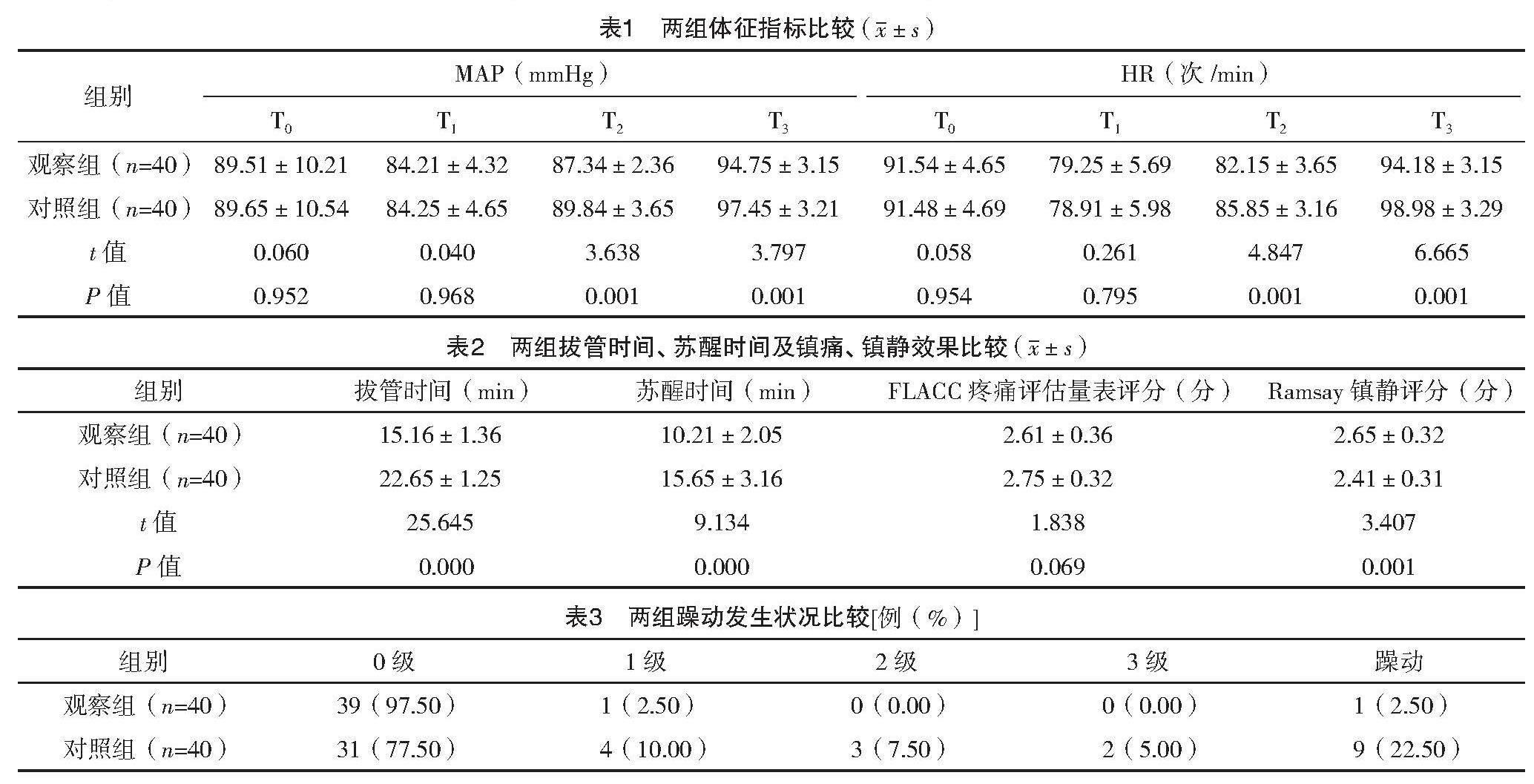
【摘要】 目的:探讨纳布啡联合罗哌卡因腹横筋膜阻滞多模式镇痛对全麻腹腔镜手术患儿苏醒期躁动的影响。方法:选取2022年6月—2023年8月在吉安市妇幼保健院接受全麻腹腔镜手术患儿80例作为研究对象,用随机数字表法将其分对照组和观察组,各40例。对照组在气管插管后,超声引导下行双侧假腹横筋膜阻滞(注射0.5 mL/kg氯化钠,术毕前15 min静注0.2 mg/kg纳布啡);观察组在气管插管后,超声引导下行双侧腹横筋膜阻滞(注射0.5 mL/kg罗哌卡因,术毕前15 min时静注0.2 mg/kg纳布啡)。对比两组体征指标、躁动评分、镇静评分、镇痛评分、拔管时间和苏醒时间、不良反应。结果:观察组T2、T3时平均动脉压(MAP)、心率(HR)均低于对照组,差异均有统计学意义(P<0.05);观察组拔管时间、苏醒时间均早于对照组,Ramsay镇静评分高于对照组,差异均有统计学意义(P<0.05);观察组躁动发生率(2.50%)低于对照组(22.50%),差异有统计学意义(P<0.05);两组不良反应发生率比较,差异无统计学意义(P>0.05)。结论:纳布啡联合罗哌卡因腹横筋膜阻滞多模式镇痛能在稳定血流动力学的基础上,降低苏醒期躁动发生率,有良好的镇痛、镇静效果,且不影响拔管时间和苏醒时间。
【关键词】 腹腔镜手术 全身麻醉 苏醒期躁动 纳布啡 罗哌卡因 腹横筋膜阻滞 镇痛
Effect of Nalbuphine Combined with Ropivacaine Abdominal Transversal Fascia Block Multimodal Analgesia on Emergence Agitation in Children Undergoing Laparoscopic Operation under General Anesthesia/WANG Aiping, LI Yaoyao, XIAO Peijun, GAO Qin, HUANG Jianping. //Medical Innovation of China, 2024, 21(14): -111
[Abstract] Objective: To explore the effect of Nalbuphine combined with Ropivacaine abdominal transversal fascia block multimodal analgesia on emergence agitation in children undergoing laparoscopic operation under general anesthesia. Method: A total of 80 children received laparoscopic operation under general anesthesia in the Matemity and Child Health Hospital of Jian from June 2022 to August 2023 were selected as the study objects, and were divided into control group and observation group by random number table method, with 40 cases in each group. In the control group, after tracheal intubation, bilateral false abdominal transversal fascia block was performed under the guidance of ultrasound (0.5 mL/kg Sodium Chloride was injected, 0.2 mg/kg Nalbuphine was injected intravenously 15 minutes before the end of the operation). In the observation group, after tracheal intubation, bilateral abdominal transversal fascia block was performed under the guidance of ultrasound (0.5 mL/kg Ropivacaine was injected, 0.2 mg/kg Nalbuphine was injected intravenously 15 minutes before the end of the operation). The sign indexes, agitation score, sedation score, analgesia score, extubation time, recovery time and adverse reactions were compared between the two groups. Result: The mean arterial pressure (MAP) and heart rate (HR) at T2 and T3 in observation group were lower than those in control group, the differences were statistically significant (P<0.05). The extubation time and recovery time of observation group were earlier than those of control group, and Ramsay sedation score was higher than that of control group, the differences were statistically significant (P<0.05). The incidence of agitation in observation group (2.50%) was lower than that in control group (22.50%), the difference was statistically significant (P<0.05). There was no significant difference in the incidence of adverse reaction between the two groups (P>0.05). Conclusion: Nalbuphine combined with Ropivacaine abdominal transversal fascia block multimodal analgesia can reduce the incidence of emergence agitation on the basis of stable hemodynamics, has good analgesic and sedative effects, and does not affect the extubation time and recovery time.
[Key words] Laparoscopic operation General anesthesia Emergence agitation Nalbuphine Ropivacaine Abdominal transversal fascia block Analgesia
First-author's address: Department of Obstetrics and Gynecology, the Matemity and Child Health Hospital of Jian, Jian 343000, China
doi:10.3969/j.issn.1674-4985.2024.14.026
近年临床外科技术明显改进,单孔腹腔镜手术方式已在临床小儿腹部疾病治疗中得到广泛应用,如急性阑尾炎、腹股沟斜疝等[1]。患儿接受单孔腹腔镜手术治疗时,往往会选用全麻协助,但因腹腔镜手术需建立气腹,会一定程度上影响人体正常生理,因此,在制订小儿腹腔镜手术全麻方案时不仅需考虑常规因素,还需考虑术中二氧化碳气腹对患儿心肺功能等方面的影响[2],以确保所制订的麻醉方案具有科学性。……