支气管哮喘住院患者的药学监护及合理用药
2021-12-13王玉函
王玉函
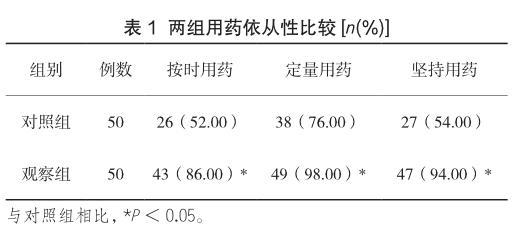

【摘 要】目的:探讨支气管哮喘住院患者临床治疗期间的药学监护及合理用药管理措施与应用效果。方法:选取我院 2020年6月至2021年6月收治的支气管哮喘住院患者100例为研究对象,随机平均分为对照组、观察组各50例,两组采取同样的治疗方法,观察组在此基础上开展药学监护及合理用药管理工作,观察比较两组患者用药依从性、病情控制情况与自护能力。结果:观察组用药依从性、ACT评分与ESCA评分均显著优于对照组(P<0.05)。结论:支气管哮喘住院患者临床治疗过程中,落实药学监护及合理用药管理,有效显著提高患者用药依从性与支气管哮喘控制水平,值得在临床推广应用。
【关键词】支气管哮喘;住院患者;药学监护;合理用药
Pharmaceutical care and rational drug use of hospitalized patients with bronchial asthma
Wang Yuhan
Peoples Hospital of Yongxiu County, Jiujiang City, Jiangxi Province ,Jiangxi Jiujiang 330300, China
【Abstract】Objective: To explore the pharmaceutical care and rational drug use management measures and application effect of hospitalized patients with bronchial asthma during clinical treatment. Methods: 100 hospitalized patients with bronchial asthma treated in our hospital from June 2020 to June 2021 were randomly divided into control group and observation group, with 50 cases in each group. The two groups adopted the same treatment method. On this basis, the observation group carried out pharmaceutical care and rational drug use management, and observed and compared the drug use compliance, condition control and self-care ability of the two groups. Results: the medication compliance, act score and ESCA score in the observation group were significantly better than those in the control group(P<0.05). Conclusion: during the clinical treatment of hospitalized patients with bronchial asthma, the implementation of pharmaceutical care and rational drug use management can effectively and significantly improve the drug compliance and control level of bronchial asthma, which is worthy of clinical application.
【Key?Words】Bronchial asthma; Inpatients; Pharmaceutical care; Rational use
支氣管哮喘(BA)是一种异质性疾病,以慢性气道炎症、气道高反应性为主要特征[1]。近年来,由于生态环境的不断恶化,支气管哮喘的发病率逐年升高,作为一种慢性气道反应性疾病,哮喘需要长期药物控制,但由于患者依从性不高,自行停药现象普遍,以至于大部分哮喘患者没有达到稳定控制。本文选取我院 2020年6月至2021年6月收治的支气管哮喘患者100例为研究对象,实施药学监护及合理用药措施,具体报道如下。
1 资料与方法
1.1 一般资料
本研究选取我院 2020年6月至2021年6月收治的支气管哮喘住院患者100例,按随机数字表法将所有患者分为两组,对照组、观察组各50例。对照组,男28例,女22例,年龄43岁~80岁,平均年龄(62.01±2.34)岁,病程1年~2年,平均病程(1.55±0.21)年,疾病分级Ⅰ级23例,Ⅱ级27例。观察组男27例,女23例,年龄44岁~79岁,平均年龄(61.55±2.31)岁,病程1年~3年,平均病程(1.64±0.31)年,疾病分级Ⅰ级21例,Ⅱ级29例。两组患者一般资料差异无统计学意义(P>0.05),具有可比性。
1.2 方法
两组患者……