上海某社区老年女性营养状况与OSTA指数的相关性研究
2021-10-09郑熙方圆李淑梅
郑熙 方圆 李淑梅
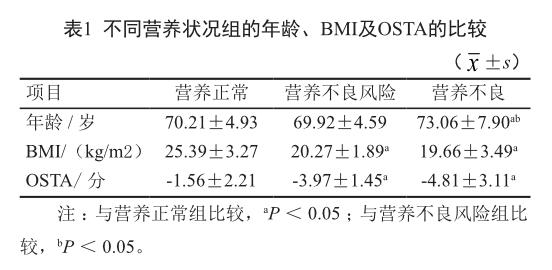
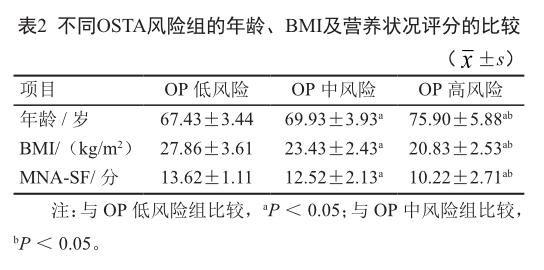
摘 要 目的:了解社區老年女性营养状况与亚洲人骨质疏松自我筛查工具(OSTA)指数的相关性。方法:以2018年6月15日-2019年7月31日自愿参加体检的上海江湾社区532名60岁及以上老年女性为研究对象,平均年龄为(70.34±5.14)岁,平均停经年龄为(50.13±3.93)岁。应用微型营养评估简表(MNA-SF)和OSTA进行调查。结果:经MNA-SF评估,营养正常者415例(78.0%)、营养不良风险者84例(15.8%)和营养不良者33例(6.2%)。营养不良风险组和营养不良组的OSTA评分低于营养正常组(P<0.05)。社区老年女性的营养状况与OSTA呈正相关(r=0.432,P=0.001);其中60~69岁组和70~79岁组的营养状况与OSTA风险分级的相关性有统计学意义(P<0.05)。结论:低营养状况老年女性的骨质疏松风险较高,应注意提高老年女性的营养状况。OSTA指数在反映老年女性营养状况方面具有一定的参考价值,
关键词 营养状况;老年女性;亚洲人骨质疏松自我筛查工具;微型营养评估简表;相关性
中图分类号:R681 文献标志码:A 文章编号:1006-1533(2021)18-0049-04
Study of the correlation between the nutritional status of elderly women in a community in Shanghai and the OSTA index
ZHENG Xi1, FANG Yuan1, LI Shumei2
(1. General Practice Department of Jiangwan Community Health Service Center of Hongkou District, Shanghai 200080, China; 2. Endocrinology Department of Shanghai Fourth Peoples Hospital Affiliated to Tongji University, Shanghai 200081, China)
ABSTRACT Objective: To investigate the correlation between the nutritional status of elderly women in the community and osteoporosis self-assessment tool for Asians(OSTA) index. Methods: Five hundred and thirty-two elderly women aged 60 and above who voluntarily participated in physical examination in Jiangwan Community of Shanghai from June 15, 2018 to July 31, 2019 were selected as the research objects, the average age was (70.34±5.14) years, and the average age at menopause was(50.13±3.93) years. The mini nutritional assessment short-form(MNA-SF) and the OSTA were used for the investigation. Results: According to MNA-SF assessment, 415 cases(78.0%) were normal nutrition, 84 cases(15.8%) were at risk of malnutrition, and 33 cases(6.2%) were malnourished. The OSTA score of malnutrition risk group and malnutrition group was lower than that of normal nutrition group(P<0.05). The nutritional status of elderly women in the community was positively correlated with OSTA(r=0.432, P=0.001); among them, the nutritional status of the 60-69-year-old group and the 70-79-year-old group had a statistically significant correlation with the OSTA risk classification(P<0.05). Conclusion: The risk of osteoporosis in the elderly women with low nutritional status is higher, so attention should be paid to improve the nutritional status of the elderly women. OSTA index has a certain reference value in reflecting the nutritional status of elderly women.
KEY WORDS nutritional status; elderly women; osteoporosis self-assessment tool for Asians; mini nutritional assessment short-form; association
第六次全国人口普查数据显示,上海60岁及以上的人口已占总人口的15.26%[1],提示上海老龄化问题日益严重。老年患者中营养不良发生率较高,微型营养评估简表(short-form Mini-nutritional Assessment, MNA-SF)可以作为一种有效的筛选社区老年营养不良患者的工具[2]。同时,营养不良又是导致骨质疏松症(osteoporosis, OP)发生的危险因素[3],OP不仅会影响患者生活质量,而且OP所致的脊柱变形、骨折等则会致残,甚至致死,给患者、家庭、社会造成严重负担[4]。亚洲人骨质疏松自我筛查工具(osteoporosis self-assessment tool for Asians,OSTA)是由Koh等[5]于2001年提出的一种用于预测亚洲绝经妇女患OP危险的工具,现已广泛应用于老年女性的OP早期筛查。本研究旨在分析老年女性营养状况与OSTA指数的相关性,同时分析判断OSTA指数对评估营养状况的价值。
1 对象与方法
1.1 对象
选取2018年6月15日-2019年7月31日在上海江湾社区自愿参加体检的532名老年女性作为研究对象,年龄为60~91岁,平均年龄为(70.34±5.14)岁。……