oxLDL、HDL及其比值对急性缺血性脑卒中病情 严重程度的评价及对疾病复发预测作用
2021-09-18张晓冬张艳敏
张晓冬 张艳敏
【摘要】 目的 分析氧化低密度脂蛋白(oxLDL)、高密度脂蛋白(HDL)及其比值對急性缺血性脑卒中的评价作用及对疾病复发预测价值。
方法 选取2017年1月~2019年1月收治的急性缺血性脑卒中患者202例,均于入院后第2天抽取外周空腹肘静脉血检测oxLDL、HDL并计算比值,以美国国立卫生研究院卒中量表(NIHSS)评价患者的病情严重程度。对比不同病情严重程度患者的oxLDL、HDL水平及oxLDL/HDL值,分析其与NIHSS评分的相关性。均随访1年,统计患者的复发率,logistic回归分析评价oxLDL、HDL水平及oxLDL/HDL值与急性缺血性脑卒中患者疾病复发的关系。
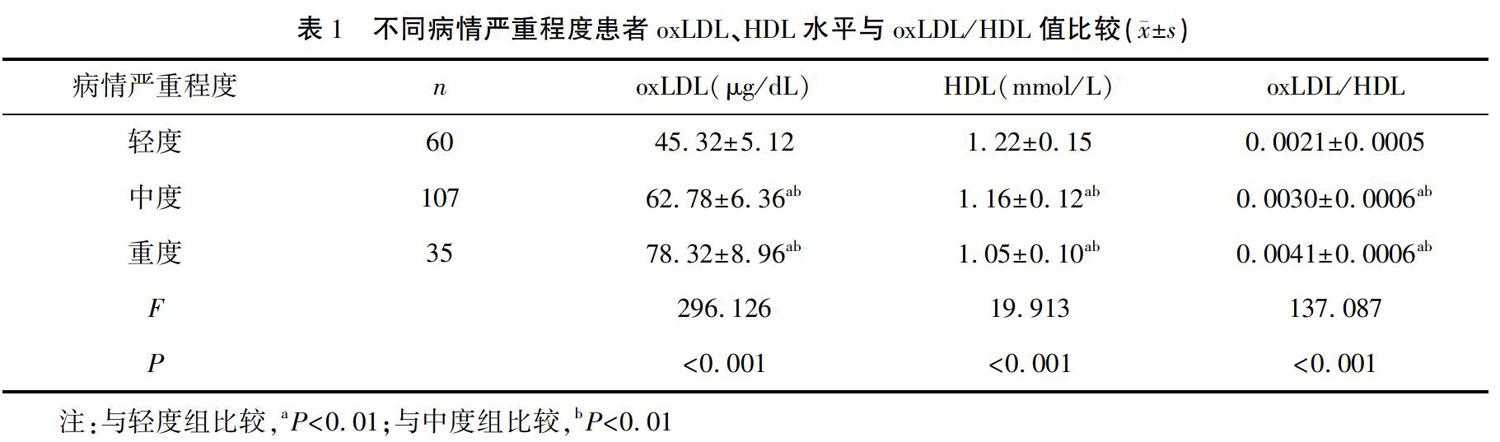
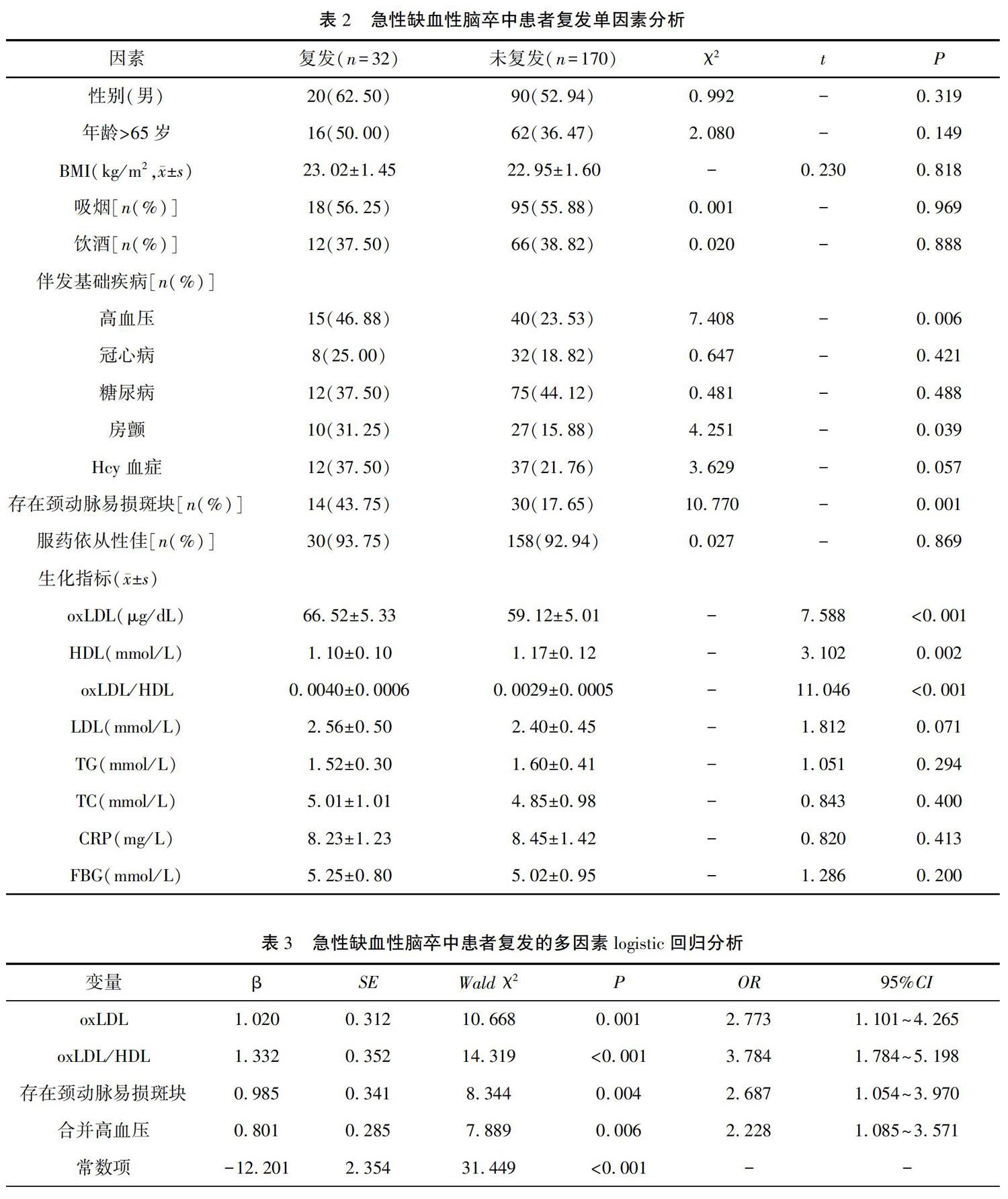
结果 轻度急性缺血性脑卒中患者oxLDL水平、oxLDL/HDL值低于中度和重度患者,HDL水平高于中度和重度患者,中度急性缺血性脑卒中患者oxLDL水平、oxLDL/HDL值低于重度患者,HDL水平高于重度患者,差异有统计学意义( P <0.01或0.001)。Pearson相关性分析显示oxLDL、oxLDL/HDL值与NIHSS评分呈正相关,HDL水平与NIHSS评分呈负相关( P <0.05)。单因素分析复发患者的oxLDL水平、oxLDL/HDL值、存在颈动脉易损斑块、合并房颤、合并高血压的占比高于未复发患者,HDL水平低于未复发患者,差异有统计学意义( P <0.05),logistic回归分析显示oxLDL、oxLDL/HDL值、合并高血压、存在颈动脉易损斑块是导致急性缺血性脑卒中患者复发的独立危险因素( P <0.05)。
结论 oxLDL、HDL及其比值可反映急性缺血性脑卒中患者病情严重程度,且oxLDL、oxLDL/HD值是影响疾病复发的独立危险因素。
【关键词】 氧化低密度脂蛋白;高密度脂蛋白;急性缺血性脑卒中;病情严重程度;复发;危险因素
中图分类号: R734.3 文献标志码: A DOI: 10.3969/j.issn.1003-1383.2021.08.009
Evaluation of oxLDL, HDL and their ratio on severity of acute ischemic stroke and prediction on disease recurrence
ZHANG Xiaodong1, ZHANG Yanmin2
(1.Department of Medical Laboratory, Anyang District Hospital, Anyang 455000, Henan, China; 2. Comprehensive Outpatient Department of Anyang Meinian Health Management Co. Ltd, Anyang 455000, Henan, China)
【Abstract】 Objective To analyze the evaluation effects of oxidized low density lipoprotein (oxLDL), high-density lipoprotein (HDL) and their ratio on acute ischemic stroke and the predictive value of disease recurrence.
Methods A total of 202 patients with acute ischemic stroke admitted to hospital from January 2017 to January 2019 were selected. On the second day of admission, fasting venous blood samples were collected to detect oxLDL and HDL and calculate the ratio. National Institutes of Health Stroke Scale (NIHSS) score was used to evaluate the severity of the disease. The levels of oxLDL, HDL and oxLDL/HDL in patients with different severity were compared, and the correlation between oxLDL and NIHSS score was analyzed. And then, all patients were followed up for 1 year, and the recurrence rate was counted. Logistic regression analysis was used to evaluate the relationship between oxLDL, HDL levels and oxLDL/HDL value and the recurrence of acute stroke.
Results The levels of oxLDL and oxLDL/HDL value in patients with mild acute ischemic stroke were lower than those in moderate and severe patients, HDL levels were higher than those in moderate and severe patients, and oxLDL levels and oxLDL/HDL values in patients with moderate acute ischemic stroke were lower than those in severe patients, and HDL levels were higher than those in severe patients, and difference was statistically significant ( P < 0.01 or 0.001). Pearson correlation analysis showed that oxLDL, oxLDL/HDL values were positively correlated with NIHSS score, and HDL level was negatively correlated with NIHSS score ( P < 0.05). Univariate analysis showed that oxLDL levels, oxLDL/HDL values, carotid artery vulnerable plaques, atrial fibrillations, and hypertensions in patients with recurrence of acute stroke accounted for higher proportions than patients without recurrence, while HDL levels were lower than patients without recurrence, so the difference was statistically significant ( P < 0.05). Logistic regression analysis showed that oxLDL, oxLDL/HDL values, hypertensions and carotid artery vulnerable plaques were independent risk factors for recurrence in patients with acute ischemic stroke ( P < 0.05).
Conclusion OxLDL, HDL and their ratio can reflect the severity of the disease in patients with acute ischemic stroke, and oxLDL and oxLDL/HDL value are independent risk factors for the recurrence of the disease.
【Key words】 oxLDL; HDL; acute ischemic stroke; severity of disease; recurrence; risk factor
急性缺血性脑卒中是各种原因的脑组织供血障碍引起的神经系统疾病,有发病急、病情进展快的特点,发病后可造成不同程度的偏瘫、失语等症状,具有较高的致残、致死率[1]。研究表明[2],首次脑卒中后有较高的复发风险,且复发患者致残和血管性死亡风险进一步提高,不仅对患者生命安全造成威胁,也造成了极大的医疗负担。因此,有效识别脑卒中复发的危险因素,及时采取预防措施具有重要意义。……