基于改进BP神经网络的音乐流派分类
2021-09-13樊思含
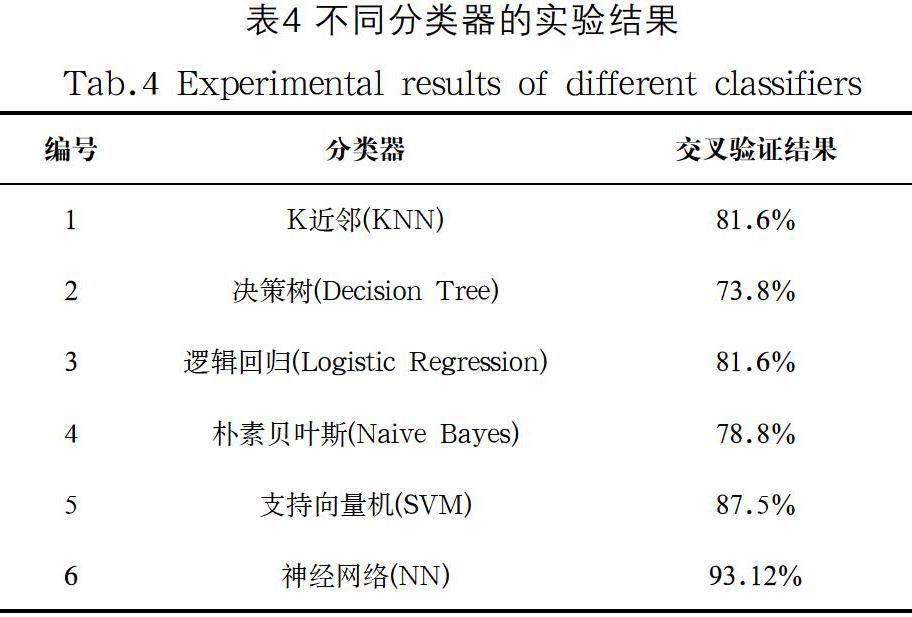
摘 要:针对传统音乐流派分类模型性能不稳定、音乐信号特征单一导致分类准确率低的问题,提出了改进的BP神经网络(Back Propagation Neural Network)音乐流派分类模型,通过Python的Librosa库提取了音乐的均方根能量、过零率、频谱质心、频谱对比度等多种特征,并使用PCA(Principal Component Analysis)和LDA(Linear Discriminant Analysis)数据降维方法对特征数据进行可视化分析,证明了特征选取的合理性。最后对四类音乐流派进行仿真实验,并与传统的分类模型对比。实验证明,提出的模型10 折交叉验证的准确率为93.12%,优于KNN(K-Nearest Neighbor)、SVM(Support Vector Machine)等传统的分类模型。
关键词:机器学习;特征提取;支持向量机;梅尔频率倒谱系数
中图分类号:TP39 文献标识码:A
文章编号:2096-1472(2021)-09-17-04
Abstract: Classification models of traditional music genre have problems of unstable performance and low classification accuracy caused by single characteristics of music signals. In view of these problems, this paper proposes an improved BP (Back Propagation) Neural Network music genre classification model. Various features such as root mean square energy, zero crossing rate, spectral centroid, and spectral contrast of music are extracted through the Librosa library of Python. Then, visual analysis of the feature data using PCA (Principal Component Analysis) and LDA (Linear Discriminant Analysis) data dimensionality reduction methods has proved the rationality of feature selection. Finally, simulation experiments are conducted on four types of music genres, and compared with the traditional classification model. The experiment proves that the accuracy of the 10-fold cross-validation of the model proposed in this paper is 93.12%, which is better than traditional classification models such as KNN (K-Nearest Neighbor) and SVM (Support Vector Machine).
Keywords: machine learning; feature extraction; SVM; MFCC
1 引言(Introduction)
随着多媒体技术的发展,音乐以各种方式出现在人们身边,面对网络上海量的音乐,不同的人喜好差异较大,为方便检索,对音乐流派进行分类尤为重要。庄严[1]等人提出了一种基于谱图分离的音乐流派分类算法,通过对音乐信号的谱图滤波,分离出音乐的打击与和声部分,对特征进行优化,通过SVM分类器对8 种音乐流派进行仿真实验,最终达到73%的准确率。陆欢[2]则采用梅尔频率倒谱系数(Mel-Frequency Cepstral Coefficients, MFCC)特征矩阵作为音乐信号的特征,训练了卷积神经网络作为分类器,在4 种音乐流派上得到88%的结果。本文借助于Python的Librosa库,研究了音乐信号的某些时域特征和频域特征,选取了过零率、均方根能量、频谱质心、滚降截止频率、频谱对比度、梅尔频率倒谱系数作为音乐数据集的特征,有效解决了单一特征造成的分类准确率低的问题。……