急性阑尾炎手术后并发症中循证护理的应用
2021-09-10申万妹张裕
申万妹 张裕
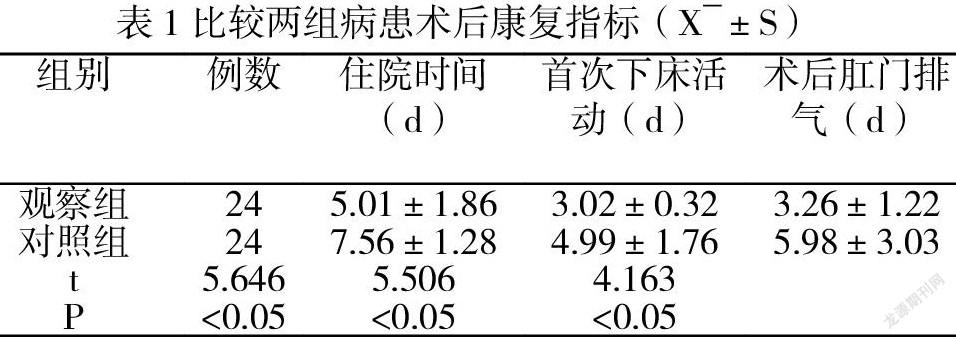
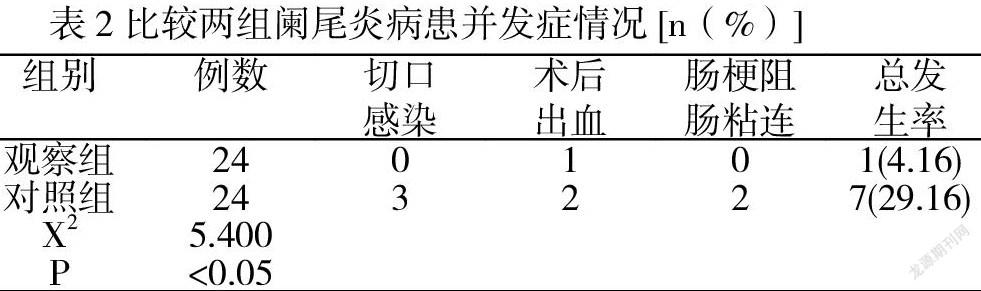
【摘要】目的:观察研究循证护理应用于急性阑尾炎手术后并发症的发生率。方法:纳入本院收治的 48 例急性阑尾炎患者作为研究对象,随机分为对照组(n=24 采取常规护理措施) 观察组( n=24 实施循证护理措施) ,比较两组患者经过护理措施干预后的应用效果。结果:观察组患者术后住院时间、首次下床活动、术后肛门排气等康复情况更优于对照组,P < 0.05 ;观察组患者术后切口感染 、术后出血、 肠梗阻肠粘连、疼痛等并发症发生率更低于对照组, P < 0.05 。结论:急性阑尾炎病患实施循证护理的临床效果比较明显,可有效提高病患治疗效果,改善病患不良症状,促进恢复 。
【关键词】急性阑尾炎;手术;并发症;循证护理;
【Abstract】Objective: To observe and study the incidence of complications after the application of evidence-based nursing to acute appendicitis surgery. Methods: Include 48 patients with acute appendicitis admitted to this hospital as the research objects, and randomly divide them into the control group (n=24 taking routine nursing measures) and the observation group (n=24 implementing evidence-based nursing measures), and comparing the two groups of patients who have undergone nursing measures Application effect after intervention. Results: Postoperative hospital stay, first getting out of bed, postoperative anus exhaust, and other rehabilitation conditions of the observation group were better than those of the control group, P <0.05; postoperative wound infection, postoperative bleeding, intestinal obstruction and intestinal adhesions in the observation group The incidence of pain and other complications was lower than the control group, P <0.05. Conclusion: The clinical effect of evidence-based care for patients with acute appendicitis is relatively obvious, which can effectively improve the treatment effect of patients, improve patients' adverse symptoms, and promote recovery.
[Keywords] acute appendicitis; surgery; complications; evidence-based nursing;
急性阑尾炎是普外科常见疾病,发病率较高,该病由于细菌入侵和阑尾管腔堵塞所致。手术是治疗急性阑尾炎的首先方式,但术后易出现切口感染、切口出血、肠梗阻及肠粘连等并发症,影响术后康复效果[1]。因此,予以患者优质的护理措施可以促进患者术后恢复。基于此,本文选择我院48例急性阑尾炎手术患者作为研究对象,探讨循证护理应用于急性阑尾炎手术患者的疗效,现作如下报告。
1资料与方法
1.1一般资料
选取我院 2019 年 11 月至 2020 年 10 月至我院就诊的急性阑尾炎手术患者48例,均经辅助检查及临床症状确诊为急性阑尾炎,随机分为观察组和对照组各24例。观察组包含男15例,女9例,年齡为25-58岁,平均年龄(32.48±3.58)岁,对照组包含男14例,女10例,年龄为24-59岁,平均年龄(31.52±3.49)岁.两组患者一般资料无统计学差异,P>0.05,具有可比性。……
