黄芪甲苷对变应性鼻炎模型小鼠改善作用的机制初探
2021-07-11陈旭青马华安周龙云严道南刘书芬吴继勇
陈旭青 马华安 周龙云 严道南 刘书芬 吴继勇
中圖分类号 R765.2;R285.5 文献标志码 A 文章编号 1001-0408(2021)10-1187-09
DOI 10.6039/j.issn.1001-0408.2021.10.06
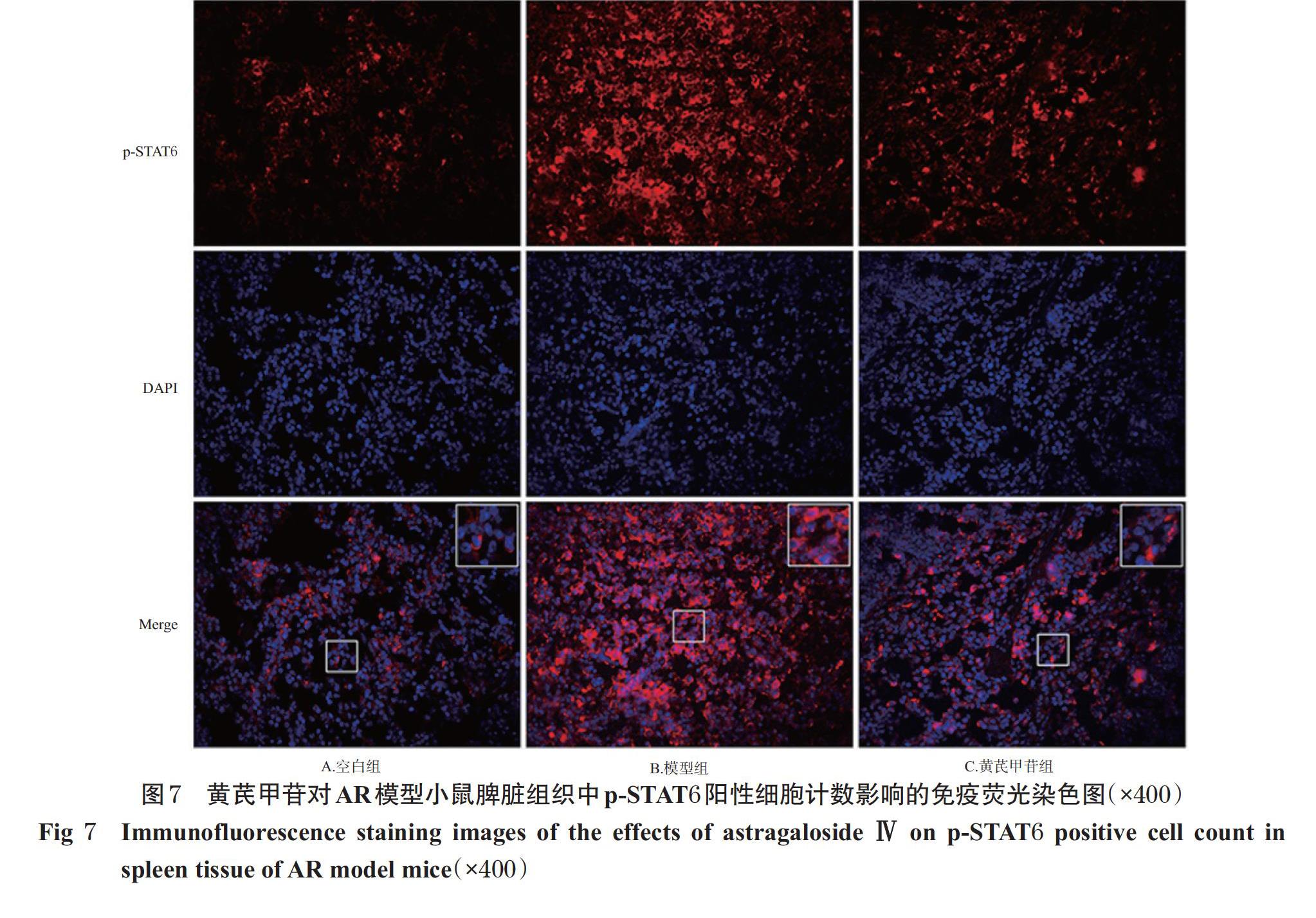
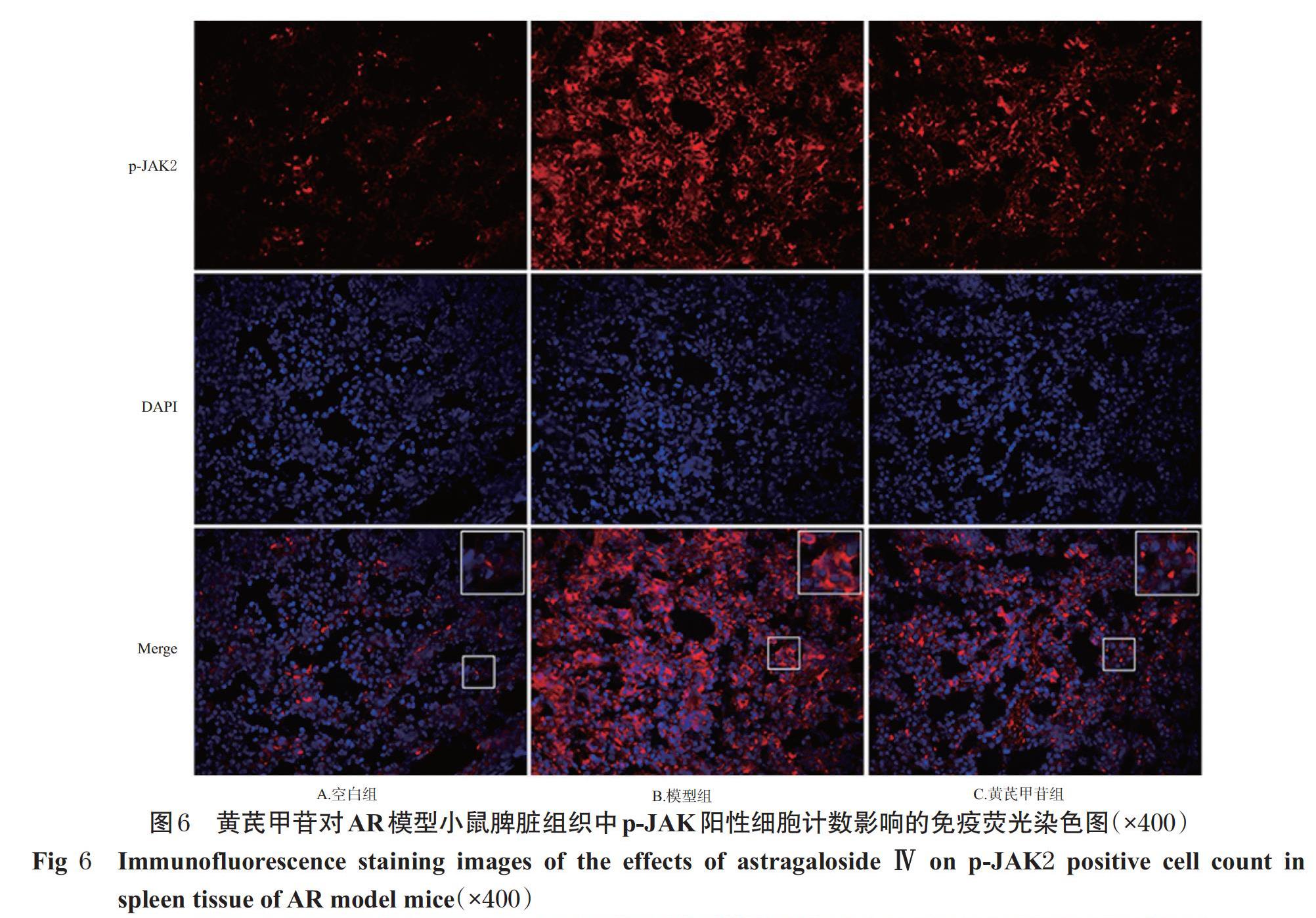
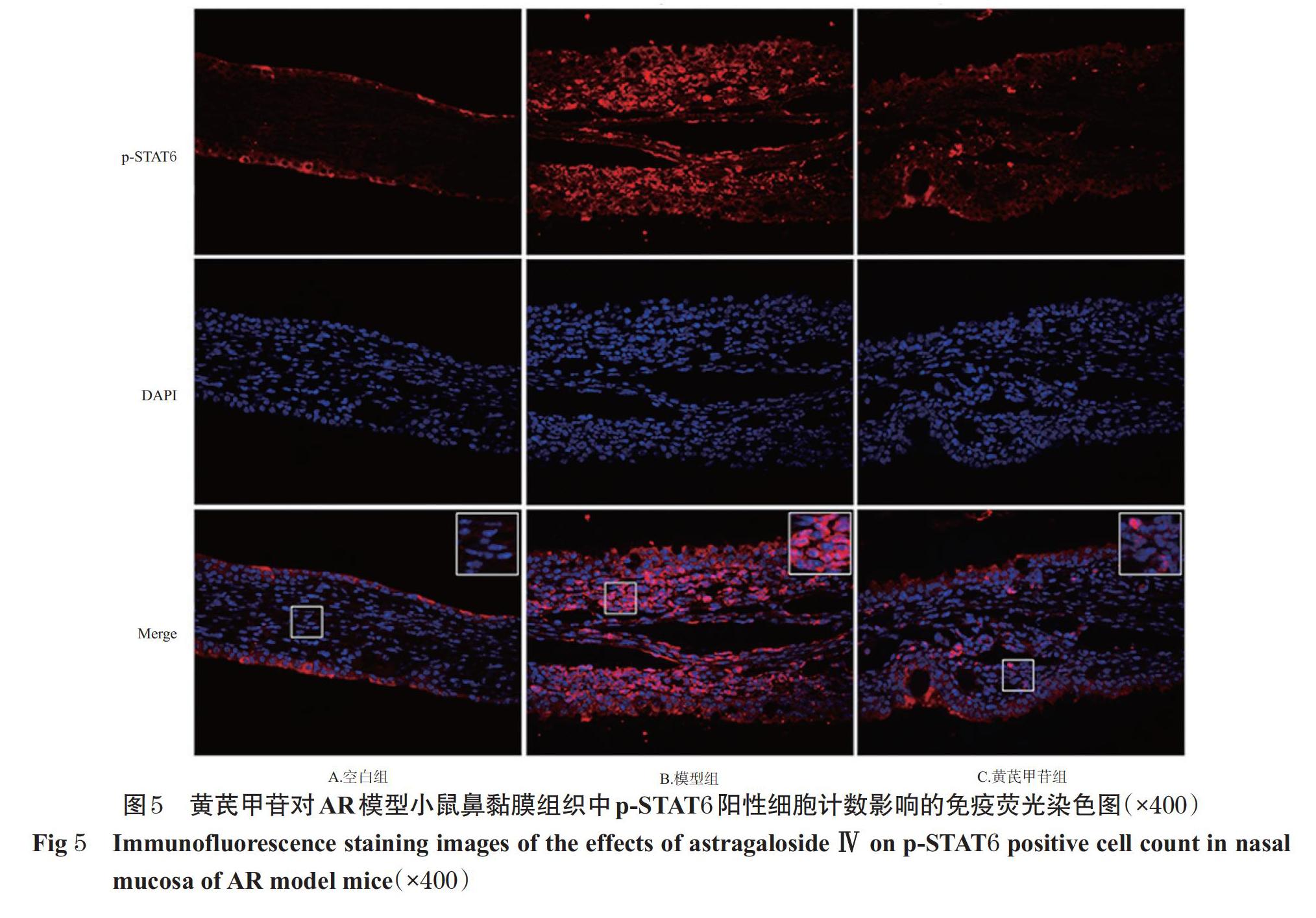
摘 要 目的:初步研究黄芪甲苷对变应性鼻炎(AR)模型小鼠改善作用的可能机制。方法:将C57/BL6小鼠随机分为空白组、模型组和黄芪甲苷组,每组10只。除空白组外,其余大鼠均于第0、7、14、21~27天以卵清蛋白为致敏源进行攻击以复制AR模型。于造模第15~27天,黄芪甲苷组小鼠按0.02 mL/g腹腔注射黄芪甲苷40 mg/kg(第21~27天均于攻击致敏前1 h给药),空白组和模型组小鼠腹腔注射等体积生理盐水,每天1次。末次攻击致敏24 h后,观察各组小鼠鼻黏膜组织中炎症细胞的浸润情况,检测其鼻腔灌洗液中白细胞介素4(IL-4)、IL-5、干扰素γ(IFN-γ)含量,鼻黏膜和脾脏组织中活性氧簇(ROS)水平和磷酸化Janus激酶2(p-JAK2)、磷酸化信号转导及转录激活蛋白6(p-STAT6)阳性细胞计数,以及脾脏组织中JAK2、STAT6蛋白的磷酸化水平(即p-JAK2/JAK2比值、p-STAT6/STAT6比值)。结果:与空白组比较,模型组小鼠鼻黏膜组织中炎症细胞(嗜酸粒细胞和肥大细胞)计数,鼻腔灌洗液中IL-4、IL-5含量,鼻黏膜和脾脏组织中ROS水平和p-JAK2、p-STAT6阳性细胞计数,脾脏组织中p-JAK2/JAK2比值、p-STAT6/STAT6比值均显著升高(P<0.05),鼻腔灌洗液中INF-γ含量显著降低(P<0.05)。与模型组比较,黄芪甲苷组小鼠鼻黏膜组织中炎症细胞计数,鼻腔灌洗液中IL-4、IL-5含量,鼻黏膜和脾脏组织中ROS水平和p-JAK2、p-STAT6阳性细胞数量,脾脏组织中p-JAK2/JAK2比值、p-STAT6/STAT6比值均显著降低(P<0.05),鼻腔灌洗液中INF-γ含量显著增加(P<0.05)。结论:黄芪甲苷能够有效改善AR模型小鼠变应性炎症反应,其机制可能与下调JAK2/STAT6信号通路及ROS水平有关。
关键词 变应性鼻炎;黄芪甲苷;活性氧簇;Janus激酶2/信号转导及转录激活蛋白6信号通路;小鼠
Preliminary Study on the Improvement Effects of Astragaloside Ⅳ on Allergic Rhinitis Model Mice
CHEN Xuqing1,MA Huaan1,ZHOU Longyun2,YAN Daonan1,LIU Shufen3,WU Jiyong1(1. Dept. of Otorhinolaryngology, the Affiliated Hospital of Nanjing University of TCM, Nanjing 210029, China; 2. Dept. of Rehabilitation, the First Affiliated Hospital of Nanjing Medical University, Nanjing 210029, China; 3. Faculty of Basic Medicine, Longhua Hospital Affiliated to Shanghai University of TCM, Shanghai 210032, China)
ABSTRACT OBJECTIVE: To preliminarily study the potential mechanism of astragaloside Ⅳ on allergic rhinitis (AR) model mice. METHODS: C57/BL6 mice were randomly divided into blank group, model group and astragaloside Ⅳ group, with 10 mice in each group. Except for blank group, AR model was prepared by sensitization and challenge with ovalbumin on day 0, 7, 14 and 21-27. Astragaloside Ⅳ group was given astragaloside Ⅳ 40 mg/kg intraperitoneally at the dose of 0.02 mL/g on the 15th to 27th day of modeling (given the drug 1 h before challenge sensitization on the 21st to 27th day). Blank group and model group were given constant volume of normal saline intraperitoneally, once a day. Twenty-four hours after sensitization from the last challenge, the infiltration of inflammatory cells in the nasal mucosa of each group was observed, and the contents of interleukin 4 (IL-4), IL-5 and interferon gamma (IFN-γ) in the nasal lavage fluid were measured. The levels of reactive oxygen species (ROS), and the count of phosphorylated Janus kinase 2 (p-JAK2) and phosphorylation signal transduction and activation of transcription protein 6 (p-STAT6) positive cells in the nasal mucosa and spleen as well as the phosphorylation levels of JAK2 and STAT6 proteins in spleen tissue (i.e. p-JAK2/JAK2 ratio, p-STAT6/STAT6 ratio) were also determined. RESULTS: Compared with blank group, the number of inflammatory cells in the nasal mucosa (eosinophils and mast cells) in the model group, the contents of IL-4 and IL-5 in the nasal lavage fluid, and the levels of ROS in the nasal mucosa and spleen tissues in the model group, the count of p-JAK2 and p-STAT6 positive cells increased significantly, the p-JAK2/JAK2 ratio, p-STAT6/STAT6 ratio in the spleen tissue were significantly increased (P<0.05), and the content of INF-γ in the nasal lavage fluid was significantly decreased (P<0.05). Compared with model group, the count of inflammatory cells infiltrated in the nasal mucosa, the contents of IL-4 and IL-5 in the nasal cavity lavage fluid, the level of ROS and the number of p-JAK2 and p-STAT6 positive cellsin the nasal mucosa and spleen tissue as well as the p-JAK2/JAK2 ratio and p-STAT6/STAT6 ratio in spleen tissue were decreased significantly (P<0.05), and the content of INF-γ in nasal lavage fluid was significantly increased (P<0.05). CONCLUSIONS: Astragaloside Ⅳ can effectively improve the inflammatory response in AR model mice, the mechanism of which may be related to down-regulation of JAK2/STAT6 signaling pathway and ROS level.
KEYWORDS Allergic rhinitis; Astragaloside Ⅳ; ROS;JAK2/STAT6 signaling pathway; Mice
变应性鼻炎(AR)为耳鼻咽喉头颈外科最常见的疾病之一[1-3]。据统计,世界范围内约有10.0%~40.4%的人口具有AR的临床表现[4-6]。研究表明,内源性活性氧簇(ROS)水平升高以及Janus激酶2(JAK2)、信号转导及转录激活蛋白6(STAT6)信号分子活化是变应性炎症发生发展的重要病理机制,而选择性降低ROS水平,抑制JAK2、STAT6信号分子活化,则能显著改善AR等变应性炎症[7-10]。……
