神经内镜联合自制透明管鞘治疗高血压脑出血的效果分析
2021-06-15郭邦明刘德华邹连生高志强刘鹏邱传珍黄骏
郭邦明 刘德华 邹连生 高志强 刘鹏 邱传珍 黄骏

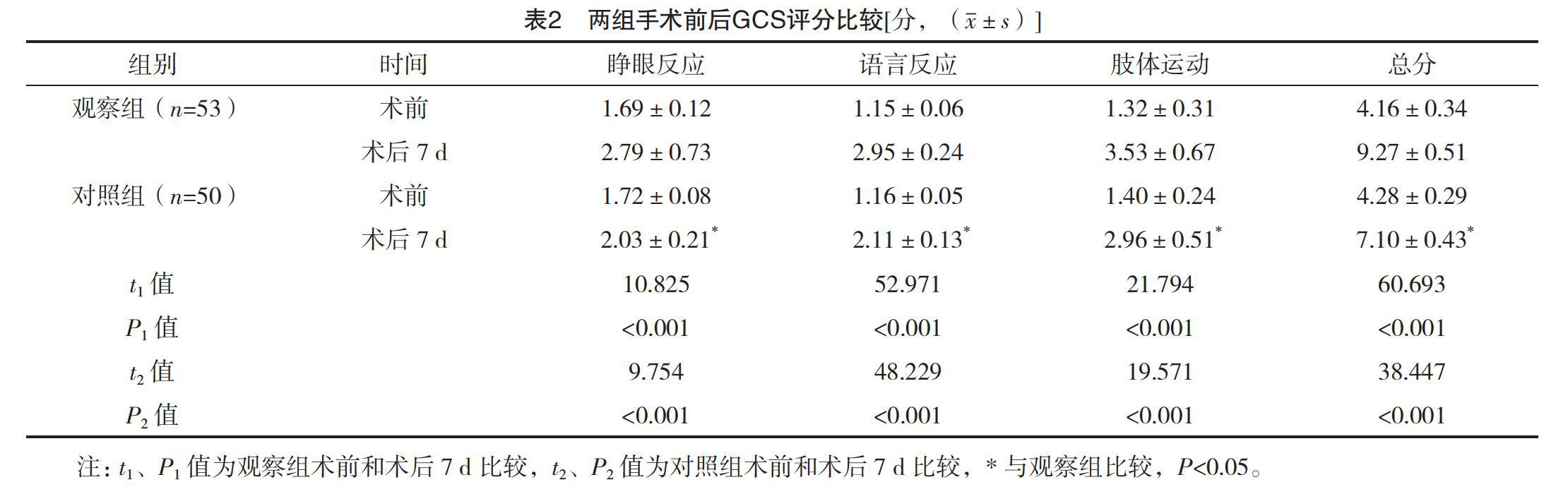
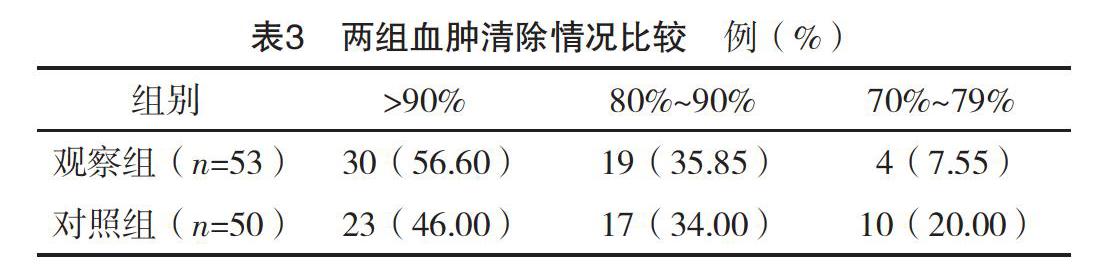
【摘要】 目的:探讨高血压脑出血患者经神经内镜联合自制透明管鞘治疗的效果,为未来该类疾病治疗方案的制定提供参考。方法:选取2018年3月-2019年12月于本院接受治疗的103例高血压脑出血患者。向全部患者介绍常规开颅手术治疗方案与神经内镜联合自制透明管鞘辅助治疗方案,按照家属的意愿将患者分为观察组(神经内镜联合自制透明管鞘辅助治疗,53例)与对照组(常规开颅手术治疗,50例)。比较两组临床指标,比较两组手术前后的格拉斯哥昏迷指数评估量表(GCS)、日常生活能力量表(ADL)评分,比较两组的血肿清除情况、再出血及并发症发生情况。结果:观察组术中出血量及住院总费用均少于对照组,手术时间及住院时间均短于对照组,差异均有统计学意义(P<0.05)。术后7 d,两组睁眼反应、语言反应、肢体运动及总分均高于术前,且观察组睁眼反应、语言反应、肢体运动及总分均高于对照组,差异均有统计学意义(P<0.05)。两组的血肿清除率比较,差异无统计学意义(P>0.05)。两组术后再出血率比较,差异无统计学意义(P>0.05);观察组肺部感染、脑脊液切口漏、脑积水及硬膜下积液发生率均低于对照组,差异均有统计学意义(P<0.05)。术后6个月,两组进食、洗澡、修饰洗漱、穿衣、大便控制、小便控制、用厕、床-椅转移、平地行走、上下楼梯及总分均高于术前,且观察组上述评分均高于对照组,差异均有统计学意义(P<0.05)。结论:高血压脑出血患者经神经内镜联合自制透明管鞘治疗效果显著,有利于减少术中出血量、缩短住院时间、减轻昏迷程度、促进术后日常生活能力提高,且在一定程度上可减少部分并发症发生,临床应用价值高。
【關键词】 高血压脑出血 神经内镜 自制透明管鞘 开颅手术
Effect Analysis of Neuroendoscopy Combined with Self-made Transparent Tube Sheath in the Treatment of Hypertensive Cerebral Hemorrhage/GUO Bangming, LIU Dehua, ZOU Liansheng, GAO Zhiqiang, LIU Peng, QIU Chuanzhen, HUANG Jun. //Medical Innovation of China, 2021, 18(12): 0-025
[Abstract] Objective: To explore the therapeutic effect of neuroendoscopy combined with self-made transparent sheath in patients with hypertensive cerebral hemorrhage, and to provide a reference for the future treatment plan for such diseases. Method: A total of 103 patients with hypertensive cerebral hemorrhage who received treatment in our hospital from March 2018 to December 2019 were selected. All patients were introduced to the conventional craniotomy treatment plan and neuroendoscopy combined with self-made transparent tube sheath adjuvant treatment plan, and the patients were divided into observation group (neuroendoscopy combined with self-made transparent tube sheath adjuvant treatment, 53 cases) and control group (conventional craniotomy, 50 cases) according to the wishes of their families. Clinical indicators were compared between the two groups. The scores of Glasgow Coma Scale (GCS) and daily living ability scale (ADL) before and after operation were compared. The hematoma clearance, rebleeding and complications were compared between two groups. Result: The amount of intraoperative blood loss and total hospitalization cost in the observation group were less than those in the control group, and the duration of operation and hospitalization were shorter than those in the control group, the differences were statistically significant (P<0.05). At 7 d after operation, the eye opening response, language response, body movement and total score in both groups were higher than those of before operation, and the above scores in the observation group were higher than those in the control group, the differences were statistically significant (P<0.05). There was no significant difference in hematoma clearance rate between two groups (P>0.05). There was no significant difference in the rate of postoperative rebleeding between two groups (P>0.05). The incidence of pulmonary infection, cerebrospinal fluid incision leakage, hydrocephalus and subdural effusion in the observation group were lower than those in the control group, the differences were statistically significant (P<0.05). Six months after surgery, the scores of eating, bathing, grooming, dressing, stool control, urination control, toilet use, bed-chair transfer, flat walking, walking up, down stairs and total scores in both groups were higher than those before surgery, and the above scores in the observation group were higher than those in the control group, the differences were statistically significant (P<0.05). Conclusion: The therapeutic effect of neuroendoscopy combined with self-made transparent tube sheath on patients with hypertensive intracerebral hemorrhage is significant, which is conducive to reducing intraoperative blood loss, shortening hospitalization time, reducing coma degree, improving postoperative daily living ability, and reducing partial complications to a certain extent. Therefore, the clinical application value is high.
[Key words] Hypertensive cerebral hemorrhage Neuroendoscopy Self-made transparent tube sheath Craniotomy
First-authors address: First Affiliated Hospital of Gannan Medical University, Ganzhou 341000, China
doi:10.3969/j.issn.1674-4985.2021.12.005
作为高血压最严重的并发症之一,高血压脑出血发病急骤,病情可在较短时间内迅速发展,具有高发病率、病死率及复发率,严重威胁患者的生命安全[1]。文献[2]指出,手术治疗能够显著改善高血压脑出血导致的血肿占位效应,阻止红细胞降解,减轻毒性作用,对降低复发率、挽救患者生命安全具有重要作用。既往,临床上常采用常规开颅手术治疗高血压脑出血,具有視野清晰、操作便捷、可取得良好血肿清除效果等优势,但有研究指出,常规开颅手术常造成较大创伤,手术时间长,且术后可发生多种并发症,不利于预后[3]。神经……