持续质量改进管理联合纽曼系统模式在ICU血液透析患者中的应用观察
2021-05-06陈上学刘子圆吴袁琴
陈上学 刘子圆 吴袁琴
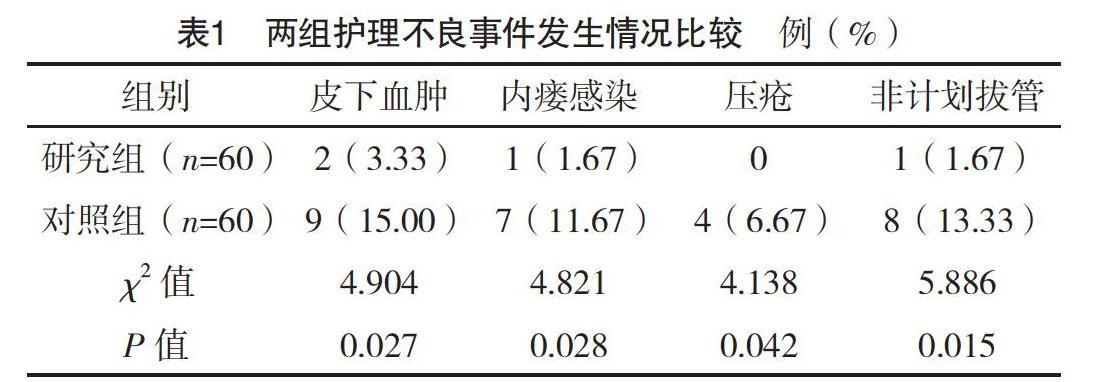


【摘要】 目的:探討持续质量改进管理联合纽曼系统模式在重症监护室(ICU)血液透析患者中的应用观察。方法:选取2018年6月-2019年6月于本院ICU血液透析的120例患者为受试对象,按照随机数表法将其分为研究组与对照组,各60例。对照组采取常规护理结合纽曼系统模式,研究组在对照组基础上联合持续质量改进管理护理。比较干预1周时,两组护理不良事件(皮下血肿、内瘘感染、压疮、非计划拔管),并发症(静脉端血栓、动脉端血栓、假性动脉瘤)发生情况;比较干预前及干预1周时,两组营养状态(上臂围、肱三头肌皮褶厚度、左小腿围)及心理状态。结果:研究组皮下血肿、内瘘感染、压疮、非计划拔管不良事件发生率均低于对照组,差异均有统计学意义(P<0.05)。研究组静脉端血栓、动脉端血栓、假性动脉瘤发生率均低于对照组,差异均有统计学意义(P<0.05)。干预1周,研究组上臂围、肱三头肌皮褶厚度、左小腿围与干预前比较,差异均无统计学意义(P>0.05),对照组上臂围、肱三头肌皮褶厚度、左小腿围较干预前均降低,且均低于研究组,差异均有统计学意义(P<0.05)。干预1周,两组SCL-90各项评分均较干预前降低,且研究组均低于对照组,差异均有统计学意义(P<0.05)。结论:持续质量改进管理联合纽曼系统模式应用于ICU血液透析患者,可有效减少护理不良事件及并发症发生率,改善患者营养状况及心理状态。
【关键词】 持续质量改进管理护理 纽曼系统模式 血液透析
Observation on the Application of Continuous Quality Improvement Management Combined with Newman System Model in Hemodialysis Patients in ICU/CHEN Shangxue, LIU Ziyuan, WU Yuanqin. //Medical Innovation of China, 2021, 18(01): -109
[Abstract] Objective: To explore the application of continuous quality improvement management combined with Newman system model in hemodialysis patients in intensive care unit (ICU). Method: A total of 120 patients on hemodialysis in ICU of our hospital from June 2018 to June 2019 were selected as subjects, they were divided into study group and control group according to random number table method, 60 cases in each group. The control group adopted routine nursing combined with Newman system mode, the study group combined with continuous quality improvement management nursing on the basis of the control group. The nursing adverse events (subcutaneous hematoma, internal fistula infection, pressure sore, unplanned extubation) and complications (venous thrombus, arterial thrombus, pseudoaneurysm) were compared between the two groups at 1 week after the intervention; the nutritional status (upper arm circumference, triceps skinfold thickness, left calf circumference) and psychological status were compared between the two groups at before and 1 week after the intervention. Result: The incidence of subcutaneous hematoma, internal fistula infection, pressure sore and unplanned extubation adverse events in the study group were all lower than those in the control group, the differences were statistically significant(P<0.05). The incidence of venous thrombosis, arterial thrombosis and pseudoaneurysm in the study group were lower than those in the control group, the differences were statistically significant (P<0.05). After 1 week of intervention, there were no statistically significant differences in upper arm circumference, triceps skin fold thickness, left calf circumference compared with that before intervention in the study group (P>0.05), while in the control group, upper arm circumference, triceps skin fold thickness, left leg circumference were all lower than those before intervention, and were all lower than those in the study group, the differences were statistically significant (P<0.05). After 1 week of intervention, SCL-90 scores in the two groups were lower than those before intervention, in the study group were all lower than those in the control group, the differences were statistically significant (P<0.05). Conclusion: Continuous quality improvement management combined with Newman system can effectively reduce the incidence of nursing adverse events and complications, improve the nutritional status and psychological status of patients.
[Key words] Continuous quality improvement management nursing Newman system model Hemodialysis
First-authors address: Pingxiang Peoples Hospital, Pingxiang 337000, China
doi:10.3969/j.issn.1674-4985.2021.01.027
随着人们生活水平不断提高,医疗体制改革创新,患者安全问题成为卫生保健系统及社会群体关注的重点,同时也成为护理管理中的重要难题[1]。血液透析患者的生命体征、输血及输注药物是重症监护室(ICU)护理管理当中需重点改进之处[2]。此外,由于ICU患者自身受到疾病与客观环境影响,会产生焦虑、恐惧等负面情绪[3]。持续质量改进管理护理作为一种全新的护理干预模式,转变原有的护理观念,从根本上减少护理不良事件及患者并发症发生[4],“以患者为中心”的护理方式,使患者在生存质量、心理状态得到进一步提升[5]。……
