知识-信念-行为模式训练对抑郁症药物治疗患者服药依从性、抑郁程度、生活质量影响研究
2021-02-03沈妃何国琪严焕然郑春美
沈妃 何国琪 严焕然 郑春美


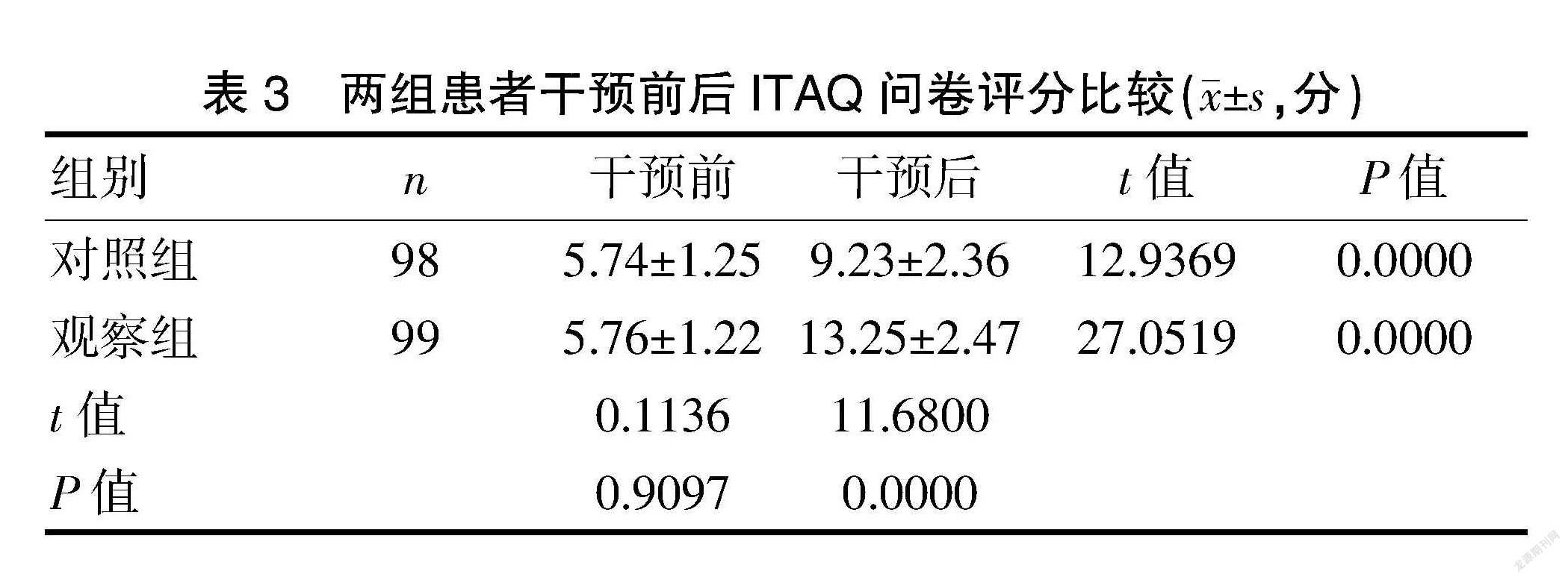
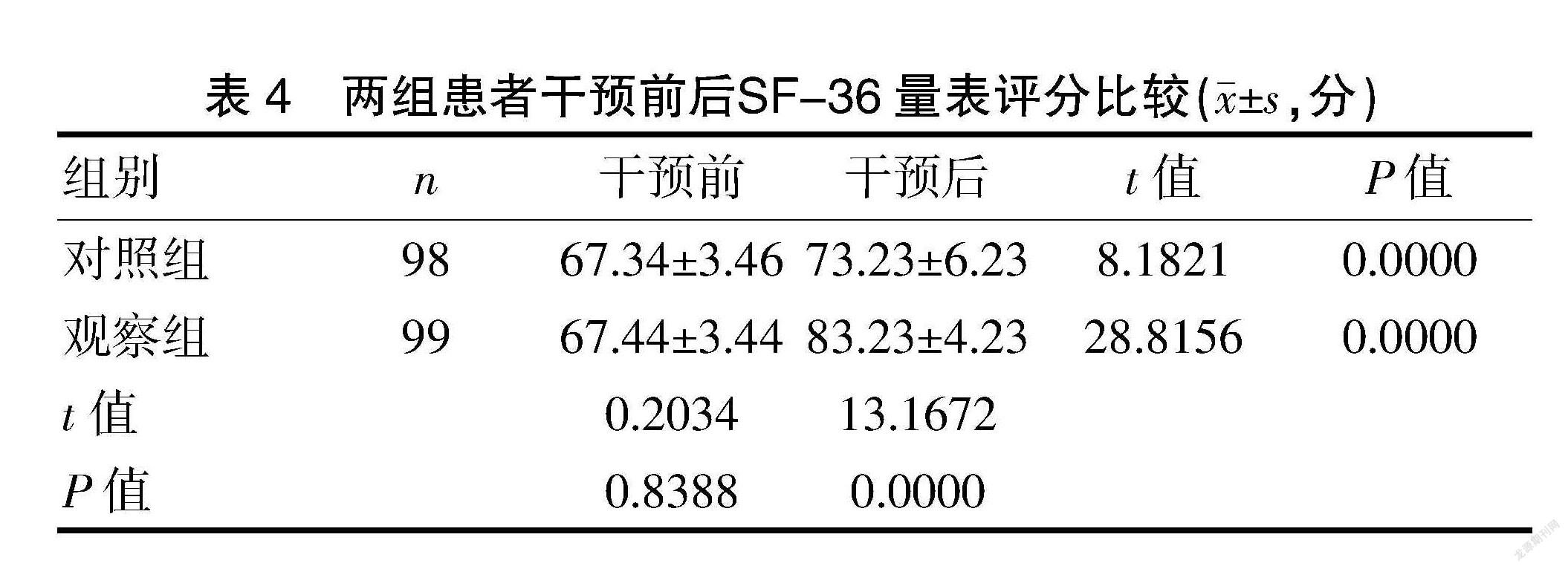

[摘要] 目的 探討知识-信念-行为模式训练对抑郁症药物治疗患者服药依从性、抑郁程度、生活质量影响。 方法 研究合计纳入197例抑郁症药物治疗患者,均由我院2019年1月至2020年6月收治,采取随机数字表法将其分为观察组及对照组,予以对照组患者(n=98)常规临床干预,予以观察组患者(n=99)常规干预及知识-信念-行为模式训练,比较两组患者干预前后药物态度量表(DAI-10)及药物依从性评定量表(MARS)评分变化、汉密尔顿焦虑量表(HAMA)及抑郁量表(HAMD)评分变化、自知力和治疗态度问卷(ITAQ)评分变化、生活质量量表(SF-36)评分变化、患者对本次干预满意度。 结果 干预前,两组患者DAI-10及MARS、HAMA、HAMD量表评分、ITAQ问卷评分、SF-36量表评分比较,差异无统计学意义(P>0.05),干预后两组患者DAI-10及MARS、ITAQ问卷评分、SF-36量表评分均较干预前显著升高,HAMA、HAMD量表评分均较干预前显著降低,观察组患者干预后DAI-10及MARS、ITAQ问卷评分、SF-36量表评分均高于对照组,HAMA、HAMD量表评分均低于对照组,差异有统计学意义(P<0.05);观察组患者干预满意率为97.98%,高于对照组的88.78%,差异有统计学意义(P<0.05)。 结论 知识-信念-行为模式训练可提升抑郁症药物治疗患者服药依从性,改善患者病情,提升患者生活质量及满意率,值得深入研究。
[关键词] 抑郁症;药物治疗;知识-信念-行为模式训练;服药依从性;抑郁程度;生活质量
[中图分类号] R749 [文献标识码] B [文章编号] 1673-9701(2021)35-0091-04
Study on the effects of knowledge-belief-behavior pattern training on medication compliance, depression degree and quality of life in the patients with depression taking medication
SHEN Fei HE Guoqi YAN Huanran ZHENG Chunmei
No. 1 Ward of Psychiatry, Shaoxing Seventh People′s Hospital, Shaoxing 312000, China
[Abstract] Objective To explore the effects of knowledge-belief-behavior model training on medication compliance, depression degree and quality of life in the patients with depression taking medication. Methods A total of 197 patients with depression taking medication were included in the study, all of whom were admitted to our hospital from January 2019 to June 2020. The random number table method was used to divide them into observation group and control group. Patients in the control group(n=98) were given routine clinical intervention, and patients in the observation group (n=99) were given routine intervention and knowledge-belief-behavior model training. The changes in the scores of the Drug Attitude Scale(DAI-10) and the Drug Compliance Rating Scale (MARS), the changes in the scores of Hamilton Anxiety Scale (HAMA) and Depression Scale (HAMD), the changes in the scores of the insight and treatment attitude questionnaire (ITAQ), the changes in the scores of the quality of life scale (SF-36), as well as patients′ satisfaction with this intervention were compared between the two groups before and after intervention. Results Before the intervention, the scores of DAI-10 and MARS, HAMA, HAMD scale, ITAQ questionnaire score and SF-36 scale score were compared between the two groups of patients(P>0.05). After the intervention, the DAI-10, MARS, ITAQ questionnaire scores,and SF-36 scale scores in both groups were significantly higher than that before the intervention(P<0.05). After the intervention,HAMA,HAMD scale scores in both groups were significantly lower than that before the intervention(P<0.05). DAI-10 and MARS,ITAQ questionnaire scores, and SF-36 scale scores in the observation group were higher than those in the control group after intervention (P<0.05).After the intervention,HAMA,HAMD scale scores in the observation group were lower than those in the control group(P<0.05). The intervention satisfaction rate was 97.98% in the observation group, which was higher than that of 88.78% in the control group (P<0.05). Conclusion Knowledge-belief-behavior model training can improve the compliance of patients with depression taking medication, improve their conditions, and improve their quality of life and satisfaction rate, which is worth in-depth study.
[Key words] Depression; Medication; Knowledge-belief-behavior model training; Medication compliance; Degree of depression; Quality of life
抑郁症是精神科较为常见疾病,属于慢性、复发性精神疾病,影响患者身心健康,给其家庭带来严重负担及不良后果[1-2]。目前临床治疗抑郁症多采取药物控制患者病情,预防病情发作,取得一定效果,临床应用广泛[3-4]。……