脑卒中后肢体偏瘫患者深静脉血栓的风险防范与管理措施效果评价
2020-12-23赵娅卢姗姗
赵娅 卢姗姗

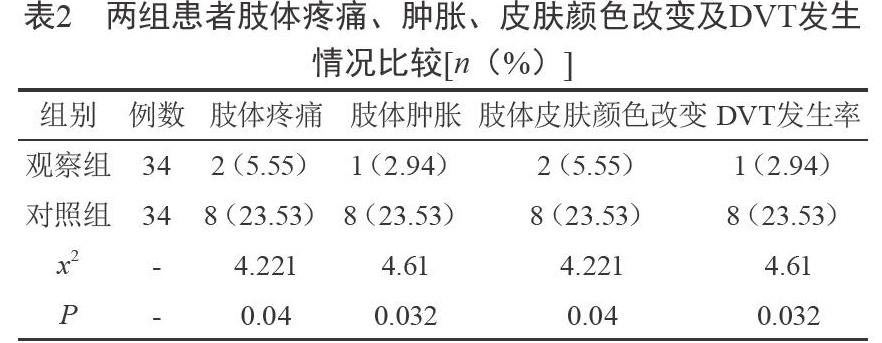
【摘要】目的 探讨评价脑卒中后肢体偏瘫患者深静脉血栓(DVT)的风险防范与管理措施的临床效果。方法 选取我院神经内科2019年01月~2020年04月收治的68例脑卒中后肢体偏瘫患者,随机均分为对照组和观察组各34例。对照组予正确体位安置、肢体按摩、定时翻身、弹力袜等预防DVT发生的常规护理,观察组在对照组基础上应用住院患者下肢深静脉血栓危险因素评估表(Autar)评估DVT风险等级,并根据风险等级采取相应的干预措施。对比两组干预两周后的肢体疼痛、肿胀DVT发生率、生活质量(SS-QOL)及血清D-二聚体水平。结果 干预前,两组SS-QOL评分及血清D-二聚体水平比较无明显差异,差异无统计学意义(P>0.05);干预后,观察组肢体疼痛、肿胀、皮肤颜色改变及DVT发生率均明显低于对照组,差异有统计学意义(P<0.05);干预后,两组SS-QOL评分明显高于本组干预前,其中观察组干预后SS-QOL评分又明显高于对照组,差异有统计学意义(P<0.05);干预后,观察组血清D-二聚体水平明显低于对照组,差异有统计学意义(P<0.05)。结论 对脑卒中后肢体偏瘫患者采用风险评估及对应的防范措施,可明显改善患者血液循環及高凝状态,减少患者肢体疼痛、肿胀、皮肤颜色改变及DVT发生率,提高患者生活质量,利于患者康复。
【关键词】脑卒中;肢体偏瘫;深静脉血栓;生活质量;血液循环
【中图分类号】R743.3 【文献标识码】A 【文章编号】ISSN.2095.6681.2020.33..03
【Abstract】Objective To evaluate the clinical effect of risk prevention and management measures of deep vein thrombosis (DVT) in patients with limb hemiplegia after stroke.Methods A total of 68 patients with limb hemiplegia after stroke who were admitted to our department of neurology from January 2019 to April 2020 were randomly divided into a control group and an observation group with 34 cases each.The control group was given routine care such as correct posture placement,limb massage regular turning, and elastic stockings to prevent the occurrence of DVT.The observation group used the risk factor assessment table (Autar) for lower limb deep vein thrombosis of inpatients on the basis of the control group to assess the risk level of DVT, and Take appropriate interventions according to the risk level. The two groups were compared after two weeks of limb pain,swelling DVT incidence, quality of life (SS-QOL) and serum D-dimer levels.Results Before intervention,there was no significant difference in SS-QOL score and serum D-dimer level between the two groups (P>0.05);after intervention, limb pain, swelling,skin color change and incidence of DVT in the observation group were significantly lower than those in the control group (P<0.05); after intervention, the SS-QOL scores of the two groups were significantly higher than those of the group before intervention, and the SS-QOL score of the observation group after intervention was significantly higher than the control group (P<0.05);after intervention, the serum of the observation group The level of D-dimer was significantly lower than that of the control group (P<0.05).Conclusion Risk assessment and corresponding preventive measures for patients with limb hemiplegia after stroke can significantly improve the patient's blood circulation and hypercoagulability, reduce the patient's limb pain, swelling, skin color changes and the incidence of DVT,improve the patient's quality of life,and benefit the patient's recovery.
【Key words】Stroke;Limb hemiplegia;Deep vein thrombosis;Quality of life;lood circulation
目前我国每年新发脑血管病患者约270万, 其中因脑卒中导致的死亡居中国居民第一位死因,已成为严重危害中国居民健康和生命的主要疾病,呈现出高发病率、高致残率、高死亡率、高复发率、高经济负担五大特点[1-2]。肢体偏瘫是脑卒中后主要功能残疾,患者需长期卧床,血液瘀滞粘稠,导致循环不畅,血液成高凝状态,极易发生下肢深静脉血栓形成(deep venous thrombosis,DVT)等并发症,从而可能加重脑卒中患者病情,甚至导致死亡[3]。临床护理工作中针对脑卒中后偏瘫患者DVT风险防范和预防措施通常有正确体位安置、肢体按摩、定时翻身、弹力袜等[4],本文着重探讨和评价我院神经内科护理组近两年来针对脑卒中后肢体偏瘫患者发生肢体DVT风险等级评估而采取的相应干预措施和临床效果,现总结如下。