情感交互模式对广泛性焦虑症患者负性情绪及睡眠质量的影响
2020-08-21高莹
高莹

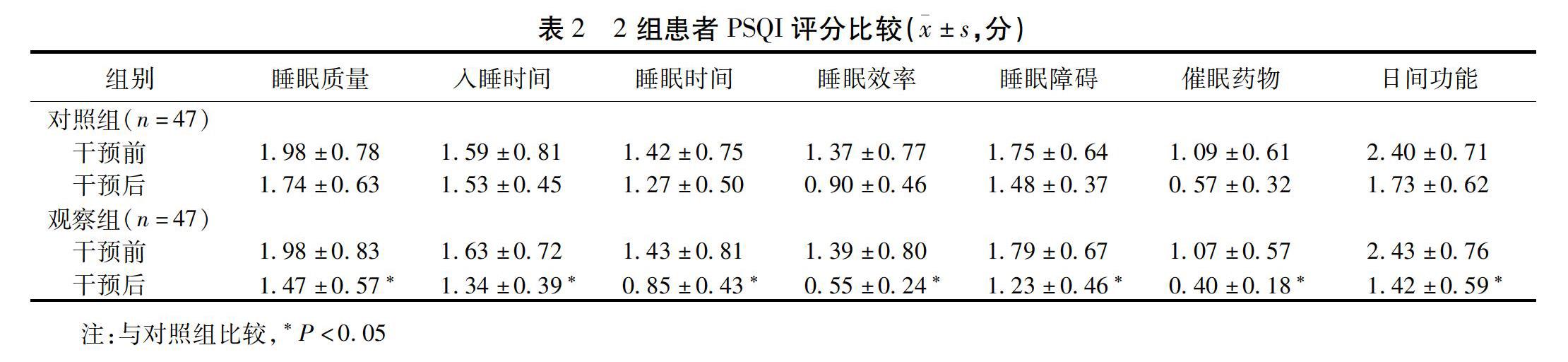
摘要目的:探讨情感交互模式对广泛性焦虑症患者负性情绪及睡眠质量的影响。方法:选取2018年7月至2019年6月淄博市第五人民医院收治的广泛性焦虑症患者94例作为研究对象,随机分为观察组和对照组,每组47例,对照组给予精神病科常规护理,在此基础上,观察组给予情感交互模式。干预4周后,比较2组患者汉密尔顿焦虑量表(HAMA)、汉密尔顿抑郁量表(HAMD)、匹兹堡睡眠质量指数(PSQI)评分。结果:观察组HAMA、HAMD评分均明显低于对照组(P<005);PSQI各维度评分均明显低于对照组(P<005)。结论:情感交互模式有助于缓解广泛性焦虑症患者的负性情绪,改善睡眠质量。
关键词广泛性焦虑症;情感交互;负性情绪;睡眠质量
Effect of Emotional Interaction Pattern on Negative Emotion and Sleep Quality in Patients with Extensive Anxiety Disorder
GAO Ying
(Department of psychiatry No2 ward for women,the Fifth People′s Hospital of Zibo Shandong Province,Zibo 255100,China)
AbstractObjective:To investigate the effect of affective interaction on negative emotion and sleep quality in patients with extensive anxiety disorderMethods:A total of 94 patients with extensive anxiety disorder were randomly divided into observation group(n=47)and control group(n=47),from July 2018 to June 2019, the Fifth people′s Hospital of Zibo CityThe control group was given routine nursing care in psychiatry departmentOn this basis,the observation group was given emotional interaction modeAfter 4 weeks of intervention,the Hamilton anxiety scale(HAMA),Hamilton depression scale(HAMD),Pittsburgh sleep quality index(PSQI)Was compared between the two groupsResults:The HAMA,HAMD scores of the observation group were significantly lower than those of the control group(P<005); PSQI)The scores of each dimension were significantly lower than those of the control group(P<005)Conclusion:Emotional interaction mode is helpful to alleviate the negative emotion of patients with extensive anxiety disorder and improve the quality of sleep.
KeywordsExtensive anxiety disorder;Emotional interaction;Negative emotion;Sleep quality
中圖分类号:R7494+1;R33863文献标识码:Adoi:10.3969/j.issn.2095-7130.2020.06.072
广泛性焦虑症是临床常见的一种精神障碍性疾病,临床研究证实,有效的心理干预联合药物治疗有助于提高广泛性焦虑症患者的临床疗效[1]。情感交互模式从精神心理学角度出发,通过双方互帮互助,实现情感共情、共鸣,从而达到改善个体不良情感的目的[2]。本文采取随机对照研究的方法,探讨情感交互模式对广泛性焦虑症患者负性情绪及睡眠质量的影响。
1资料与方法
11一般资料选取2018年7月至2019年6月淄博市第五人民医院收治的广泛性焦虑症患者94例作为研究对象,随机分为对照组和观察组,每组47例。对照组中男20例,女27例;年龄20~57岁,平均年龄(3697±856)岁;病程1~7年,平均病程(324±138)年;上学年限5~15年,平均年限(937±360)年。观察组中男19例,女28例;年龄23~58岁,平均年龄(3874±926)岁;病程05~6年,平均病程(315±147)年;上学年限4~15年,平均年限(932±347)年。2组患者一般资料比较,差异无统计学意义(P>005),具有可比性。
12纳入标准1)符合广泛性焦虑症的诊断标准;2)年龄:18~60岁;3)签署知情同意书。