恶意弹窗广告攻击检测技术的研究
2020-05-21孙冲冲徐亚峰卜东泰韩港成胥勋鹏高明
孙冲冲 徐亚峰 卜东泰 韩港成 胥勋鹏 高明
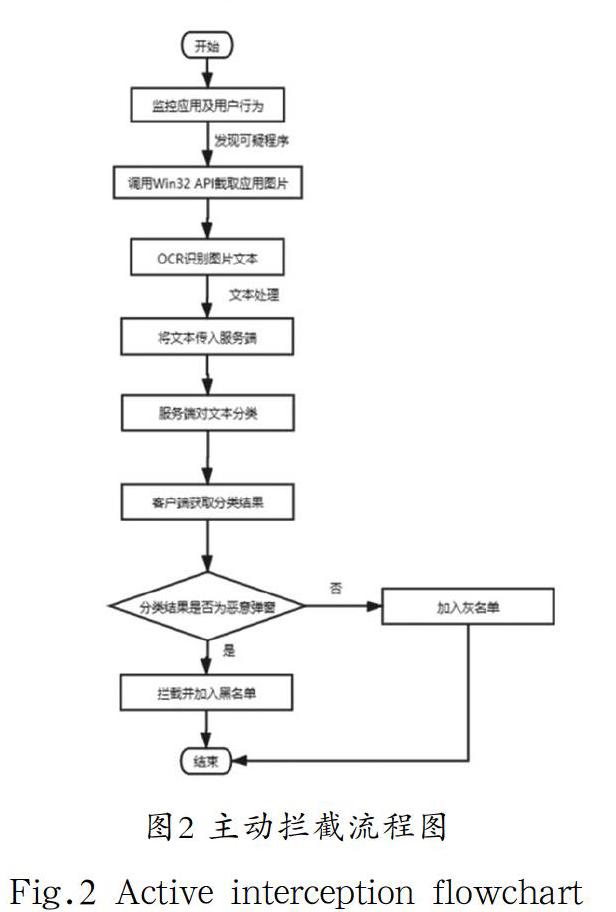
摘 要:恶意弹窗广告是一种强迫式的广告,这些广告给投放者带来巨大的利益,但是严重影响了用户体验,侵犯了用户权益,同时也带来很多安全隐患。恶意弹窗广告攻击检测系统采用C/S架构,服务端使用朴素贝叶斯算法根据训练集生成和更新训练结果,并利用训练结果对客户端发送的弹窗截图文本进行分类预测。客户端包括基础拦截、截图拦截以及主动拦截三个模块,主动拦截模块使用OCR技术将可疑弹窗截图转化为文本,然后把此文本传给服务端,服务端加载之前训练集产生的训练结果,利用朴素贝叶斯算法得到此文本的预测结果,客户端根据预测结果确定对此弹窗是否拦截。本系统实现了弹窗识别拦截的智能化,配置方便,交互界面易于使用。
关键词:弹窗广告;机器学习;朴素贝叶斯算法;拦截
中图分类号:TP315 文献标识码:A
Abstract:Malicious pop-up advertisements are imposed on users. These advertisements bring huge benefits to the publishers, but seriously affect user experience, infringe on user rights and interests, and also bring many security risks. The malicious pop-up advertisements attack detection system uses C/S (Client/Server) architecture. The server uses Naive Bayes algorithm to generate and update training results based on the training set, and uses the training results to classify and predict the pop-up screenshot text sent by the client. The client includes three modules: basic interception, screenshot interception, and active interception. The active interception module uses OCR (Optical Character Recognition) technology to convert the suspicious pop-up screenshot into text, and then transmits this text to the server. The server loads the training results generated by the previous training set. The naive Bayesian algorithm is used to obtain the prediction result of this text, and the client determines whether to block the pop-up window according to the prediction result. The system implements the intelligent identification and interception of the pop-up window, with convenient configuration and user-friendly interface.
Keywords:pop-up advertisements; machine learning; naive Bayesian algorithm; interception
1 引言(Introduction)
受到利益的驅使,很多恶意软件都捆绑了大量的广告。但是,以这种方式获利是不健康,不正当的,不利于互联网产业的正常发展。虽然目前有一部分拦截软件实现了恶意广告拦截的功能,但很多弹窗广告依赖用户识别,智能化程度不高。本项目就是在研究相应的检测技术的基础上,设计与实现一款高效率的智能恶意弹窗检测系统,扼制恶意广告泛滥的情况,营造良好的上网环境。
2 系统功能介绍(Introduction of system function)
本系统采用C/S(Client/Server, 客户端/服务端)架构。客户端主要负责与用户的交互,同时具有轻量的数据处理任务;服务端主要负责用户数据处理。……