预见性护理对宫腔镜术患者围术期并发症的预防作用分析
2020-01-11朱卫平
朱卫平
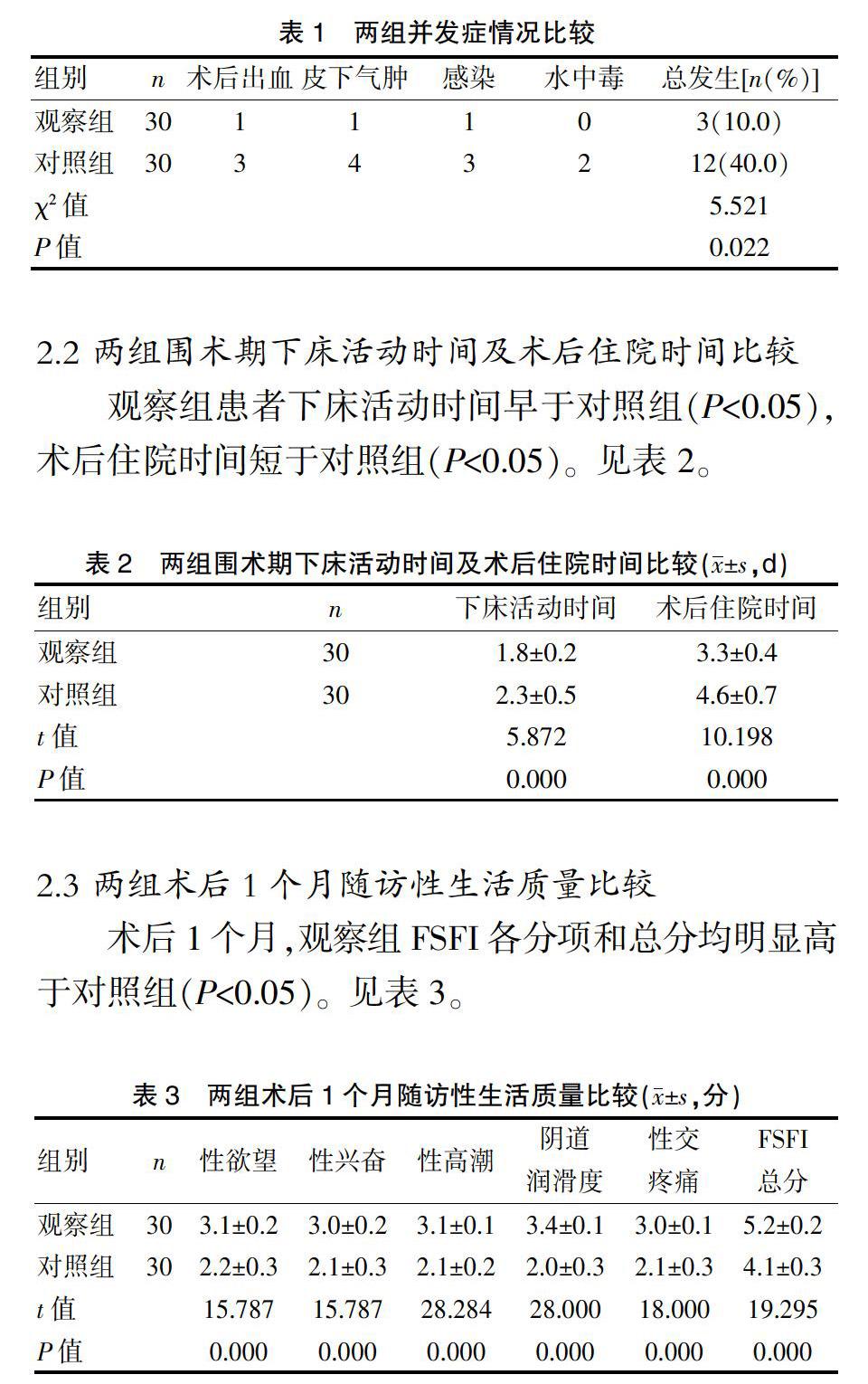
[摘要] 目的 探讨预见性护理对宫腔镜术患者围术期并发症的预防作用。 方法 选择2018年2月~2019年2月本院收治的宫腔镜术患者60例,分为两组,每组各30例。对照组以常规护理为主,观察组实施预见性护理。比较两组围术期发生的并发症,统计两组手术后下床时间、术后住院时间及两组术后1个月时性生活质量。 结果 观察组发生术后出血、皮下气肿、感染及水中毒等并发症的总发生率显著低于对照组(P<0.05),观察组患者下床活动时间早于对照组(P<0.05),术后住院时间短于对照组(P<0.05),术后1个月,观察组FSFI各分项和总分均明显高于对照组(P<0.05)。 结论 针对宫腔镜术可能出现的并发症进行预见性护理,能显著降低并发症发生率,促进患者恢复,提高术后性生活质量。
[关键词] 预见性护理;宫腔镜;围术期;并发症;预防
[中图分类号] R713 [文献标识码] B [文章编号] 1673-9701(2020)31-0170-04
[Abstract] Objective To explore the preventive effect of predictive nursing on perioperative complications of the patients having undergone hysteroscopy. Methods From February 2018 to February 2019, a total of 60 patients having undergone hysteroscopy admitted to and treated in our hospital were selected and divided into two groups according to random number method, with 30 patients in each group. The control group was mainly given conventional nursing, while the observation group was given predictive nursing. The perioperative complications were compared, and the postoperative off-bed time, the hospitalization time after operation and the quality of sexual life 1 month after operation of the two groups were counted. Results The total incidence of complications such as postoperative bleeding, subcutaneous emphysema, infection and water intoxication in the observation group was significantly lower than that in the control group(P<0.05). The off-bed activity time of the patients in the observation group was earlier than that in the control group(P<0.05), the hospitalization time after operation was shorter than that of the control group(P<0.05), and 1 m after operation, the FSFI item scores and total scores were all significantly higher than those of the control group(P<0.05). Conclusion Predictive nursing for the potential complications of hysteroscopy can significantly reduce the incidence of complications, promote the recovery of the patients and improve the quality of postoperative sexual life.
[Key words] Predictive nursing; Hysteroscope; Perioperative period; Complication; Prevention
宮腔镜检查与治疗是妇科临床常见的一种诊治方法[1],通过宫腔镜置入宫腔内进行明视检查与治疗,具有微创、诊断效率高等优点[2]。宫腔镜是目前针对子宫腔内相关疾病最有效的诊断与治疗手段,其能清晰地观察患者子宫腔内各种病变情况,并实施有效地治疗[3]。采取宫腔镜技术,能直接了解患者子宫腔内的病变情况,从而进行快速准确的检验、诊断与治疗[4]。但宫腔镜手术亦非绝对安全,术中应防止因操作不当导致的宫颈撕裂、术后出血、感染等,同时还要注意避免子宫穿孔、输卵管道出血等严重并发症。为更好地提高宫腔镜检查治疗的安全性,本研究主要探讨预见性护理对宫腔镜术后并发症的预防作用,现报道如下。
1 资料与方法
1.1 一般资料
选择2018年2月~2019年2月本院收治的宫腔镜术患者60例,纳入标准[5]:所有入组者均以术前床表现、超声检查确诊并拟定实施宫腔镜手术,签署手术同意书、入组同意书,且本研究获得医院医学伦理委员会批准。……