呼唤式护理在重型颅脑损伤昏迷患者中的应用
2020-01-11肖黎丽
肖黎丽
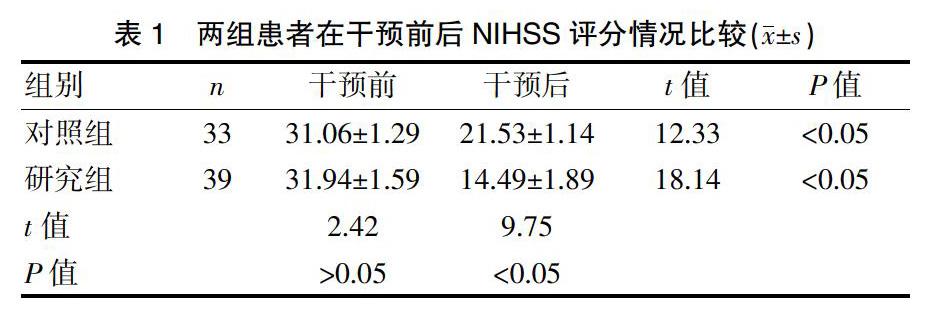

[摘要] 目的 觀察实施呼唤式护理在重型颅脑损伤昏迷患者中的效果,分析其临床应用价值。 方法 回顾性选择我院2018年6月~2019年12月收治的72例重型颅脑损伤昏迷患者的临床资料进行分析,按护理措施将其分为对照组与研究组,将接受常规护理的33例患者作为对照组,将接受呼唤式护理的39例患者作为研究组。比较两组患者干预前和干预后1周的神经功能缺损程度评分(NIH stroke scale,NIHSS)、格拉斯哥昏迷评分(Glasgow coma scale,GCS)、生活质量评分(Barthel指数)及昏迷转醒情况。 结果 治疗1个月后,研究组的NIHSS评分为(14.49±1.89)分,对照组的NIHSS评分为(21.53±1.14)分,研究组的NIHSS评分显著低于对照组(P<0.05);研究组中GCS评分≤8分的人数比例为5.13%、12~15分的人数比例为64.10%,对照组中GCS评分≤8分的人数比例为30.30%、12~15分的人数比例为39.40%,研究组的GCS评分情况明显优于对照组(P<0.05);研究组的生活质量优良率为92.31%,对照组为72.73%,研究组患者生活质量优良率明显低于对照(P<0.05);研究组在干预后第1周、第2周、第3周和第4周的昏迷转醒累计人数显著高于对照组(P<0.05)。 结论 呼唤式护理能有效改善重型颅脑损伤昏迷患者的神经功能缺损程度,还能加速患者苏醒的速度,值得临床推广使用。
[关键词] 呼唤式护理;重型颅脑损伤;昏迷;神经功能缺损程度
[中图分类号] R473.6 [文献标识码] B [文章编号] 1673-9701(2020)31-0174-04
[Abstract] Objective To observe the effect of calling type nursing care in patients with severe craniocerebral injury and to analyze its clinical application value. Methods The clinical data of 72 patients with severe craniocerebral injury and coma admitted to our hospital from June 2018 to December 2019 were retrospectively analyzed. They were divided into control group and study group according to nursing measures. The 33 patients who received routine nursing were set as a control group, and 39 patients receiving calling type nursing care were set as a study group. The NIH Stroke Scale(NIHSS), Glasgow Coma Scale(GCS), quality of life score(Barthel index), and coma-wake status of the two groups before intervention and 1 week after intervention were observed and compared. Results After one month of treatment, the NIHSS of the study group was(14.49±1.89) points,significantly lower than(21.53±1.14) points of the control group(P<0.05). The proportion of people with a GCS score of ≤8 was 5.13%,and the proportion of people with a score of 12-15 was 64.10%, which were significantly better than those(30.30% and 39.40%) of the control group(P<0.05).The excellent and good rate of quality of life in the study group was 92.31%, which was significantly lower than that(72.73%) of the control group(P<0.05). The cumulative number of people in the study group who turned into awake from coma in the first, second, third and fourth week after the intervention was significantly higher than that of the control group(P<0.05). Conclusion Calling type nursing care can effectively improve the degree of neurological deficits in patients with severe craniocerebral injury and coma, and can also speed up the recovery of patients. It is worthy of clinical application.
[Key words] Calling type nursing care; Severe craniocerebral injury; Coma; Neurological deficit
重型颅脑损伤是指患者因突发意外等原因,其脑实质出现明显的挫伤、出血、水肿等症状的损伤,该损伤除了会导致自身意识障碍或昏迷外,还可能会导致残疾或死亡,是临床致死率和致残率较高的一种疾病[1]。因为人体颅脑内分布着大量关键的神经,长时间的昏迷会加剧患者脑组织的缺氧程度,提高严重并发症的发生概率,患者的残疾和死亡概率也会随之增高[2],因此,重型颅脑损伤的临床护理应该加强对缩短患者昏迷时间护理方面的重视程度。常规护理措施在干预重型颅脑损伤患者时采取的措施不够全面,无法有效缩短患者的昏迷时间;呼唤式护理则利用中枢神经系统的可塑性特点,通过语言、音乐的方式来加速患者的苏醒过程[3]。……