自动听性脑干诱发电位用于新生儿听力筛查准确性的影响因素分析
2019-10-21孔敏
孔敏
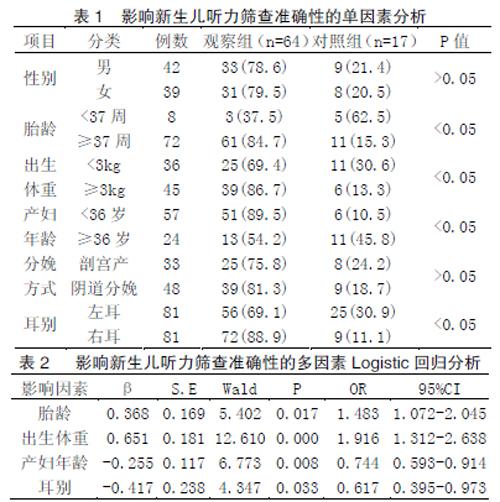
【摘 要】目的:分析自動听性脑干诱发电位用于新生儿听力筛查准确性的影响因素。方法:选出我院2018年1~9月的81例(162耳)新生儿,应用自动听性脑干诱发电位对其进行听力筛查,统计筛查通过率,同时收集新生儿的性别、胎龄、出生体重、产妇年龄、分娩方式、耳别等资料,分析其对听力筛查准确性的影响。结果:81例新生儿中,初筛结果通过64例,初筛通过率为79.0%;17例复筛,通过12例,复筛通过率为70.6%;5例转诊诊断,随访3个月,明确诊断为听力障碍2例,确诊率为40.0%。将初筛通过者纳入观察组,未通过者纳入对照组,对比两组的胎龄、出生体重、产妇年龄、耳别,差异均有统计学意义(P<0.05);对比两组的性别、分娩方式,差异均无统计学意义(P>0.05)。多因素Logistic回归分析结果显示,胎龄、出生体重是新生儿听力筛查准确性的保护因素,产妇年龄、耳别是其危险因素。结论:自动听性脑干诱发电位用于新生儿听力筛查的准确性较高,胎龄、出生体重、产妇年龄、耳别是影响听力筛查准确性的相关因素,应重视新生儿听力筛查,及早诊治听力障碍。
【关键词】自动听性脑干诱发电位;新生儿;听力筛查;准确性;影响因素
【中图分类号】R764 【文献标识码】A 【文章编号】1004-7484(2019)01-0026-02
【Abstract】objective: to analyze the influencing factors of the accuracy of automatic auditory brainstem evoked potential (aep) in neonatal hearing screening. Methods: to select our hospital from January 2018 to September 81 cases (162 ears) of newborn and applied automatically to brainstem evoked potential for hearing screening, screening pass rate statistics, at the same time to collect the newborn's gender, gestational age, birth weight and maternal age, childbirth way, ear don't such information, to analyze its impact on the accuracy of hearing screening. Results: among the 81 neonates, 64 of them passed the screening test, and the screening rate was 79.0%. The rescreening rate was 70.6% in 12 cases. Five cases were referred for diagnosis and followed up for 3 months. 2 cases were definitely diagnosed with hearing impairment, with a diagnosis rate of 40.0%. Those who passed the initial screening were included in the observation group, while those who failed were included in the control group. The differences in gestational age, birth weight, maternal age and ear difference between the two groups were statistically significant (P<0.05). There was no significant difference in gender and delivery mode between the two groups (P>0.05). Multivariate Logistic regression analysis showed that gestational age and birth weight were protective factors for the accuracy of newborn hearing screening, and maternal age and ear were risk factors. Conclusion: the accuracy of automatic auditory brainstem evoked potential in neonatal hearing screening is relatively high. Gestational age, birth weight, maternal age, and especially the relevant factors affecting the accuracy of hearing screening should be paid more attention to neonatal hearing screening and early diagnosis and treatment of hearing impairment.
【key words】automatic auditory brainstem evoked potential; The newborn; Hearing screening; Accuracy; Factors affecting the
目前,针对新生儿的听力筛查,自动听性脑干诱发电位获得了广泛应用,能够准确反映新生儿的听力受损情况[1]。本研究为了进一步分析自动听性脑干诱发电位用于新生儿听力筛查准确性的影响因素,就我院81例新生儿的听力筛查情况展开分析,汇报如下。
1 资料与方法
1.1 一般资料
选出我院2018年1~9月的81例(162耳)新生儿,其中男42例,女39例;……